01 / Reading Guide
Reading Guide
Citation
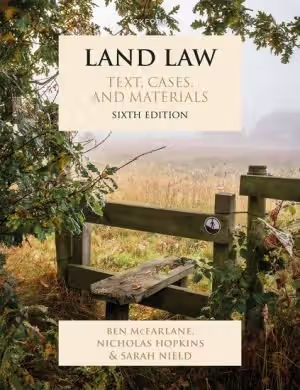
McFarlane, B., Hopkins, N., & Nield, S. (2024). Land Law: Text, Cases, and Materials (6th ed.). Oxford University Press.
Chapter Summary
The sixth edition has twenty-seven chapters grouped in eight lettered parts, A to H. The grouping is by question rather than by traditional topic: the parts are headed Introduction, The Content Question, The Acquisition Question, The Shared Home, Priority (the defences question and land registration), Leases, Neighbours and Neighbourhoods, and Security Rights. The publisher describes the approach as combining the authors' commentary with extracts from judgments, responses to controversial decisions and the authors' own opinions, and says that each chapter begins with a discussion of "central issues" and includes self-test questions and further research notes.
Part A, Chapters 1–3: What's Special About Land?; What Is Land?; Registration
By their titles, the introductory chapters ask what is special about land as a subject of property law, what the word "land" covers, and how registration works. Registration returns later in Part E, which applies the priority rules to registered land.
Part B, Chapters 4–7: Human Rights and Land; Legal Estates and Legal Interests; Equitable Interests; Personal Rights: Licences
Part B addresses the content question: what rights in land exist. It begins with human rights and land (Chapter 4), then sets out the legal estates and interests (Chapter 5), equitable interests (Chapter 6) and personal rights, represented by licences (Chapter 7).
Part C, Chapters 8–11: Formal Methods of Acquisition: Contracts and Deeds; Adverse Possession; Proprietary Estoppel; Trusts
Part C turns to the acquisition question: how a person comes to hold a right in land. It covers formal methods through contracts and deeds, adverse possession, proprietary estoppel (a chapter the publisher says was restructured in light of the Supreme Court decision in Guest v Guest), and trusts.
Part D, Chapters 12–14: Interests in the Home: The Acquisition Question; Regulating Co-ownership: The Content Question; Co-ownership and Third Parties: Applications for Sale
Part D concerns the shared home. The chapters take up how interests in a home are acquired, how co-ownership is regulated, and applications for sale where co-owners and third parties are involved.
Part E, Chapters 15–18: The Priority Triangle; Priorities in Registered Land; Co-ownership and Priorities: The Defences Question; Reform of the Land Registration Act 2002
Part E is on priority, the question of when a right survives against someone who later acquires the land. It introduces a "priority triangle" (Chapter 15), applies the rules to registered land (Chapter 16), considers co-ownership and priorities (Chapter 17), and ends with a chapter on reform of the Land Registration Act 2002 (Chapter 18).
Part F, Chapters 19–21: Leases; Regulating Leases and Protecting Occupiers; Leasehold Covenants
The leases part covers leases as interests in land, the regulation of leases and the protection of occupiers, and the covenants that run with leasehold property.
Part G, Chapters 22–24: Easements; Freehold Covenants; Flat Ownership: Long Leases and Commonhold
Part G is about relations between neighbours and within buildings: easements, freehold covenants and the ownership of flats through long leases and commonhold. The publisher notes that proposed new legislation on flat ownership is discussed.
Part H, Chapters 25–27: Security Interests in Land; Lender's Rights and Remedies; Protection of the Borrower
The last part addresses mortgages and other security: security interests in land, lenders' rights and remedies, and the protection of the borrower.
Key Concepts
Parts A–C
- Registration: the system by which rights in land are recorded and protected, introduced in Chapter 3.
- Legal and equitable interests: the two kinds of proprietary right, treated in Chapters 5 and 6.
- Licences: personal permissions to use land, set against proprietary rights in Chapter 7.
- Adverse possession and proprietary estoppel: two routes to acquiring a right other than by formal grant, in Chapters 9 and 10.
Parts D–E
- Co-ownership: shared ownership of land, and the rules that govern the home and sale.
- The priority triangle: the framework for deciding which of several competing rights prevails, Chapter 15.
- Registered land priorities: the application of the framework under land registration, Chapter 16.
Parts F–H
- Leasehold covenants: the obligations that attach to leases, Chapter 21.
- Easements and freehold covenants: rights and obligations between neighbouring land, Chapters 22 and 23.
- Commonhold: the form of flat ownership treated in Chapter 24.
- Security interests: mortgages and lenders' rights, with protection of the borrower, Chapters 25 to 27.
Critical Analysis
Strengths
- Organised around questions. Parts are named for the question each answers, such as the content question, the acquisition question and the defences question. This gives the reader a way of asking of any problem whether a right exists, how it was acquired, and whether it survives against a later buyer, and the publisher describes this as the authors' "unique approach".
- Extracts, commentary and opinion together. The publisher states that each area is discussed through extracts from leading judgments, responses to controversial decisions and the authors' own views, with the aim of a "well-rounded" account. Students who need to work from the cases themselves have the primary material in the book.
- Study supports in every chapter. Each chapter opens with central issues and contains self-test questions with guidance and further research notes, and the publisher says the e-book and Law Trove add self-test questions, guidance for answering end-of-chapter questions and further research notes.
- Visible currency. The publisher lists the cases considered in this edition, including recent Supreme Court and Court of Appeal decisions, notes the restructuring of the proprietary estoppel chapter, and says that proposed legislation on flat ownership and new academic writing are covered.
Limitations
- Length and format. Twenty-seven chapters with extracts from judgments, statutes and scholarship make a long book; a course that wants only a short account of the rules will find a narrative textbook easier to carry.
- Question-based ordering. Because the parts follow the authors' own questions, some topics are split: co-ownership appears in Part D and again in Part E (Chapter 17), and registration is introduced in Part A but applied in Part E. A reader following a syllabus in another order will need to move between parts.
- A moving target. The edition dates from November 2024, and the publisher itself points to proposed legislation, so any statement about reform of flat ownership or registration should be checked against later developments.
Where It Fits in the Course
This is the course's text, cases and materials book on land law, aimed at students who want the judgments themselves alongside commentary. Two shorter books suit a first encounter with the subject: Sandra Clarke and Sarah Greer's Land Law Directions is an introductory textbook in plain language with diagrams and worked examples, and Elizabeth Cooke's Land Law is a short introduction in continuous prose with few footnotes, explaining where property rights in land come from. Martin Dixon's Modern Land Law is a compact narrative textbook organised by topic across twelve chapters and is an alternative for students who want a compact, continuous account.
For further reading, Kevin and Susan Francis Gray's Elements of Land Law is a scholarly treatise that reflects on the concept of property itself and draws on comparative material. Megarry & Wade: The Law of Real Property is the large scholarly treatise on the whole subject, to be consulted when a point needs historical or technical detail beyond what McFarlane, Hopkins and Nield provide.
How to Use This Book
The book is for undergraduates taking land or property law, and for postgraduates who want to see the reasoning in the leading cases. Familiarity with the basic ideas of contract and trusts or equity is helpful, since Part C includes trusts and proprietary estoppel and Part E depends on understanding competing equitable and legal rights.
A practical plan:
- Core: Parts A and B first, to establish what land is, how registration works and what rights can exist. Then Part E on priority, which draws on the earlier material and is central to problem questions. Part C on acquisition follows naturally.
- By topic: Part D for modules covering the family home and co-ownership; Part F for leases; Part G for easements, freehold covenants and flats; Part H for mortgages.
- Using the features: read each chapter's central issues before the extracts, attempt the self-test questions before consulting the guidance, and use the further research notes for essays.
Read the extracts from the judgments in full where an assignment is based on a particular case, and check later cases and the status of any proposed legislation, since the book reflects the law as it stood in 2024.