01 / Reading Guide
Reading Guide
Citation
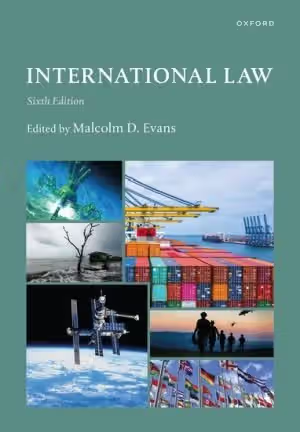
Evans, M. D. (Ed.). (2024). International Law (6th ed.). Oxford University Press.
Chapter Summary
The book has twenty-nine chapters in seven parts, each chapter written by a named specialist, and runs to roughly 940 to 1,000 pages (Google Books and a bookseller listing give different counts). The publisher says that the volume was carefully edited by Sir Malcolm Evans to ensure a consistent style, and that it is suitable for readers with varying prior exposure to international law. Only the contents, with contributor names, are available, so the summaries below describe scope from the chapter titles.
Part I, The History and Theory of International Law (Chapters 1–3)
Three chapters open the book: Stephen Neff on "A short history of international law", Martti Koskenniemi on "What is international law for?", and Iain Scobbie on "Voyaging towards Ithaca: thinking about international legal theory". They set the history and the purposes of the subject before the doctrine begins.
Part II, The Structure of International Legal Obligation (Chapters 4–6)
Anthea Roberts and Sandesh Sivakumaran write on "The theory and reality of the sources of international law", Alan Boyle on "Soft law in international law-making", and Malgosia Fitzmaurice on "The practical working of the law of treaties". Together they cover how international obligations arise.
Part III, The Subjects of the International Legal Order (Chapters 7–10)
Brendan Plant writes on "Territory", Matthew Craven and Rose Parfitt on "Statehood, self-determination, and recognition", Dapo Akande on "International organizations", and Andrew Clapham on "The individual and the international legal system". Plant and Clapham are among the new contributors named by the publisher.
Part IV, The Scope of Sovereignty (Chapters 11–14)
Christopher Staker writes on "Jurisdiction", Philippa Webb on "International law and restraints on the exercise of jurisdiction by national courts of states", Chanaka Wickremasinghe on "Immunities enjoyed by officials of states", and Eileen Denza on "The relationship between international and national law".
Part V, Responsibility (Chapters 15–16)
Simon Olleson on "The character and forms of international responsibility" and Phoebe Okowa on "Issues of admissibility and the law on international responsibility".
Part VI, Responding to Breaches of International Obligations (Chapters 17–20)
Nigel White on "Countermeasures and sanctions", Eric De Brabandere on "The means of dispute settlement", Christian Tams on "The International Court of Justice", and Christine Gray and Andrew Sanger on "The use of force and the international legal order".
Part VII, The Application of International Law (Chapters 21–29)
The longest part, with nine chapters on specialised regimes: Malcolm Evans and Reece Lewis on "The law of the sea"; Rossana Deplano on "International space law"; Catherine Redgwell and Eva van der Marel on "International environmental law"; Andrew Lang on "International trade law"; Surya Subedi on "International investment law"; Paola Gaeta on "International criminal law"; Rosa Freedman on "International human rights law"; Geoff Gilbert and Anna Magdalena Bentajou on "International refugee and migration law"; and David Turns on "The law of armed conflict (international humanitarian law)".
New in the Sixth Edition
The publisher names three new chapters, "Acquisition of Territory", "International Economic Law" and "International Space Law", and a group of new contributors, without mapping the first two to the listed chapter titles. It also lists decisions of the International Court of Justice (including the genocide cases Ukraine v Russian Federation and The Gambia v Myanmar, Qatar v United Arab Emirates and Somalia v Kenya), an International Tribunal for the Law of the Sea advisory opinion on climate change and international law, and arbitral decisions including the Enrica Lexie incident.
Key Concepts
Parts I–II: History, Theory and Sources
- Purposes and theory of international law: the questions about what the subject is for and how it is theorised (Chapters 2–3).
- Sources: how international obligations are made and identified (Chapter 4).
- Soft law and treaties: non-binding norms in law-making, and the practical working of the law of treaties (Chapters 5–6).
Parts III–V: Subjects, Sovereignty and Responsibility
- Territory, statehood and recognition: Chapters 7 and 8.
- Jurisdiction and immunities: the scope of a state's authority and its limits (Chapters 11–13).
- Relationship between international and national law: Chapter 14.
- International responsibility and admissibility: Chapters 15 and 16.
Parts VI–VII: Responses to Breach and Specialised Regimes
- Countermeasures, sanctions and dispute settlement: Chapters 17 and 18.
- The International Court of Justice and the use of force: Chapters 19 and 20.
- Specialised regimes: sea, space, environment, trade, investment, criminal law, human rights, refugee and migration law, and armed conflict (Chapters 21–29).
Critical Analysis
Strengths
- Authority from specialists. Each chapter is by a scholar or practitioner active in the field, and the publisher presents the line-up as a major strength. Reviewers quoted in the bookseller's listing, Michael Waibel (University of Vienna), Dino Kritsiotis (University of Nottingham) and Tawhida Ahmed (The City Law School), praise the volume as up to date, relevant and, in Ahmed's words, very easy to read.
- Breadth in one volume. The seven parts run from history and theory through sources, subjects, sovereignty, responsibility and enforcement to nine specialised regimes, so one book can support a general course and several option modules.
- Renewal. The sixth edition adds new chapters and contributors, and recent decisions of the International Court of Justice, the International Tribunal for the Law of the Sea and arbitral tribunals, which keeps the treatment of cases current.
- Editorial consistency. The publisher says the entire volume was edited to ensure a consistent style, which addresses a common concern about multi-author books.
Limitations
- Size. The book is very long, with roughly 940 to 1,000 pages, and each specialised regime receives a single chapter, so students taking an option on one of them will need a specialist text.
- Different voices. Although the editor harmonises the style, chapters are by different authors with different emphases, and the Part I chapters on history and theory are, judging by their titles, of a different kind from the doctrinal chapters.
- Learning aids are not described. The publisher's description does not mention exercises or study questions, so students who want practice questions will need other materials.
Where It Fits in the Course
Evans's volume is the edited, multi-author textbook in the public international law list, and it works as a main text for a general course. Shaw's International Law is a comprehensive single-author textbook that cites cases, treaties and practice extensively, and is the natural alternative for readers who prefer one voice. Akehurst's Modern Introduction to International Law is a compact introductory textbook and a good first read, and Lowe's International Law: A Very Short Introduction is shorter still, as an orientation before the textbooks.
Brownlie's Principles of Public International Law is a single-volume treatise to consult for precise statements of doctrine, with the precision of a working practitioner and judge. Koskenniemi, who contributes Chapter 2, "What is international law for?", to Evans, is also the author of From Apology to Utopia, a study of the structure of argument in international law, which suits readers who want to pursue the theory further.
How to Use This Book
The publisher presents the book as suitable for students and academics with varying prior exposure to international law, and as a resource for practitioners. No specific prerequisites are stated.
A practical plan:
- Core: Parts II to IV (Chapters 4–14) on sources, subjects and sovereignty, then Part V on responsibility.
- Enforcement: Part VI on countermeasures, dispute settlement, the International Court of Justice and the use of force (Chapters 17–20) follows naturally.
- By syllabus: the chapters in Part VII can be read as the course reaches each regime: the law of the sea, human rights, environment, criminal law, armed conflict and so on. The history and theory in Part I suit a reading at the start or at the end of the course.
- Practice: use the cases the publisher highlights (the International Court of Justice genocide cases, the maritime delimitation and climate advisory opinions) as a list of current authorities.