01 / Reading Guide
Reading Guide
Citation
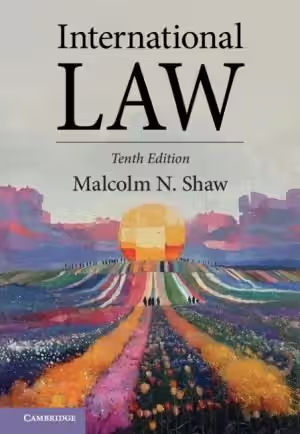
Shaw, M. N. (2026). International Law (10th ed.). Cambridge University Press.
Chapter Summary
The tenth edition runs to about 1,440 printed pages in 22 chapters, preceded by a preface, tables of cases and treaties and a list of abbreviations, and followed by an index. The chapters move from the nature and sources of the system, through its subjects and the substantive fields in which states operate, to dispute settlement, force and institutions. The publisher describes the book as a treatise that keeps detailed referencing so that readers can move on to the primary material.
Chapters 1–2: The Nature and Development of International Law; International Law Today
The opening chapters cover the nature of international law and the development of the system, then its present-day character.
Chapters 3–4: Sources; International Law and Municipal Law
Chapter 3 covers the sources from which international rules are drawn. Chapter 4 addresses how international law relates to the national legal systems in which it must often be applied.
Chapters 5–8: The Subjects of International Law; The International Protection of Human Rights; Individual Criminal Responsibility in International Law; Recognition
This group deals with who and what the system addresses: states and other entities, the individual as a holder of protected rights, the individual as a person who can be held criminally responsible, and the practice of recognition.
Chapters 9–12: Sovereign Territory and Beyond; The Law of the Sea; Jurisdiction; Immunities from Jurisdiction
These chapters concern the spatial and jurisdictional reach of states: title to territory and areas beyond it, the maritime regime, the limits of a state's authority to prescribe and enforce, and the immunities that restrict the exercise of jurisdiction. The publisher lists the law of the sea among the areas given expanded coverage in this edition.
Chapters 13–16: State Responsibility; International Environmental Law; The Law of Treaties; State Succession
Chapter 13 deals with state responsibility. The remaining chapters take up one substantive field, international environmental law, then the law of treaties and the position when states succeed one another.
Chapters 17–19: The Settlement of Disputes by Peaceful Means; The International Court of Justice; International Law and the Use of Force by States
The group opens with the peaceful settlement of disputes in general, continues with the International Court of Justice and ends with the law on the use of force by states. The publisher singles out the International Court of Justice as an area of expanded coverage.
Chapters 20–22: International Humanitarian Law; The United Nations; International Organisations
The book ends with international humanitarian law and with two institutional chapters, one on the United Nations and one on international organisations. International humanitarian law is also named by the publisher as an area of expanded coverage.
Key Concepts
Chapters 1–8: Foundations and Subjects
- Sources: the processes and materials from which rules of international law are identified; the subject of Chapter 3.
- Subjects of international law: the entities the system addresses, taken up in Chapter 5 and, for the individual, in Chapters 6 and 7.
- Recognition: the practice by which states acknowledge entities and situations, the subject of Chapter 8.
Chapters 9–16: Territory, Jurisdiction and Responsibility
- Sovereign territory: title to land and areas beyond national territory, treated in Chapter 9 together with the law of the sea in Chapter 10.
- Jurisdiction and immunities: the reach of a state's authority and the limits that immunities place on it (Chapters 11 and 12).
- State responsibility: the consequences of breach of an international obligation (Chapter 13).
- Law of treaties: the rules governing agreements between states (Chapter 15).
Chapters 17–22: Disputes, Force and Institutions
- Peaceful settlement: the methods of resolving disputes without force, including adjudication before the International Court of Justice.
- Use of force: the rules limiting resort to force by states (Chapter 19), set beside the law that governs conduct in armed conflict (Chapter 20).
- International organisations: the United Nations and other bodies treated in the last two chapters.
Critical Analysis
Strengths
- Breadth in a single volume. The contents list covers sources, subjects, human rights, individual criminal responsibility, territory, the sea, jurisdiction, responsibility, the environment, treaties, succession, dispute settlement, force, humanitarian law and institutions. A student can follow most of a general public international law syllabus in one book.
- Referencing designed for further study. The publisher stresses that the book retains and develops detailed referencing of cases, treaties and practice, which makes it useful as a route into primary sources for coursework and research.
- A logical running order. The chapters move from foundations (sources, municipal law) through subjects and territorial questions to responsibility, disputes, force and institutions, so the book can be read through as a progression rather than only consulted.
- Updated coverage. The publisher reports expanded treatment of outer space, the law of the sea, the International Court of Justice and international humanitarian law, with added material on cyber operations and non-state actors.
Limitations
- Size. At over 1,400 pages the book is a treatise-scale text; the publisher itself uses that word. Students new to the subject may find it more than a first course needs and may do better to start with a shorter introduction.
- No chapter on trade or investment law. The publisher mentions international economic law among the fields covered, but no chapter title in the contents list is devoted to it, so students taking a course on trade, investment or economic regulation should check the index and expect to need a specialist text.
- No dedicated chapter on theory. The contents list gives no separate chapter on theoretical approaches to international law, so readers who want an extended critical or theoretical treatment will need another book.
Where It Fits in the Course
Shaw is the comprehensive single-author textbook in this course list, for students who want one detailed reference. For a first encounter, two shorter books fit better: Vaughan Lowe's International Law: A Very Short Introduction explains what international law is and how it works in a short compass, and Akehurst's Modern Introduction to International Law (revised by Alexander Orakhelashvili) is a compact survey in a positivist framework with reference to court decisions.
Malcolm Evans's edited International Law offers a different format, with each chapter written by a specialist in the field, and is a natural alternative or companion when a course follows its chapter structure. James Crawford's revision of Brownlie's Principles of Public International Law is another single-volume treatise, suited to readers who want the doctrine at practitioner depth. Martti Koskenniemi's From Apology to Utopia is a different kind of book altogether, a study of the structure of international legal argument, and is best read after a doctrinal text such as Shaw.
How to Use This Book
The book suits law students taking a public international law course, and practitioners or researchers who need a referenced account of a topic. No prior study of international law is needed in principle, but given the book's scale and referencing, readers will get most from it if they already read cases and treaties comfortably.
A practical reading plan for a full course:
- Core: Chapters 1–5 (nature, today's setting, sources, relation to national law, subjects) and Chapter 13 (state responsibility). These supply the framework the other chapters assume.
- By syllabus topic: read Chapters 9–12 for territory, the sea and jurisdiction; Chapters 15 and 17–19 for treaties, dispute settlement, the International Court of Justice and force; Chapters 6, 7 and 20 for human rights, criminal responsibility and humanitarian law.
- Optional or selective: Chapters 8, 14, 16, 21 and 22 can be read when a course or essay calls for recognition, environmental law, succession or the institutions.
Use the tables of cases and treaties and the detailed referencing to find the primary texts behind a point, and read selected judgments or treaty provisions alongside each chapter. For revision, pair the chapters on sources and responsibility with a short introduction, since most later topics depend on them.