01 / Reading Guide
Reading Guide
Citation
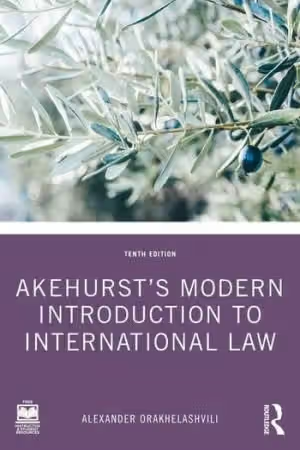
Orakhelashvili, A. (2026). Akehurst's Modern Introduction to International Law (10th ed.). Routledge.
Chapter Summary
The tenth edition has twenty-three chapters, about 700 pages in all, numbered without parts. First published in 1970 by Michael Akehurst, the book is now revised by Alexander Orakhelashvili, a professor at the University of Birmingham whose own monographs include studies of peremptory norms, collective security, statehood and the relationship between international law and international politics. The publisher describes it as the shortest of the major textbooks in the field, a concise overview that keeps Akehurst's original positivist approach and takes a cross-jurisdictional approach intended to open the subject to students from all backgrounds. The new edition takes account of more than forty-five decisions of international and national courts, as well as treaties and major incidents since the ninth edition. The groupings below are for orientation only.
Chapters 1–4: Introduction; History; Sources of international law; International law and municipal law
The foundations: what international law is, how it developed, where its rules come from, and how it relates to national (municipal) legal systems. These four chapters set up the positivist framework that the publisher says the book retains.
Chapters 5–6: Creation and recognition of States; Legal personality of non-State entities
The subjects of international law. Chapter 5 treats how states come into being and are recognised; Chapter 6 extends legal personality to entities other than states.
Chapters 7–9: Territory; The law of the sea; Air space and outer space
The spatial chapters: title to territory, the law of the sea, and the legal regimes of airspace and outer space.
Chapters 10–11: State jurisdiction; Immunity from jurisdiction
When a state may make and enforce law over persons and events, and the immunities that limit that jurisdiction.
Chapters 12–14: Law of treaties; State responsibility; State succession
The general law of obligations between states: how treaties are made, interpreted and ended; the consequences of internationally wrongful acts; and what happens to rights and obligations when one state replaces another.
Chapters 15–16: Protected persons and entities: nationality and individual rights; Protected persons and entities: human rights, group rights, and self-determination
Two chapters on the position of individuals and groups. The first covers nationality and individual rights; the second human rights, group rights and the right of peoples to self-determination.
Chapters 17–19: Protection of the environment; International economic relations; International criminal justice
Three specialised fields: environmental protection, international economic relations, and international criminal justice. An endorsement by Kevin W. Gray quoted by the publisher notes that this edition adds recent case law on climate law.
Chapters 20–22: Use of force; Laws applicable to war and armed conflict; The United Nations and peace and security
Three chapters on armed force: the rules on when force may be used, the law governing the conduct of armed conflict, and the collective security system of the United Nations.
Chapter 23: Settlement of disputes
The book ends with the peaceful settlement of disputes between states.
Key Concepts
Chapters 1–6: Foundations and subjects
- Sources of international law: the recognised ways in which binding international rules are created, such as treaties and custom.
- International and municipal law: how international rules relate to, and operate within, national legal systems.
- Statehood and recognition: how states come into existence and how other states respond to them.
- Non-state legal personality: the capacity of entities other than states to hold international rights and duties.
Chapters 7–14: Space, jurisdiction and obligations
- Territory and the law of the sea: title to land territory and the legal zones of the sea.
- Jurisdiction and immunity: the reach of a state's laws and courts, and its limits.
- Law of treaties: the making, interpretation and termination of treaties.
- State responsibility: the legal consequences of a state's breach of an international obligation.
- State succession: the transfer of rights and duties when sovereignty over territory changes.
Chapters 15–23: Persons, special regimes and force
- Nationality and human rights: the legal bond between individual and state, and the rights protected against states.
- Self-determination: the right of peoples to determine their political status.
- International criminal justice: individual criminal responsibility under international law.
- Use of force and armed conflict: the rules on resort to force and on the conduct of hostilities.
- Collective security and dispute settlement: the UN system for peace and security, and the peaceful resolution of disputes.
Critical Analysis
Strengths
- A whole field in one manageable volume. Twenty-three chapters cover the general part (sources, subjects, jurisdiction, treaties, responsibility) and the main special regimes (sea, air and space, human rights, environment, economic relations, criminal justice, force, the UN), so the book can serve a full course on its own.
- A clear method. The publisher stresses a transparent positivist methodology. For a student, this means a consistent way of asking what the rule is and where it comes from, which gives the book a coherent line through very diverse material.
- Up to date. Published in August 2026, the edition accounts for more than forty-five new court decisions. Endorsements quoted by the publisher mention new climate case law and updating in the light of the pushback against international institutions.
- A long record of use. The book has been in print since 1970 and is now in its tenth edition. Endorsements quoted by the publisher, from Christian Henderson and Philip Alston among others, praise its accessibility, readability and coverage of both doctrinal and theoretical questions.
Limitations
- Short only by comparison. The publisher calls it the shortest of the major textbooks, but at about 700 pages it is still a substantial book and not a quick introduction.
- One methodological line. The positivist approach is deliberate. Students who want critical and theoretical perspectives on international law will need other reading; Koskenniemi's From Apology to Utopia in the course list is a counterpoint.
- No parts or signposting in the contents. The twenty-three chapters run without part divisions, so readers must work out for themselves which chapters form the general part and which treat special regimes.
- Few illustrations. The publisher lists only two black-and-white illustrations, so the book relies on text rather than diagrams or maps, which some readers may miss in the chapters on territory and the sea.
Where It Fits in the Course
Vaughan Lowe's International Law: A Very Short Introduction is the gentlest entry point in this course list: a pocket-sized book of about 130 pages that explains what international law is and how it works. It can be read in a weekend before starting Akehurst. Akehurst then serves as a compact main textbook covering the whole syllabus.
Malcolm Shaw's International Law and the edited International Law under Malcolm Evans are fuller textbooks for students who want more depth or more references: Shaw combines systematic exposition with extensive citation of cases, treaties and practice, while Evans gathers chapters by scholars and practitioners active in each field. Brownlie's Principles of Public International Law, now by James Crawford, is a treatise to consult on particular points and for advanced study. Martti Koskenniemi's From Apology to Utopia is a theoretical study of the structure of international legal argument, best read after the foundations of Chapters 1–4 are secure.
How to Use This Book
The publisher addresses the book to undergraduate and postgraduate students of international law, and to students of government, politics and international relations. No prior study of international law is needed; general awareness of world affairs and of basic legal ideas such as treaties and courts helps.
A practical plan:
- Core: Chapters 1–6 (nature, history, sources, the relationship with national law, states and other subjects), then Chapters 12–13 on treaties and state responsibility. These form the general part on which the rest depends.
- Commonly taught next: Chapters 10–11 on jurisdiction and immunity, Chapter 16 on human rights and self-determination, and Chapters 20 and 22 on the use of force and the UN collective security system.
- By syllabus: Chapters 7–9 (territory, sea, air and space), 14 (state succession), 17–19 (environment, economic relations, criminal justice), 21 (armed conflict) and 23 (dispute settlement).
- Read with primary materials. Keep the UN Charter, the Statute of the International Court of Justice and the Vienna Convention on the Law of Treaties to hand, and read the leading judgments of the International Court of Justice on each topic.
- For politics and international relations students, Chapters 1–3, 5, 20 and 22 give a compact legal grounding for courses on world politics.