01 / Reading Guide
Reading Guide
Citation
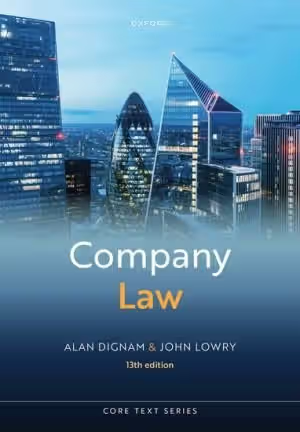
Dignam, A., & Lowry, J. (2025). Company Law (13th ed.). Oxford University Press.
Chapter Summary
The thirteenth edition (August 2025) belongs to Oxford's Core Text series and runs to about 500 pages of text in 17 chapters, grouped in three parts, with a table of legislation, a select bibliography and an index. Alan Dignam is Professor of Corporate Law at Queen Mary University of London and John Lowry Emeritus Professor of Law at University College London. The publisher describes the book as condensing a very complex subject around its core principles, adding coverage of corporate governance and corporate theory, and supporting study with chapter introductions, further reading and self-test questions. This edition adds the Economic Crime (Transparency and Enforcement) Act 2022, the Retained EU Law (Revocation and Reform) Act 2023, the Economic Crime and Corporate Transparency Act 2023, the UK Corporate Governance Code 2024 and recent cases including BTI 2014 LLC v Sequana SA (2022) and ClientEarth v Shell plc (2023).
Part I, Chapter 1: Introduction to company law
Part I, "Fundamental Principles", takes up roughly the first hundred pages. The introduction orients the reader in the subject before the principles are set out.
Chapters 2–3: Corporate personality and limited liability; Lifting the veil
The company as a separate legal person whose members enjoy limited liability, and the circumstances in which the courts look behind that separate personality. Salomon is among the terms that recur in the text.
Chapter 4: Promoters and pre-incorporation contracts
The duties of those who set up a company and the status of contracts made on its behalf before it exists.
Chapters 5–6: Raising capital: equity and its consequences; Raising capital: debentures: fixed and floating charges
How companies raise money: by issuing shares, with the consequences that follow, and by borrowing against debentures secured by fixed and floating charges.
Part II, Chapter 7: Share capital
Part II, "Behind the Corporate Veil", turns to the relationship between the company and its members, beginning with the rules governing share capital.
Chapters 8–9: The constitution of the company: dealing with insiders; Classes of shares and variation of class rights
The company's constitution as it governs members and the company among themselves, and the rights attached to different classes of shares and how they may be varied.
Chapters 10–11: Derivative claims; Statutory shareholder remedies
Minority shareholder protection: the derivative claim, which lets a member sue for a wrong done to the company (the rule in Foss v Harbottle is among the recurring terms), and statutory remedies such as the unfair prejudice petition.
Part III, Chapter 12: The constitution of the company: dealing with outsiders
Part III, "Issues of Corporate Authority", the longest part, opens with the constitution in dealings with third parties, including questions of corporate capacity and authority.
Chapters 13–14: Corporate management; Directors' duties
How companies are managed and the duties directors owe. The publisher notes that this edition expands the coverage of environmental, social and governance (ESG) factors in these two chapters, with reference to ClientEarth v Shell plc.
Chapters 15–16: Corporate governance 1: corporate governance and corporate theory; Corporate governance 2: the UK corporate governance debate
Two chapters set company law in the context of theories of the company and the UK debate on corporate governance, now covering the UK Corporate Governance Code 2024.
Chapter 17: Corporate rescue and liquidations in outline
An outline of corporate rescue and winding up, to which the new edition adds discussion of misfeasance in the BHS litigation (Wright v Chappell, 2024).
Key Concepts
Part I: Fundamental Principles (Chapters 1–6)
- Corporate personality: the company as a legal person separate from its members.
- Limited liability: members' liability for the company's debts is limited to their investment.
- Lifting the veil: the exceptional cases in which the courts disregard separate personality.
- Fixed and floating charges: the two forms of security that lenders take over a company's assets.
Part II: Behind the Corporate Veil (Chapters 7–11)
- Share capital: the rules governing the capital that members contribute.
- Class rights: rights attached to a class of shares and the procedure for varying them.
- Derivative claim: a member's action on behalf of the company for a wrong done to it.
- Statutory shareholder remedies: court remedies for members, including relief from unfairly prejudicial conduct.
Part III: Issues of Corporate Authority (Chapters 12–17)
- Directors' duties: the statutory duties that directors owe to the company.
- Corporate governance: the system of control and accountability for company management, and the theories behind it.
- ESG: environmental, social and governance factors in directors' decision-making.
- Corporate rescue and liquidation: what happens to a company in financial distress.
Critical Analysis
Strengths
- Concise without being simplistic. The publisher's aim is to balance depth, succinctness and accessibility, condensing the subject to its core principles without compromising academic integrity.
- Theory and governance as well as rules. Two full chapters on corporate governance and corporate theory give a broader context than a purely doctrinal account, which suits essay questions on the purpose of the company.
- Study support. Each chapter has an introduction, further reading and self-test questions intended for revision and examination practice.
- Current. The thirteenth edition covers the 2022 and 2023 economic crime legislation, the 2024 Governance Code and major cases such as Sequana on directors' duties when a company nears insolvency.
Limitations
- Insolvency in outline only. The final chapter treats corporate rescue and liquidation "in outline", so courses with a substantial insolvency component will need a specialist text.
- Condensed treatment. The publisher presents condensation as a feature; the corollary is that students writing extended essays or dissertations will need fuller textbooks, monographs and the case law itself.
- No chapters on capital markets or takeovers. Takeovers are mentioned in the text, but neither securities regulation nor takeovers is a chapter topic; courses with a corporate finance emphasis will need further reading.
Where It Fits in the Course
This is a main textbook for a first course in company law. Smith & Keenan's Company Law, by Charles Wild and Stuart Weinstein, is a long-running alternative written in straightforward language with case summaries, practical examples and exam-style questions; students may prefer whichever style suits them, and many will use one as the main text and dip into the other for a second explanation of difficult topics. Dignam and Lowry's chapters on corporate governance and theory are the stronger choice for courses that set essay questions on the nature and purpose of the company.
The other books on this course list go further in particular directions. Goode and McKendrick on Commercial Law is a comprehensive account of commercial law, from sale and payment to secured transactions and insolvency, which complements Chapter 6's treatment of charges. Vanessa Finch and co-authors' Corporate Insolvency Law: Perspectives and Principles develops in depth what Chapter 17 sets out in outline. Eva Micheler's Company Law: A Real Entity Theory is an advanced theoretical study of corporate personality that builds on Chapters 2 and 15.
How to Use This Book
The book is written for undergraduate law students taking company law, usually after contract law; a basic knowledge of contract and of reading statutes helps. Because it concentrates on core principles, it also works as a revision text for students using a longer textbook.
A practical plan:
- Start with Part I in order. Chapters 1–3 on corporate personality, limited liability and lifting the veil are the foundation for everything else and commonly examined. Chapters 5–6 on capital and charges can be read when the course reaches finance.
- Core of most courses: Chapters 8, 10–11 and 12–14, covering the constitution, minority shareholder remedies and directors' duties. Directors' duties (Chapter 14) and shareholder remedies (Chapters 10–11) lend themselves particularly to problem questions, so work through them with the statute open.
- For essays: Chapters 15–16 on corporate governance and theory should be read alongside the duties chapters, since the debate about whose interests the company serves runs through both.
- Selective: Chapters 4, 7, 9 and 17 as the syllabus requires.
Use the self-test questions at the end of each chapter after a first reading, and return to them in revision. Read the key statutory provisions of the Companies Act 2006 beside the text, especially the directors' duties provisions, and read the leading judgments, such as Salomon and Sequana, in full. The further reading at the end of each chapter points to the academic debate for essay preparation.