01 / Reading Guide
Reading Guide
Citation
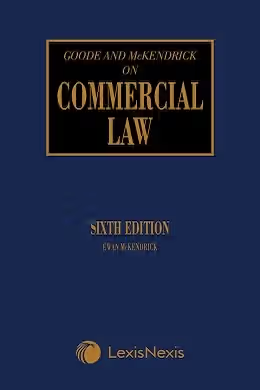
Goode, R., & McKendrick, E. (2020). Goode and McKendrick on Commercial Law (6th ed.). LexisNexis Butterworths.
Chapter Summary
Goode and McKendrick on Commercial Law is a large treatise on English commercial law, running to about 1,500 pages in its sixth edition. The work was formerly titled Goode on Commercial Law; the sixth edition was retitled to carry the names of both Roy Goode and Ewan McKendrick. The publisher presents it as a leading practitioner's work with both theoretical and practical coverage of commercial law in a national and international context. The topic areas below are those the publisher names in its description of the edition.
Foundations and Commercial Contract Law
The book combines deep theoretical analysis of foundational principles with a practical approach set in the context of typical commercial and financial transactions. For this edition the publisher lists new sections on the importance of certainty in commercial law and on the relationship between law and technology. It also reports developments in commercial contract law, including the principles applicable to the interpretation of contracts, the regulation of no-reliance and basis clauses, and the emergence of negotiating damages.
Payment and Money
The publisher says the chapters on payment and money were rewritten for the sixth edition. The rewriting reflects extensive changes in the regulation of payment systems, increasing reliance on electronic communications and the emergence of cryptocurrencies. Readers who want the law on how money moves between commercial parties should use this edition rather than an earlier one.
Security, Retention of Title and Receivables
Among the Supreme Court decisions analysed in this edition, the publisher lists cases on retention of title clauses. It also records coverage of the Business Contract Terms (Assignment of Receivables) Regulations 2018, which bear on the assignment of receivables as a financing technique.
Insolvency
Insolvency is named alongside retention of title, letters of credit and arbitration among the subjects of the Supreme Court decisions analysed. The publisher gives no further detail on the insolvency material, so readers should check the contents of the edition they use for how the topic is organised.
International Trade and Letters of Credit
The edition covers Incoterms 2020, the standard trade terms for international sales, and analyses Supreme Court authority on letters of credit. These topics make up the book's international trade coverage.
Dispute Resolution and Technology
Arbitration is one of the dispute-related subjects on which the publisher reports Supreme Court analysis. The new material on cryptoassets, cryptocurrencies and electronic signatures belongs to the edition's treatment of law and technology, and the publisher also notes consideration of the implications of Brexit for the future of commercial law.
Key Concepts
Topic Areas Named by the Publisher
- Certainty in commercial law: a principle given its own new discussion in the sixth edition.
- Interpretation of contracts, no-reliance and basis clauses, negotiating damages: recent developments in commercial contract law.
- Payment systems, electronic communications and cryptocurrencies: the subjects behind the rewritten payment and money chapters.
- Retention of title and assignment of receivables: security-related topics, with the 2018 Regulations on receivables.
- Letters of credit and Incoterms 2020: documentary credits and standard terms in international trade.
- Law and technology: cryptoassets and electronic signatures.
Critical Analysis
Strengths
- Theory and practice together. The publisher stresses that foundational principles are analysed in depth and set against typical transactions, so the book explains why rules exist as well as how they work.
- Diagrams and specimen forms. The text includes diagrams and specimen forms for a wide range of transactions, which make complex multi-party structures easier to follow.
- Authority. The publisher reports that the work is regularly cited by courts from the Supreme Court downwards, which signals its standing for practising lawyers.
- A current edition. The sixth edition takes in recent Supreme Court decisions, Incoterms 2020, rewritten payment chapters and the consequences of Brexit.
Limitations
- Size and level. At roughly 1,500 pages it is a practitioner's reference rather than a student text; reading it through is unrealistic, and a first-time student can find the density hard to navigate.
- Not a casebook. The work is a treatise that states and analyses the law, not a casebook; readers wanting extracts of judgments need a separate materials book.
- Dating. The edition is from 2020, so later developments in payments, cryptoassets and insolvency must be checked in newer sources.
Where It Fits in the Course
In the company and commercial law course, this is the course's commercial law treatise; the other books are on company law and insolvency. Dignam and Lowry's Company Law is a concise Core Text on the Companies Act 2006 and Wild and Weinstein's Smith & Keenan's Company Law is a long-running student textbook, so both teach corporate structures that commercial transactions often involve. Micheler's Company Law: A Real Entity Theory is an advanced theoretical work on corporate personality and governance, and Finch's Corporate Insolvency Law is an advanced analysis of insolvency, which links directly to the insolvency and security topics in Goode and McKendrick.
A reasonable order is a general commercial or contract course first, then Goode and McKendrick for the topics a course selects, with the company and insolvency books read alongside when a transaction involves a company in difficulty.
How to Use This Book
The book is aimed at advanced students of commercial law, postgraduate students and practising lawyers who need a thorough account of English commercial law. Prior study of contract law, and ideally of property and company law, is useful.
A practical plan:
- Use it as a reference. Go to the relevant part through the index or contents for a specific topic, such as payment, security or letters of credit, instead of reading from the front.
- Start with the framing sections. The discussions of foundational principles and certainty give the approach used in the rest of the work.
- Use the diagrams. For multi-party transactions, begin with the diagrams and specimen forms, then read the text around them.
- Read current developments next. For payments, cryptoassets and electronic signatures, read the rewritten and new sections first and then check for later changes.
- Pair it with case materials. Read the leading Supreme Court decisions the publisher lists in the original judgments to see the reasoning behind the text.