01 / Reading Guide
Reading Guide
Citation
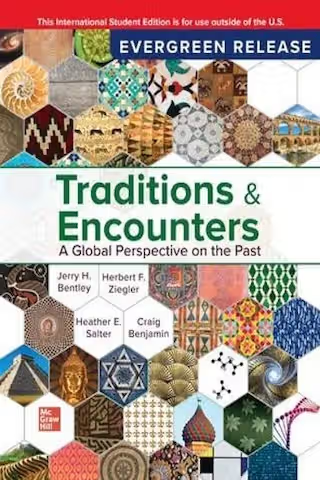
Bentley, J. H., Ziegler, H. F., & Streets Salter, H. (2021). Traditions & Encounters: A Global Perspective on the Past (7th ed., international student edition). McGraw-Hill Education.
Chapter Summary
The seventh edition is a single-volume survey of about 960 pages, organized chronologically in seven parts and 38 chapters, from the earliest human societies to the present. Its title names the two themes that run through the whole narrative: the "traditions" that individual societies built and maintained, and the "encounters" through which those societies traded, migrated, fought and exchanged ideas. Each part covers a period defined by the pattern of interaction that the authors see as typical of it, and within each part chapters are mostly regional, with some chapters devoted to cross-regional processes such as the Silk Roads or transoceanic voyages.
Part 1: The Early Complex Societies, 3500 to 500 B.C.E. (Chapters 1–7)
Chapter 1, "Before History", is followed by chapters on "Early Societies in Southwest Asia and the Indo-European Migrations", "Early African Societies and the Bantu Migrations", "Early Societies in South Asia", "Early Society in East Asia" and "Early Societies in the Americas and Oceania". The part closes with Chapter 7, "The Empires of Persia". The pairing of societies with migrations in the chapter titles shows the book's approach from the start: each early society is presented together with the movements of people that connected it to its neighbours. The Americas and Oceania receive their own chapter rather than a short aside.
Part 2: The Formation of Classical Societies, 500 B.C.E. to 500 C.E. (Chapters 8–12)
Four regional chapters, "The Unification of China", "State, Society, and the Quest for Salvation in India", and the two chapters on "Mediterranean Society" (the Greek phase and the Roman phase), are followed by Chapter 12, "Cross-Cultural Exchanges on the Silk Roads". The closing chapter moves from individual classical societies to the overland routes that connected them.
Part 3: The Postclassical Era, 500 to 1000 C.E. (Chapters 13–16)
"The Expansive Realm of Islam", "The Resurgence of Empire in East Asia", "India and the Indian Ocean Basin" and "The Two Worlds of Christendom". The last title signals that the Byzantine east and the western Christian world are treated side by side rather than as separate histories.
Part 4: The Acceleration of Cross-Cultural Interaction, 1000 to 1500 C.E. (Chapters 17–21)
"Nomadic Empires and Eurasian Integration", "States and Societies of Sub-Saharan Africa", "The Increasing Influence of Europe", "Worlds Apart: The Americas and Oceania", and a closing chapter, "Reaching Out: Expanding Horizons of Cross-Cultural Interaction", which draws the part's networks together on the eve of the oceanic voyages.
Part 5: The Origins of Global Interdependence, 1500 to 1800 (Chapters 22–27)
The part opens with "Transoceanic Encounters and Global Connections" and then follows the consequences region by region: "The Transformation of Europe", "New Worlds: The Americas and Oceania", "Africa and the Atlantic World", "Tradition and Change in East Asia" and "The Islamic Empires".
Part 6: An Age of Revolution, Industry, and Empire, 1750 to 1914 (Chapters 28–32)
"Revolutions and National States in the Atlantic World", "The Making of Industrial Society", "The Americas in the Age of Independence", "Societies at Crossroads" and "The Building of Global Empires". Reviews of the third edition describe this part as comparative by design: one chapter examines the Atlantic revolutions together, and another sets the responses of the Ottoman, Qing and Russian states to the industrializing West side by side.
Part 7: Contemporary Global Realignments, 1914 to the Present (Chapters 33–38)
"The Great War: The World in Upheaval", "An Age of Anxiety", "Nationalism and Political Identities in Asia, Africa, and Latin America", "New Conflagrations: World War II and the Cold War", "The End of Empire" and "A World without Borders". The final chapter carries the story into contemporary globalization.
Key Concepts
Parts 1–2: Early complex and classical societies
- Traditions and encounters: the book's twin organizing themes, the distinctive institutions and beliefs of particular societies and the contacts between them.
- Migration as a historical force: Indo-European and Bantu migrations are named in chapter titles and treated as central to the formation of early societies.
- Silk Roads: overland trade routes across Eurasia that linked the classical societies.
Parts 3–4: Postclassical era and accelerating interaction
- Indian Ocean basin: a maritime trading world linking East Africa, the Islamic lands, South Asia and East Asia.
- Nomadic empires and Eurasian integration: the role of pastoral peoples' empires in tying Eurasia together.
- Cross-cultural interaction: the exchange of goods, technologies and ideas between societies, which the book treats as the main engine of historical change.
Parts 5–7: Global interdependence to the present
- Global interdependence: the linking of all the world's regions after the transoceanic voyages of the sixteenth century.
- Atlantic world: the societies of Europe, Africa and the Americas connected by trade, slavery and revolution.
- Global empire building and decolonization: the expansion of industrial powers before 1914 and the end of empire after 1945.
- Globalization: the contemporary integration of the world that the final chapter examines.
Critical Analysis
Strengths
- A clear organizing idea. Heather Streets, reviewing the third edition in World History Connected (2006), found that the two themes of tradition and encounter give students a mental map for a very large body of information, and that dividing the past into seven eras, each opened by an essay on its unifying features, lets students break the subject into manageable pieces. The seventh edition keeps the seven-part structure.
- Genuinely global coverage. The same review singled out the treatment of Africa, Oceania and the Americas before European contact. The table of contents bears this out: sub-Saharan Africa, the Americas and Oceania have chapters of their own in Parts 1, 4 and 5.
- Readable, human-centred narrative. Reviews of earlier editions in World History Connected (Betterly on the second edition, Bell and Sperotto and Streets on the third) praised chapter-opening stories about individuals and the use of primary sources and maps; Betterly found the book engaging and never dry.
- Comparative chapters. Bell and Sperotto noted comparative chapters such as the one on the Atlantic revolutions and the one on Ottoman, Qing and Russian responses to the West, which suit courses built around comparison.
Limitations
- Length and density. At about 960 pages the book is long; Betterly called the second edition "very long and very heavy", and Bell and Sperotto found its early sections too extensive and warned that students need strong reading skills.
- An emphasis on trade and cities. Betterly argued that, because the book makes trade the central connection between societies, it gives most space to urban, literate and commercial history, and that it is weaker on the development of world religions and on physical geography. These observations concern an earlier edition and are worth checking against the current text.
- Narrative rather than historiography. Streets observed that current scholarly debates are rarely discussed explicitly, although recent research shapes the narrative. Students who need to engage with the historiography of world history will need other reading.
- Edition confusion. McGraw Hill has also issued an AP edition and later "release" versions with renamed and reordered chapters, so chapter numbers and titles cited by a course may not match this international student edition.
Where It Fits in the Course
This is one of the full-length, single-volume world history surveys on the course list, alongside Bulliet and colleagues' The Earth and Its Peoples and the Norton text Worlds Together, Worlds Apart. Of these, Traditions & Encounters is the one most explicitly organized around cross-cultural interaction. Strayer and Nelson's Ways of the World is a brief global history and suits a course that wants a shorter narrative with more time for primary sources; Streets's review records that some instructors moved from Worlds Together, Worlds Apart to this book, finding it more readable, though it lacks that book's later starting point for courses that begin around 1300.
The survey gives the factual backbone that the course's more specialized books assume. Sebastian Conrad's What Is Global History? explains the approach behind books like this one and is a good short companion at the start; Janet Abu-Lughod's Before European Hegemony develops at monograph length the thirteenth-century world system that Part 4 surveys; Jürgen Osterhammel's The Transformation of the World treats the nineteenth century of Part 6 thematically and in much greater depth; and David Christian's Maps of Time sets the human story in a big-history frame that extends back far beyond Chapter 1. The regional histories on the list, of Latin America, the modern Middle East and the Aztecs, deepen individual chapters.
How to Use This Book
The book is written for first-year university survey courses and for advanced secondary courses in world history; it assumes no prior knowledge of non-Western history, but its length and density call for steady weekly reading. A two-semester survey usually divides it at about 1500 (Parts 1–4, then Parts 5–7); a one-semester course has to select.
- Core in any course: the part introductions and the cross-regional chapters that carry the "encounters" theme: Chapter 12 (Silk Roads), Chapter 17 (nomadic empires), Chapter 21 (expanding horizons), Chapter 22 (transoceanic encounters), Chapters 28–29 (Atlantic revolutions and industrialization), Chapter 32 (global empires) and Chapter 38 (a world without borders).
- Regional chapters: choose according to the course's emphasis, but read at least one chapter each on Africa, the Americas and East Asia in every part to benefit from the book's global coverage.
- Reading method: read the opening story and the part essay first, then skim the section headings before reading in detail; afterwards, write a short note on what tradition and what encounter the chapter illustrates. This turns the twin themes into a revision tool.
- Alongside it: read the primary sources assigned with the book or in a sourcebook, and pair Part 4 with Abu-Lughod or Part 6 with Osterhammel for one deeper case. If a course uses a different printing (AP edition or a later McGraw Hill release), check chapter titles rather than numbers before reading.