01 / Reading Guide
Reading Guide
Citation
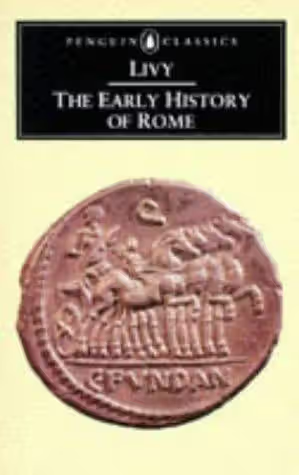
Livy. (1960). The Early History of Rome (A. de Sélincourt, Trans.). Penguin Classics.
Chapter Summary
This is a translation of the first five books of Livy's History of Rome from Its Foundation (Ab Urbe Condita), a work that originally ran to 142 books of which 35 survive. The five books here carry the story from Rome's legendary beginnings through the monarchy and the early Republic to the Gallic sack of the city in the fourth century BC. Penguin's catalogue describes the volume as covering the foundation of Rome, the seven kings, the establishment of the Republic and its internal struggles, and Rome's recovery after the Gallic invasion. The publisher credits Aubrey de Sélincourt as translator and R. M. Ogilvie as author of the introduction, and the 2002 printing adds a preface by S. P. Oakley, maps, a bibliography and an index.
Introduction and Preface
Ogilvie's introduction dates from 1971 and is reprinted in the current edition. Oakley's preface, according to the publisher, examines the text in light of recent Livy scholarship. Livy's own preface, which opens Book One, states his purpose: he will neither affirm nor refute the traditions that precede the founding, and he wants readers to follow how Rome's power was won and then how its morals gradually slipped, so that the narrative serves as a store of examples to imitate or avoid.
Book One: Rome under the Kings
Book One runs from Aeneas's arrival in Italy and the Alban line to the foundation of Rome by Romulus, who also forms the Senate and fights the Sabines. Numa then sets up religious institutions, Tullus Hostilius fights Alba (the combat of the Horatii and Curiatii), Ancus Marcius extends the city, and Tarquinius Priscus and Servius Tullius reshape it, Servius notably through the census and the division of citizens into classes and centuries. The book ends with the tyranny of Tarquinius Superbus, the assault on Lucretia and the first consuls.
Book Two: The Beginnings of the Republic
Book Two covers the first years without a king. Brutus binds the people by oath, condemns members of his own family for plotting to restore the Tarquins, and Rome faces Porsena, with the stories of Horatius Cocles, Mucius and Cloelia. Later episodes include the battle at Lake Regillus, the secession of the commons to the Sacred Mount and the creation of tribunes, Coriolanus, the first agrarian law and the Fabian family's campaign against Veii.
Book Three: The Patricians at Bay
Book Three is dominated by the quarrel over land and law. Cincinnatus is called from his farm to be dictator against the Aequi, the number of tribunes is raised to ten, and a board of decemvirs is appointed to codify the laws. The decemvirs hold office beyond their term and turn arbitrary, and they are forced to resign when the commons occupy the Aventine after the designs of Appius Claudius on Verginius's daughter.
Books Four and Five
Book Four turns on the proposal to allow intermarriage between patricians and plebeians, the introduction of military tribunes with consular power and of censors, and the killing of Spurius Maelius on suspicion of aiming at kingship. Book Five narrates the ten-year siege of Veii and its capture by Camillus, Camillus's exile, the Gauls' march on Rome, the defeat at the Allia and the occupation of the city except the Capitol. The book ends with the ransom, Camillus's return and his opposition to moving the city to Veii.
Key Concepts
Kings and Republic (Books One and Two)
- Foundation legends: the stories of Aeneas, Romulus and Remus, which Livy treats as traditions, not as certified facts.
- The seven kings: the monarchy as the setting for Rome's institutions, from the Senate to the census.
- Consuls: the magistrates who replace the king, first created at the end of Book One.
The Conflict of the Orders (Books Three and Four)
- Patricians and plebeians: the opposing groups, with the plebeians' tribunes as their representatives.
- Decemvirs: the board charged with writing down the law.
- Dictator: an emergency magistrate, as in Cincinnatus's case.
- Military tribunes with consular power: a substitute for the consulship that Book Four introduces.
Wars and Catastrophe (Book Five)
- The siege of Veii: Rome's long war against its Etruscan neighbour.
- The Gallic sack: the capture of Rome except for the Capitol, and the debate over whether to stay or move to Veii.
Critical Analysis
Strengths
- A narrative source in translation. The book lets readers meet the story of early Rome in the form Livy gave it, with its characters, legends and set-piece episodes, instead of through a modern summary.
- Scholarly apparatus. Ogilvie's 1971 introduction comes from a scholar who also wrote the Oxford commentary on Livy Books 1–5 (1965), and the current printing adds a preface on recent scholarship, maps, a bibliography and an index.
- Livy's openness about method. His preface separates tradition from established record and states his moral purpose, so the book teaches how a Roman historian understood his task.
- A compact unit. Five books fit in one volume, with a clear beginning and a clear endpoint.
Limitations
- Only five books. The story stops after the Gallic sack. Later volumes in the Penguin Livy series, such as Rome and Italy and The War with Hannibal, are separate books.
- Legend mixed with history. The earliest material belongs to tradition, and Livy declines to rule on much of it; readers need modern scholarship to distinguish reliable from legendary content.
- A translation of its time. The translation dates from 1960, so the introduction and the later preface carry the task of connecting the text to current scholarship.
- Not a textbook. The narrative proceeds year by year, magistrates and campaigns in turn, so it is a story to be read rather than a survey of institutions; modern overviews supply the structure.
Where It Fits in the Course
In the ancient history course this is a primary source, in contrast with the other books, which are modern surveys. It covers Rome's earliest period, long before the era of Goodman's The Roman World 44 BC–AD 180, and Livy wrote under Augustus, which falls within the period Goodman treats. Lane Fox's The Classical World and Cartledge's Ancient Greece: A Very Short Introduction supply a modern narrative of the Greek and Roman worlds against which Livy's account can be read, and Hornblower's The Greek World 479–323 BC and Van De Mieroop's A History of the Ancient Near East cover other regions of the ancient world.
A sensible order is to read a modern overview of Roman origins first, then Livy, and then Goodman for the imperial setting in which Livy worked.
How to Use This Book
The volume suits students of Roman history, classics and historiography who want to read an ancient narrative in English. No knowledge of Latin is needed.
A practical plan:
- Start with Ogilvie's introduction and Livy's preface, then read Book One, and return to the introduction once the first book is finished.
- Core: Books One to Three, for the kings, the first years of the Republic and the decemvirate.
- Then: Books Four and Five, for the continuing struggle between the orders, Veii and the Gauls.
- While reading: keep a short chronology, and note which episodes are presented as legend and which as institutional change.
- Alongside it: a modern survey of early Rome and, in the current printing, Oakley's preface and the bibliography for scholarly debate.