01 / Reading Guide
Reading Guide
Citation
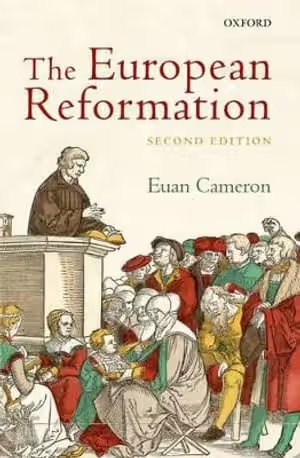
Cameron, E. (2012). The European Reformation (2nd ed.). Oxford University Press.
Chapter Summary
First published in 1991, the book offers an integrated explanation of how Western and Central Europe, from Iceland to Hungary and from the Baltic to the Pyrenees, split into separate Protestant and Catholic identities and movements. The publisher's description gives the outline of the argument. Late medieval Catholicism was not a uniformly decadent institution, but it was vulnerable to criticism whenever its claim to mediate God's grace was challenged. Luther's new account of how God forgives sin made rituals, a separate priesthood and an international church seem unnecessary, and for a critical "Reformation moment" the idea took fire in spiritual, political and community life. The second edition has an introduction, twenty-two numbered chapters in four parts, the last of which is the conclusion.
Introduction: The Reformation and Europe
The introduction frames the subject and the book's approach, which joins theological ideas to political cultures.
Part I, The Background: Chapters 1–6
The first part examines the Church on the eve of the Reformation: "The Religion of the People of Europe", "The Vulnerability of the Church", "'Reform' from Within and Its Limits", "Challenges from Outside and Their Limits", "Heresy: An Alternative Church?" and "The Church and the Christian Soul". The publisher says the material on late medieval belief was completely reorganised and expanded for this edition.
Part II, The Reformers and Their Message: Chapters 7–13
This part begins with "The 'Luther-Affair' and Its Context", "The Conversions of the Reformers" and "Rejections of Reform". Four chapters then set out the reformers' message in turn: salvation, Scripture, the Church and the sacraments. Together they form the book's account of what was taught.
Part III, Establishing the Reformed Churches: Chapters 14–17
"Unsuccessful 'Affiliations' to the Reformed Cause" is concerned with affiliations to the reformed cause that proved unsuccessful, "Self-Governing Towns and Cities" and "Principalities and Kingdoms" cover how reform was established in different political settings, and "Motives for Establishing the Reformation?" asks why authorities acted as they did.
Part IV, Beyond the "Reformation Moment": From Temporary Coalitions to Growing Communities: Chapters 18–22
The final part follows the aftermath. Its chapters deal with "Voluntary, Gathered Movements Reject the 'Coalition'", "Crisis, Survival, and Compromise in Politics", "Reformers at Odds: The 'Confessional' Reformation", "Reformers and Laypeople: Building a Religious Culture" and a "Conclusion". The publisher says the material on cultural change after the Reformation moment, including worship, popular belief, family and community life, was reorganised and expanded.
Key Concepts
Parts I–II
- Reformation moment: the short period in which Luther's idea took fire across Europe.
- Vulnerability of the Church: the claim to mediate grace, which made it open to a particular kind of criticism.
- The reformers' message: the four doctrinal strands of salvation, Scripture, church and sacraments.
Parts III–IV
- Temporary coalitions: the alliances of supporters that held together in the early movement and later divided.
- Confessional Reformation: the stage in which reformers fell out and separate confessions took shape.
- Religious culture: worship, popular belief, family and community life shaped by reformed ideas.
Critical Analysis
Strengths
- Theology and politics together. The publisher's distinctive claim, retained from the first edition, is the clear integration of theological ideas and political cultures, bridging theological and social history.
- A clear four-part design. Background, message, establishment and aftermath move from the late medieval Church to the churches that emerged, and the four consecutive chapters on salvation, Scripture, the Church and the sacraments make the doctrinal content easy to locate.
- Reader aids. The publisher notes the use of charts and tables, and the book has six maps and two figures.
- A substantially revised edition. The text is rewritten and updated, with a revised bibliography and new material on late medieval belief and on cultural change after the Reformation.
Limitations
- Length. At 592 pages with notes and a further-reading section, the book is a major commitment.
- Scope. It treats Western and Central Europe, so the Reformation's reach beyond that region is outside its frame.
- Assumes engagement with doctrine. Four chapters on the reformers' doctrinal message mean readers who are unfamiliar with Christian theology will need to work to follow them.
Where It Fits in the Course
Within the early modern history course, Cameron is the detailed scholarly account of the Reformation. Marshall's The Reformation: A Very Short Introduction is the briefest starting point, treating the Reformation as a long-term process with Protestant and Catholic strands, and Eire's Reformations is a narrative history that treats the Protestant, Catholic and radical reformations together. Wiesner-Hanks's Early Modern Europe, 1450–1789 and the Warwick-based textbook The European World 1500–1800, edited by Kümin, provide the wider political, social and economic setting. Parker's Global Crisis looks at the seventeenth century on a world scale and is a later and different kind of book.
Cameron fits best after one of the shorter accounts, as the study that explains the doctrinal and political reasons in detail.
How to Use This Book
The book suits students who have taken an introduction to early modern Europe or the Reformation, and some knowledge of Christian doctrine helps with Part II. For a first read, take the introduction, Part II and the conclusion, then add Part I for context and Part III for the political settlements. A course on the Reformation can assign the four chapters on the reformers' message as a block.
Use the endnotes and the suggestions for further reading to move to specialist studies on a particular region or reformer. Reading Marshall's short book first gives an outline to hang Cameron's detail on, and keeping a chronology and a map of the confessional divisions beside the text makes Part III easier to follow.