01 / Reading Guide
Reading Guide
Citation
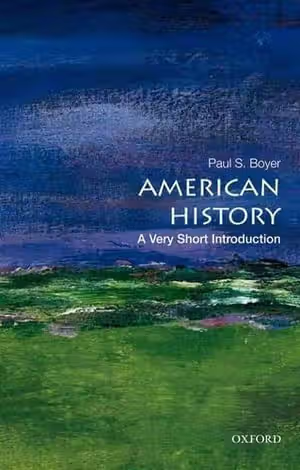
Boyer, P. S. (2012). American History: A Very Short Introduction. Oxford University Press. (Very Short Introductions.)
Chapter Summary
The book is a brief interpretive history of the United States from the first human migrations to the early twenty-first century, in nine chronological chapters of about fifteen pages each (some 138 pages of text), followed by references, further reading arranged by chapter, and an index. Each chapter covers a defined span, from several centuries at the start to two decades or so later on. The publisher's description says the book reflects Boyer's interests in social, intellectual and cultural history, including popular culture and religion, and his personal view of American history, in which paradox and irony loom large: positive achievements are weighed against the country's failures to live up to its stated ideals, and the book aims to be neither a muckraking exposé nor a celebratory panegyric.
Chapter 1: Beginnings: Pre-history to 1763
From the first settlement of the continent at least 15,000 years ago by people crossing from Siberia, through a North American population estimated at seven to ten million by 1500, to European expansion and settlement and the end of the Seven Years' War. The publisher stresses that colonisation meant very different things to colonists, Native peoples and enslaved Africans, and the chapter traces the introduction of slavery.
Chapter 2: 1763–1789: Revolution, Constitution, a New Nation
Imperial conflict, mob violence, war and political crisis after 1763; Thomas Paine's Common Sense as the trigger for the move to independence in 1776; and the challenge of self-government while the war continued, ending with the creation of a new nation within thirteen years.
Chapter 3: 1789–1850: The Promise and Perils of Nationhood
The first sixty years of independence: politics, economic growth driven by population increase, territorial expansion and transport, reform movements, religious revival and cultural creativity, all set against the reality of slavery.
Chapter 4: 1850–1865: Slavery and Civil War
Slavery as central to the southern economy and to national politics; Lincoln's war to save the Union; and emancipation emerging as a war aim under abolitionist pressure and through the actions of enslaved people who fled to Union lines. The chapter notes that full equality would take far longer.
Chapter 5: 1866–1900: Industrialization and its Consequences
The publisher's description identifies the theme: industrial expansion and vast fortunes alongside appalling conditions in immigrant slums and an exploited labour force.
Chapter 6: 1900–1920: Reform and War
The reform era of the early twentieth century and the period of war that closes it. The publisher's account of the book traces the projection of US military power abroad from the Philippines early in the century, a theme that runs on through later chapters.
Chapter 7: 1920–1945: From Conflict to Global Power
The transformation of a provincial society on the margins of world affairs into the pre-eminent international power: the prosperity of the 1920s, the Great Depression and the Second World War, whose greatest long-term effect was the shift in the global balance of power.
Chapter 8: 1945–1968: Affluence and Social Unrest
The post-war mix of material abundance and mass culture, anti-communist fears and festering racial injustice, then the reform legislation, civil rights protests and anti-war demonstrations of the 1960s and the conservative reaction of 1968.
Chapter 9: To the Present
The period from the late 1960s to the time of writing, with the presidencies of Nixon, Reagan and George H. W. Bush and ending in the Obama years; the publisher's description points to themes such as immigration and the hostility it has stirred, the global appeal of American popular culture, and military interventions up to Iraq. Jim Cullen's review notes the dark mood that shadows the final chapters, only partly offset by Boyer's statements about American resilience.
Key Concepts
Chapters 1–3: Colonies to nation
- Multiple meanings of colonisation: the same settlement history experienced differently by colonists, Native peoples and enslaved Africans.
- Revolution and Constitution: the move from colonial protest to independence and self-government.
- Promise and perils: growth, expansion and reform in a nation built on freedom yet dependent on slavery.
Chapters 4–6: Civil War to the early twentieth century
- Slavery and emancipation: slavery's place in the economy and politics, and how emancipation became a war aim.
- Industrialisation: economic expansion and its social costs for workers and immigrants.
- Reform: the early twentieth-century efforts to address the consequences of industrial society.
Chapters 7–9: Global power to the present
- Global power: the change in America's international position between 1920 and 1945.
- Affluence and unrest: post-war consumer abundance alongside protest movements and backlash.
- Ideals and realities: the book's running theme of the gap between stated ideals and practice.
Critical Analysis
Strengths
- Brevity with balance. Jim Cullen, reviewing the book for the History News Network (2012), describes it as brisk and no-nonsense and credits it with an even, well-proportioned pace across the whole of US history.
- An interpretive voice. The publisher presents it as a personal view shaped by paradox and irony, set between celebration and exposé, which gives students an argument to engage with rather than a neutral list of facts.
- Breadth of perspective. Boyer's interests in social, cultural and religious history and popular culture, named in the publisher's description, broaden a political narrative, and colonisation is presented from the viewpoints of Native peoples and enslaved Africans as well as settlers.
- Useful as a reference. Cullen notes that it works as a pocket reference, with a good index for quick reminders on topics such as the Stamp Act or the Populist Party, and suggests it as a low-cost alternative to a survey textbook as background for case-study teaching.
Limitations
- Very compressed. Cullen observes that those who have taught the survey will learn virtually nothing new; each era receives only about fifteen pages.
- Dated at the end. Published in 2012, the final chapter stops in the Obama years and cannot cover more recent events or scholarship.
- A personal emphasis. The dark mood of the closing chapters that Cullen notes is an interpretation; readers should weigh it against other accounts.
Where It Fits in the Course
This is the shortest overview in the American-history list and a good first read or a running reference. The American Yawp, an openly licensed, collaboratively written survey from Indigenous societies to the present, and Eric Foner's Give Me Liberty!, a survey told as the story of freedom, both provide the full textbook narrative that Boyer compresses; Boyer's theme of the gap between ideals and reality sits naturally alongside Foner's focus on freedom.
James McPherson's Battle Cry of Freedom is a full one-volume history of the Civil War era that expands Boyer's Chapter 4, and Dan Georgakas and Marvin Surkin's Detroit: I Do Mind Dying is a study of the League of Revolutionary Black Workers that gives depth to the labour and civil rights themes of Chapters 8–9. American History Now, edited by Eric Foner and Lisa McGirr, surveys how historians' interpretations of each period have changed and is best read after a survey, when students can follow the debates.
How to Use This Book
No prior study of American history is needed. The book suits first-year students, students from other countries or disciplines who need a quick framework, and readers preparing for a longer survey.
A suggested plan:
- Read it straight through before the course begins, or one chapter a week alongside a longer survey, since the chapters follow the course's likely chronology.
- Core: all nine chapters; each is short and the interpretive thread depends on the whole.
- For focused courses: Chapters 1–4 for a course to 1865, Chapters 5–9 for one after.
Use it as Cullen suggests: as the coordinates within which to place primary sources and detailed case studies. Pair each chapter with one primary text (for Chapter 2, for example, Paine's Common Sense) and with the corresponding chapters of The American Yawp or Give Me Liberty!. Use the chapter-by-chapter further reading to start research, and test Boyer's claims about ideals and failures against the evidence you read elsewhere.