01 / Reading Guide
Reading Guide
Citation
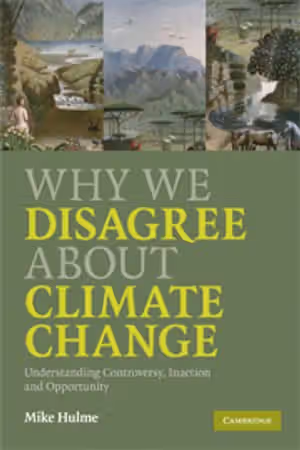
Hulme, M. (2009). Why We Disagree About Climate Change: Understanding Controversy, Inaction and Opportunity. Cambridge University Press.
Chapter Summary
The book has a foreword and a preface, ten chapters of roughly 30 to 45 pages each (about 366 pages in all) and a bibliography. The publisher's description presents it as an insider's account by a climate scientist, drawn from twenty-five years of professional work, of how climate change emerged as a phenomenon and of the different ways it is understood. A review in Times Higher Education describes the plan: two chapters on the cultural and historical background to the idea of "climate" and of human-made climate change, followed by chapters that each look at a different reason why people disagree.
Chapter 1: The Social Meanings of Climate
The first chapter (pages 1–34) belongs to the pair that, in the Times Higher Education reviewer's words, sets out the cultural and historical background to the very idea of a "climate". The reviewer quotes Hulme's view that the idea of climate change means different things to different people in different contexts.
Chapter 2: The Discovery of Climate Change
The second chapter (pages 35–71) is the second of the two background chapters; the reviewer describes them as covering the idea of climate and more recent notions of how humans promote specific climate changes.
Chapter 3: The Performance of Science
The science chapter (pages 72–108) is the one the reviewer found most interesting. It deals with how climate science is done and what its statements can claim, including the objectivity of climate projections and the role of judgment about likelihoods, with the treatment of the Greenland ice sheet as an example.
Chapter 4: The Endowment of Value
Its title points to value: the standpoints the publisher lists include economics, and this is the first of the chapters that each give a different reason for disagreement (pages 109–141).
Chapter 5: The Things We Believe
A chapter on belief as a source of disagreement (pages 142–177). The publisher lists faith among the standpoints, and the reviewer counts religious belief among the topics most distinctive to the author.
Chapter 6: The Things We Fear
The chapter on fear (pages 178–210). The reviewer mentions how environmental risks are conceptualised among the book's social-science themes, and psychology is among the publisher's listed standpoints.
Chapter 7: The Communication of Risk
The chapter on communication (pages 211–247). The reviewer notes that how the media cover climate change is among the topics treated in the book, and communication is one of the publisher's listed standpoints.
Chapter 8: The Challenges of Development
Development is one of the standpoints the publisher lists, and this chapter (pages 248–283) takes it as its subject.
Chapter 9: The Way We Govern
The chapter on governance (pages 284–321); politics is among the publisher's listed standpoints.
Chapter 10: Beyond Climate Change
The final chapter (pages 322–366) returns to the argument that climate change is not a problem waiting for a solution. According to the review, Hulme argues that it is a "wicked problem" with no single solution and that the idea of climate change should be used to rethink wider social goals.
Key Concepts
Chapters 1–3: Meaning, History and Science
- Climate as a cultural idea: climate and climate change mean different things in different contexts, places and networks.
- Scientific judgment: climate projections are statements of informed judgment about likelihoods, not simple facts.
Chapters 4–9: Reasons for Disagreement
- Value, belief and fear: the titles of Chapters 4–6 name differences in what people value, what they believe and what they fear.
- Communication, development and governance: the subjects of Chapters 7–9.
Chapter 10: Beyond Climate Change
- A wicked problem: climate change cannot be "solved" in isolation from other social goals.
- Climate change as a catalyst: the publisher's phrase for the idea that it can change how people see their place in the world.
Critical Analysis
Strengths
- A different question. The book asks why people disagree and not whether the science is right. The Times Higher Education reviewer called it distinctive and courageous, and noted that Hulme rejects the view that those who disagree are simply uninformed or swayed by commercial interests.
- Authority from inside the field. The publisher stresses twenty-five years of professional work as a climate scientist; the reviewer found the science chapter the most authoritative.
- Interdisciplinary range. The publisher lists the standpoints used to explain disagreement: science, economics, faith, psychology, communication, sociology, politics and development.
- A clear plan. The contents show two background chapters, then a run of chapters each named for one reason for disagreement, and a conclusion.
Limitations
- Uneven authority. The reviewer found that the chapters outside the author's professional field read less authoritatively than the science chapter.
- A personal standpoint. The review notes that Hulme's Christian beliefs are central to his position, so the book is an argument as well as a survey and should be read critically.
- Date. The book was published in 2009, before many later developments in climate policy and politics.
- Length. Ten chapters of about thirty to forty-five pages each, plus a preface of sixteen pages, make it a substantial read for a student who wants only a summary.
Where It Fits in the Course
In the climate and environment list, Hulme is the book about the social and cultural side of the subject, not the physical science. Mark Maslin's Climate Change: A Very Short Introduction is a concise overview of the evidence, impacts, mitigation and adaptation, and is a sensible first read; Hulme then asks why a shared body of evidence leads to different responses. Paul Robbins's Political Ecology: A Critical Introduction treats environmental change as inseparable from power, economy and social difference, and shares Hulme's interest in who defines environmental problems.
William Marsh and John Grossa's Environmental Geography is a broader textbook on human–environment interactions and sustainability, and Bill McGuire's Global Catastrophes is a short introduction to catastrophic natural hazards. Hulme fits after these for students who want to think about the controversy itself.
How to Use This Book
The book is for advanced undergraduates and graduate students in geography, environmental studies, science and technology studies or public policy, who already know the basics of climate science and want to understand the debate around it.
A practical plan:
- Core: the preface and Chapters 1–3, which state the approach, followed by Chapter 10, where the argument is drawn together.
- By interest: read Chapters 4–9 as separate essays, choosing those that match the course's theme: value (Chapter 4), belief and fear (5 and 6), risk communication (7), development (8) and governance (9).
- Reading actively: for each of Chapters 4–9, write down the reason for disagreement that it names, a position or news story that illustrates it, and whether you accept that reason.
Pair the book with a short scientific overview so that the discussion of disagreement is anchored in the evidence.