01 / Reading Guide
Reading Guide
Citation
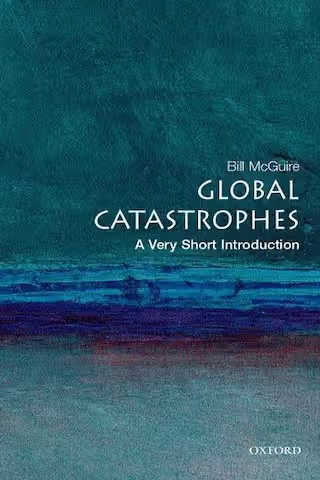
McGuire, B. (2014). Global Catastrophes: A Very Short Introduction (2nd ed.). Oxford University Press.
Chapter Summary
This is a short book of about 120 pages with five chapters, an epilogue, a list of further reading and an index. The publisher's description presents it as an exploration of the catastrophes that could befall the planet and the species, with attention to the probability of each and to humanity's chances of surviving it. It runs from the likely consequences of global warming to the eventual destruction of the Earth in the far future, and it considers a range of "end of the world scenarios": a new ice age, asteroid and comet impact, supervolcanoes and mega-tsunami. The second edition is updated with recent case studies from around the world and brings the risk research up to date. The author is a geophysical hazards specialist at University College London.
Chapter 1: Planet Earth in a nutshell
The opening chapter (pp. 1 to 21) sets the scene on the planet itself before the threats are taken one by one, giving the background that the later chapters on climate, the solid Earth and space assume.
Chapter 2: Global warming: a lot of hot air?
The chapter deals with the current trend of global warming. It covers the drivers and feedback loops of climate, taking in greenhouse gases such as carbon dioxide and methane, the IPCC's assessments, sea level rise and tropical cyclones. A reviewer for the Astrobiology Society describes the book's treatment of long-term climate stability as fair-handed.
Chapter 3: The Ice Age cometh
The counterpart to the warming chapter looks at the opposite periods in Earth's history: ice ages. It treats the causes of the glacial cycles, including the orbital variations known as Milankovitch cycles, and abrupt events such as the Younger Dryas and the Little Ice Age. Together with Chapter 2, the review notes, it addresses the drivers and feedbacks that keep planetary climate stable or unstable.
Chapter 4: The enemy within: supereruptions, giant tsunamis, and the coming great quake
This chapter (pp. 64 to 87) turns to the solid Earth. The reviewer notes that ordinary tsunamis, volcanoes and earthquakes rarely threaten life globally, and that McGuire moves to events in the extreme tail of these everyday dangers, such as rare supervolcano eruptions (the Toba eruption is among the book's examples), giant tsunamis and great earthquakes at subduction zones. The largest eruptions can inject enough dust and sulphur into the upper atmosphere to cause a volcanic winter.
Chapter 5: The threat from space: asteroid and comet impacts
The chapter covers the hazard of asteroid and comet impacts, the relative risk of a strike and the consequences of impactors of different sizes. The reviewer reports that extinction-level events appear to occur only about every 100 million years.
Epilogue
A short closing section (pp. 110 to 114) sums up the current position.
Key Concepts
Chapters 1–3: Earth and climate
- Global warming: its drivers, feedbacks and expected consequences.
- Ice ages and orbital cycles: climate change that long predates humans.
Chapters 4–5 and the Epilogue: Sudden hazards
- Supervolcano: an eruption far larger than anything in recorded history, capable of a global volcanic winter.
- Mega-tsunami: very large waves generated by a landslide or the collapse of an island.
- Subduction-zone earthquake: the setting of the largest quakes.
- Impact hazard: the risk from asteroids and comets, which differs greatly with the size of the object.
- Probability versus consequence: the book weighs how likely each scenario is against how severe it would be.
Critical Analysis
Strengths
- A wide survey in a small volume. The chapters cover global warming, ice ages, volcanic and seismic extremes and cosmic impacts, so one short book gives a map of the main natural threats to civilisation.
- An expert author. McGuire is a professor of geophysical hazards, and the Astrobiology Society reviewer called him well qualified for the subject.
- Attention to probability as well as consequence. The publisher describes the book as looking at the probability of each event as well as the chances of survival, and the reviewer cites the rarity of extinction-level impacts (about every 100 million years) as one way of putting the risks in proportion.
- Updated edition. The 2014 edition adds recent case studies and refreshed risk research, according to the publisher.
- A reading list to follow up. The book provides a brief bibliography at the end.
Limitations
- Sparse in detail. The reviewer says that, as with the other books in the series, it can feel frustratingly sparse on detail, and it can be read in a single train ride.
- Natural hazards dominate. The scenarios are geological, climatic and astronomical. Threats such as pandemics, nuclear war or technological risks are outside the chapter list.
- Dated in places. The updated edition is from 2014. Climate science, volcanic monitoring and planetary defence have moved on since, so numbers and examples need checking against current sources.
- Only five topical chapters. Each subject therefore receives a short chapter, and more technical treatment must come from other books.
Where It Fits in the Course
In the climate and environment course this is the broad-hazards introduction. Maslin's Climate Change: A Very Short Introduction is the natural companion for Chapters 2 and 3, since it is devoted to climate alone. Marsh and Grossa's Environmental Geography is a fuller textbook that places hazards inside a systematic treatment of the physical and human environment. Robbins's Political Ecology and Hulme's Why We Disagree about Climate Change move from physical hazards to the politics, power and culture of environmental issues, which McGuire largely leaves aside. Read McGuire first for the physical scenarios, then those books for how societies understand and respond to them.
How to Use This Book
The book is aimed at general readers and first-year students. No specialist background is needed, and the small size makes it suitable as a first book on the topic or a quick overview before a longer course.
Read straight through, since the chapters are short and the epilogue ties them together. If you have a particular interest, Chapters 2 and 3 form a pair on climate, while Chapters 4 and 5 deal with geophysical and cosmic events. After finishing, use the further-reading list and the other books in the course for depth, and check recent figures for climate and hazard statistics against up-to-date sources.
To get more from it, make a table of the scenarios with columns for cause, typical frequency, area affected and the available warning, and fill it in chapter by chapter; this reproduces the book's own comparison of probability and consequence.