01 / Reading Guide
Reading Guide
Citation
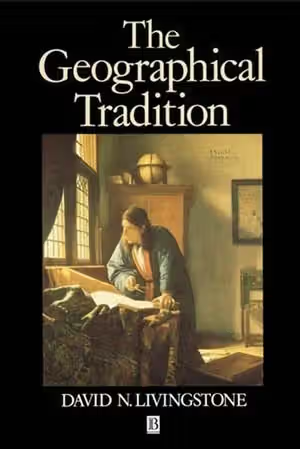
Livingstone, D. N. (1993). The Geographical Tradition: Episodes in the History of a Contested Enterprise. Wiley-Blackwell.
Chapter Summary
The book has a preface, ten chapters, a bibliography and an index, and runs to roughly 440 pages. The publisher describes it as the history of an essentially contested tradition: by examining a series of key episodes in geography's history since about 1400, Livingstone argues that the messy contingencies of history are to be preferred to the manufactured idealisations of the standard chronicles. Each episode is set against the broader social and intellectual context of its time. The chapter titles are playful, so they are listed here with the topics the publisher names.
Chapter 1: Should the History of Geography be X-Rated? Telling Geography's Story
The opening chapter is about method: how the story of geography should be told, and why a single triumphal narrative of progress is a poor model. It sets up the idea of geography as a contested enterprise whose meaning has been fought over.
Chapters 2–3: Of Myths and Maps: Geography in the Age of Reconnaissance; Revolution, Celestial and Terrestrial: Geography and the Scientific Revolution
The first two historical episodes: geography in the age of European exploration and its relation to myth and mapping, and geography's place within the Scientific Revolution.
Chapters 4–5: Naturalists and Navigators: Geography in the Enlightenment; Of Design and Dining Clubs: Pre-Darwinian Geography
Geography in the Enlightenment, with naturalists and navigators as its figures, and the period before Darwin.
Chapters 6–7: The Geographical Experiment: Evolution and the Founding of a Discipline; A 'Sternly Practical' Pursuit: Geography, Race and Empire
The publisher says the book takes up geography's relations with Darwinism and imperialism. Chapter 6 concerns evolution and the founding of geography as a discipline; Chapter 7 concerns the practical, imperial aims of geography and its connections with race.
Chapters 8–9: The Regionalising Ritual: Geography, Place and Particularity; Statistics Don't Bleed: Quantification and its Detractors
Later episodes, which the publisher names as geography's relationships with regionalism and with quantification: the regional tradition's emphasis on place and particularity, and the argument between advocates and detractors of quantitative methods.
Chapter 10: The Geographical Tradition: A Conversational Conclusion
A closing chapter, in the form of a conversation, that returns to the question of what the tradition is.
Key Concepts
Chapters 1–5
- Contested enterprise: geography's identity as something argued over rather than fixed.
- Contingency versus chronicle: preferring specific historical circumstances to a smooth story of progress.
- Age of Reconnaissance, Scientific Revolution, Enlightenment: the early modern settings in which geography took shape.
Chapters 6–10
- Evolution and the founding of a discipline: Darwinism's role in the making of academic geography.
- Geography, race and empire: the discipline's practical and imperial associations.
- Regionalism and quantification: two successive ideals of what geography should be.
Critical Analysis
Strengths
- A clear thesis. The publisher states the argument and the book's chapters follow it episode by episode.
- Contextual method. Each episode is placed in its broader social and intellectual setting, so geography is read together with the history of science.
- Scope. The contents run from the Age of Reconnaissance to quantification, giving a long view of the discipline.
- Readable by design. The publisher lists accessible, attractively written prose among its features, and one endorsement it quotes praises the easy style and the sympathy and irreverence with which five centuries of geographical work are approached.
- Reception. Publisher-quoted endorsements from geographers and historians describe it as bold in ambition and well-written, and recommend it for courses on the history and philosophy of the field.
Limitations
- Episodes, not a survey. By design the book selects episodes, so it is not a continuous chronicle and does not cover every period or place.
- Dated. First published in 1993; the late twentieth-century chapters stop before feminist, poststructural and later developments.
- Ends with quantification. The last historical chapter deals with quantification and its detractors, so later strands of human geography are outside the book; for those, use a text that covers the post-1945 period.
Where It Fits in the Course
Within the course's reading list this is the long-view history of the discipline. Matthews and Herbert's Geography: A Very Short Introduction is a brief entry point; Cresswell's Geographic Thought: A Critical Introduction traces geographic thought from ancient times to current debates and is the easier first read. Johnston and Sidaway's Geography and Geographers picks up with human geography since 1945, so Livingstone supplies the earlier centuries and the two work well in sequence. Gomez and Jones's Research Methods in Geography treats geographic thought and research methods together, and Clifford and colleagues' Key Methods in Geography is a handbook of methods; both concern how research is done rather than the long history of the discipline.
Read Livingstone after a short introduction and one general account of geographic thought, so that terms such as regional geography and quantification are already familiar. Its most distinctive use is to supply the history of science and empire that shorter surveys omit.
How to Use This Book
For advanced undergraduates and graduate students with some background in geographic thought or the history of science.
A practical plan:
- Start with Chapter 1 for the argument, then follow the chapters in order.
- Choose by interest: Chapters 6–7 for evolution, race and empire; Chapters 8–9 for the twentieth-century debates.
- Pair Chapter 9 with Johnston and Sidaway, and read Chapter 10 last.
- Use the bibliography to follow up episodes, and keep a running list of who is excluded from each story, a question the book's title invites.
- Take notes by episode: for each chapter write down the context, the people and the stakes of the dispute over what counted as geography, and compare across chapters.