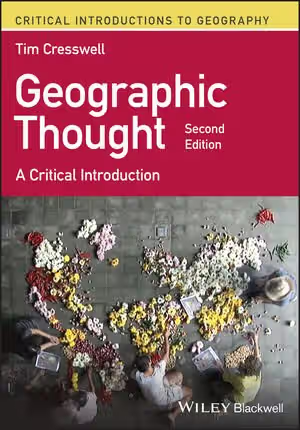
01 / Reading Guide
Reading Guide
Citation
Cresswell, T. (2024). Geographic Thought: A Critical Introduction (2nd ed.). Wiley-Blackwell.
Chapter Summary
The second edition has fifteen chapters, a glossary and an index in about 320 pages. Wiley describes it as an accessible examination of the major thinkers and theoretical developments in geography, from ancient geography to contemporary theory, with attention to the influence of Darwin and Marx, anarchist geographies and feminism. Its three new chapters are on physical geography and theory, postcolonialism and decoloniality, and Black geographies. Chapter 1 states the book's plan: it introduces bodies of thought roughly in the order they emerged but does not treat them as paradigms that replaced one another, since all remain living traditions, and it makes no claim to completeness.
Chapter 1: Introduction
The chapter argues that theory shapes geographical research at every stage: in choosing what to study, what to include, how to gather information and how to present the results. It explains what theory is, discusses difficult writing and jargon, and relates theory to the history of geography. It also explains that this edition tries to engage a wider range of voices than the first.
Chapters 2–3: Early Geographies; The Emergence of Modern Geography
Chapter 2 covers classical and medieval geography; the index places Herodotus, Strabo and Ptolemy here, along with Arab geographers such as Ibn Battutah and Ibn Khaldun. Chapter 3 follows geography into the modern period through Kant, Humboldt, Ritter and Darwin, environmental determinism, early geopolitics and geomorphology, and the anarchist geographers Reclus and Kropotkin.
Chapters 4–5: Thinking About Regions; Spatial Science and the Quantitative Revolution
Chapter 4 covers regional geography: the French tradition of Vidal, Hartshorne's work, critiques of the region idea and the "new regional geography". Chapter 5 presents spatial science, grounded in positivism, with central place theory and quantitative methods, and its later developments.
Chapters 6–8: Humanistic Geographies; Marxist Geographies; Feminist Geographies
Chapter 6 covers phenomenology and humanistic work on place, including Tuan, Relph and Seamon. Chapter 7 sets out Marxist ideas (historical materialism and the labor theory of value, according to Chapter 1) and their geographies, including uneven development. Chapter 8 introduces feminist geography, gender and its critique of knowledge.
Chapters 9–10: Postmodernism and Beyond; Toward Poststructuralist Geographies
Chapter 9 takes up postmodern thought and its challenge to grand narratives, including postmodern urbanism and representation in mapping. Chapter 10 moves from structuralism through structuration and time-geography to Bourdieu and Foucault.
Chapters 11–12: Relational Geographies; More-than-Human Geographies
Chapter 11 develops relational ideas of space and place, assemblage theory, scale and nonrepresentational theory. Chapter 12 extends geography beyond the human: post-humanism, animal geographies, actor-network theory and hybrid geographies.
Chapter 13: More-than-Physical Geographies
A chapter on theory in physical geography, one of the new chapters, including critical physical geography and debates around the Anthropocene.
Chapters 14–15: Postcolonial, Decolonial, and Anticolonial Geographies; Black Geographies
Two new chapters. The first covers postcolonial theory, decolonial thought and Indigenous perspectives; the second introduces the work of Black geographers and Black geographies.
Key Concepts
Chapters 1–5: Foundations
- Theory as a lens: an organised way of ordering experience and facts that shapes every step of research.
- Environmental determinism: the idea that the natural environment determines human life and culture, still defended by some.
- Regions and spatial science: regions as units of geographic study, and the positivist, quantitative alternative.
Chapters 6–10: Human Geography Traditions
- Place and phenomenology: humanistic geography's interest in how people dwell in the world.
- Historical materialism and uneven development: the Marxist approach to social change and space.
- Gender and standpoint: feminist critiques of supposedly objective knowledge.
- Discourse and structuration: poststructural and social-theory accounts of how structure and action interact.
Chapters 11–15: Recent Directions
- Relational space and assemblage: space and places understood through their connections.
- Actor-network theory and post-humanism: ways of including nonhuman actors in geography.
- Critical physical geography: bringing social theory into the study of the physical environment.
- Decoloniality and Black geographies: perspectives that challenge the colonial lineage of geographic thought.
Critical Analysis
Strengths
- A concrete case for theory. Chapter 1 shows how theory is already at work in choices about topic, scope, method and presentation, which suits readers who see theory as remote from practice.
- A frank treatment of difficulty. The introduction discusses obscure writing and jargon, separating what is badly written from what is simply hard, with examples.
- Wide range. From ancient geography to postcolonial, decolonial and Black geographies, with physical geography included as a theoretical subject, and new examples from a wider set of contexts and researchers.
- Study aids. A glossary, suggested readings marked in each chapter's references, and an index that makes it easy to find thinkers and concepts.
Limitations
- Selective by design. The author says the book reflects his own interests and cannot cover the field, and omits much work.
- Brief treatments. Chapters 2 to 15 run roughly 18 to 25 pages each, so every tradition receives an overview; students working on one approach will need to follow the suggested readings.
- Mostly human geography. Physical geography is the focus of Chapter 13 and appears in parts of Chapters 3 and 5, so the book is weighted towards human geography.
- Theory, not methods. The subject is the ideas behind research. Chapter 1 links theory to method, but the book is not a guide to research techniques, and a methods text is needed for practical research design.
Where It Fits in the Course
Cresswell's Geographic Thought is the main textbook for a course on geographic thought. Matthews and Herbert's Geography: A Very Short Introduction is a concise overview of how geographers connect place, environment, society and scale and makes a gentler first read. Johnston and Sidaway's Geography and Geographers is a critical history of Anglo-American human geography since 1945, following the succession of approaches from regional description to poststructural work, and is a natural follow-up for readers who want that history in more detail.
Livingstone's The Geographical Tradition presents the discipline's history as a series of episodes in which what counted as geography was contested, and suits readers drawn to the historical chapters (Chapters 2–4). For methods, Clifford, Cope and Gillespie's Key Methods in Geography and Gomez and Jones's Research Methods in Geography cover how research is done; the latter also treats geographic thought, and can be paired with Cresswell's first chapter.
How to Use This Book
The book is written for students taking a course on geographic thought or the philosophy of geography, as an undergraduate or postgraduate. No background in philosophy or social theory appears to be assumed, since Chapter 1 sets out to make difficult thinking less intimidating, but an introductory human geography course helps.
Read Chapter 1 first; it explains why theory matters and how to approach difficult texts. Then follow the order of the chapters, which roughly reflects the order in which ideas emerged, or select by interest: Chapters 4–8 for the classic twentieth-century traditions, Chapters 9–12 for the later turns, Chapters 13–15 for the newest material.
For each chapter, note the central question and what the approach made visible or left out, and follow at least one suggested reading to meet an original author.