01 / Reading Guide
Reading Guide
Citation
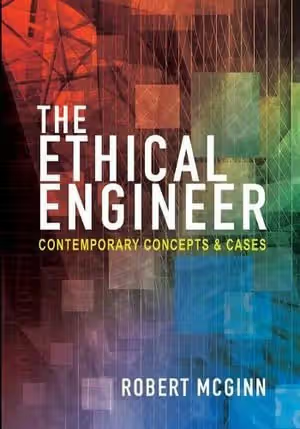
McGinn, R. (2018). The Ethical Engineer: Contemporary Concepts and Cases. Princeton University Press.
Chapter Summary
The book runs to about 350 pages (x + 340) in seven chapters. Three short conceptual chapters build an analytical framework; Chapter 4, by far the longest, applies it to eighteen case studies from what the publisher counts as ten engineering fields; and the last three chapters draw lessons from the cases and turn to the resources available to engineers. The publisher notes that each case comes with discussion questions. A bibliography and index close the volume.
Chapter 1: The Ethics Gap in Contemporary Engineering
The book opens with two vignettes and then sets out its motivating problem: a gap between the limited exposure to ethical issues that engineering students receive and the ethical challenges that practising engineers frequently meet. The chapter presents evidence for the gap, argues for its importance, criticises approaches to bridging it that the author considers unfruitful, and states the approach the book prefers.
Chapter 2: Sociological and Ethical Preliminaries
Two topics prepare the ground for the cases: the sociology of engineering, meaning the organisational and social settings in which engineers actually work, and the codes of ethics of professional engineering societies. Putting sociology alongside the codes signals that the book treats context as part of ethical analysis rather than as background.
Chapter 3: The Fundamental Ethical Responsibilities of Engineers
This is the conceptual core. McGinn adopts what he calls an ethical responsibilities approach, links ethical issues to the notion of harm, and then states the four fundamental ethical responsibilities of engineers (abbreviated FEREs) that serve as the main tool for analysing the cases.
Chapter 4: Case Studies of Ethical Issues in Engineering
Eighteen cases, in this order: the Cadillac DeVille/Seville engine-control chip; SDI battlefield management software; collaborative research practices at Bell Labs; the Apple Newton MessagePad; an employee database management system; the Citicorp Center tower; the Union Carbide pesticide plant in Bhopal; the Space Shuttle Challenger; a composite-material bicycle project; nanotechnology R&D; the Ford Pinto; Topf & Sons and the crematorium ovens built for the Nazi SS; TRW and the U.S. ballistic missile defense system; the Hyatt Regency Kansas City hotel; the Manhattan Westway project; innovations for rural Kenyan farmers; Google Street View; and opioid biosynthesis and neural enhancement. The list mixes standard disasters of engineering-ethics teaching (Challenger, Bhopal, the Pinto, the Hyatt Regency walkways, Citicorp) with software, research-practice, development and emerging-technology cases. According to the publisher, the analysis of each case examines how far the engineers' actions align with the FEREs.
Chapter 5: Key Case Ideas and Lessons
The longest list of section headings in the book recapitulates the ideas used in the cases and the lessons they suggest. Among them: the leading precept of most current engineering codes, the FEREs themselves, whistleblowing, risk and the idealisation of technology, workplace culture, an engineering professional, design and the ethics of precaution when a design departs from an established paradigm, the normalisation of risk and routinisation of the experimental, technology transfer, "two cultures", decontextualisation, the politicisation and economisation of engineering decision-making, negligence, conflicts of interest, "design for …", ethical issues in engineering research, and the factors that induce engineers to engage in misconduct, which the publisher describes as technical, social and personal.
Chapter 6: Resources and Options for Ethically Responsible Engineers
The book turns from analysis to practice: organisational resources, legal resources and options, and employment-related options available to an engineer who wants to act responsibly.
Chapter 7: Conclusion
The conclusion discusses Bucciarelli's critique of engineering-ethics education in the United States, sets out what the author calls a foundational-contextual ethical responsibilities approach, and ends with two quotations.
Key Concepts
Chapters 1–3: Framework
- Ethics gap: the mismatch between how little ethics engineering education provides and how often ethical issues arise in engineering work, the problem the book is written to address.
- Sociology of engineering: the organisational and social context of engineering practice, treated as necessary for judging what an engineer ought to do.
- Professional codes of ethics: the codes of engineering societies, examined as a starting point and, in Chapter 5, through their leading precept.
- Fundamental ethical responsibilities of engineers (FEREs): the four general responsibilities, tied to the notion of harm, that are applied to every case.
Chapters 4–5: Cases and Lessons
- Whistleblowing: the conditions under which raising concerns outside normal channels connects with an engineer's ethical responsibility.
- Normalisation of risk: the process by which anomalies and experimental conditions come to be treated as routine.
- Ethics of precaution: the extra care called for when a design departs from an established paradigm.
- Conflicts of interest: situations in which an engineer's other interests can compromise professional judgement.
- Factors conducive to misconduct: the pressures that push engineers towards wrongdoing.
Chapters 6–7: Practice and Approach
- Organisational, legal and employment-related options: the means available to an engineer facing an ethically difficult situation at work.
- Foundational-contextual approach: the author's summary of his method, combining general responsibilities with close attention to the context of each case.
Critical Analysis
Strengths
- A single framework applied consistently. The four FEREs are introduced once in Chapter 3 and then used throughout eighteen cases, so students practise one method repeatedly rather than meeting a new tool in every chapter.
- Breadth and recency of cases. Alongside the classic disasters, the case list includes software projects, research practice at Bell Labs, a development project for Kenyan farmers, Google Street View, nanotechnology and opioid biosynthesis. The publisher counts ten engineering fields, which lets students from different disciplines find cases close to their own work.
- Context taken seriously. A chapter on the sociology of engineering, and Chapter 5 sections on workplace culture, the politicisation and economisation of decisions and "two cultures", reflect the author's background in science, technology and society studies at Stanford.
- From analysis to action. Chapter 6 on organisational, legal and employment-related options addresses what an engineer can actually do, a question case analysis alone leaves open. Reviewing the book in Metaphilosophy (2019), Nicholas Danne recommended it.
Limitations
- No environmental ethics. Danne's review recommends the book but notes that it lacks coverage of environmental ethics; the table of contents confirms that sustainability and environmental responsibility have no chapter or section of their own.
- Little moral theory. The contents show no treatment of ethical theories such as consequentialism or deontology; the approach rests on responsibilities and professional codes. Courses that want students to argue from theory will need a supplement.
- Uneven structure. One chapter holds all eighteen cases while the three framework chapters are short, so the book works best read selectively rather than straight through.
- Largely American setting. Many of the cases are American, and the conclusion's discussion of engineering-ethics education concerns the United States; Bhopal, Topf & Sons and the Kenyan project are the clearest exceptions. Readers elsewhere should add their own national codes and legal context, especially for Chapter 6.
Where It Fits in the Course
Within this course, McGinn is the case-led option. Charles Fleddermann's Engineering Ethics is a shorter introduction that explains why ethics matters, sets out the main ethical theories in plain terms and gives a step-by-step method for analysing dilemmas, so it supplies the moral theory McGinn largely leaves out; the two pair well. Harris, Pritchard and colleagues' Engineering Ethics: Concepts and Cases is the other large case-based textbook, built around problem-solving methods such as line-drawing and creative middle-way solutions; a course usually chooses one of the two as its main text and borrows cases from the other. Martin and Schinzinger's Ethics in Engineering frames engineering as social experimentation and gives sustained attention to safety, risk and environmental obligations, which helps with the environmental gap noted above.
Van de Poel and Royakkers' Ethics, Technology, and Engineering is more philosophical, teaching ethical theory and argumentation and extending to design, sustainability and new technologies; it is the natural next step for students who finish McGinn wanting more theory. The Routledge Handbook of the Philosophy of Engineering, edited by Michelfelder and Doorn, is a research-level reference of fifty-five chapters for those going further.
How to Use This Book
The book suits engineering undergraduates in any discipline, graduate students and practising engineers; no background in philosophy is required. It is a good fit for a course in which most class time goes into discussing cases.
A practical plan:
- Read Chapters 1–3 first and closely. They are short, and the FEREs from Chapter 3 are used in every case. Write the four responsibilities down and keep them at hand.
- Choose cases rather than reading Chapter 4 straight through. A balanced selection of six to eight might take one classic failure (Challenger, Bhopal, Hyatt Regency or the Pinto), one software case (the Cadillac chip, SDI software or the employee database), one research case (Bell Labs or nanotechnology), one development case (rural Kenyan farmers) and one recent technology case (Google Street View or opioid biosynthesis). Add cases from the reader's own field.
- Work each case before reading the analysis. Use the discussion questions: decide who the engineers were, what each FERE required of them and where their conduct fell short, then compare with McGinn's analysis.
- Read Chapter 5 after the cases as a synthesis, and use its headings (normalisation of risk, conflicts of interest, negligence) as themes for essays or for comparing cases.
- Finish with Chapters 6 and 7. Chapter 6 can anchor a session on what to do when an employer's wishes and one's responsibilities conflict; the conclusion explains the method the book has been using.
Alongside the book, read the code of ethics of the reader's own professional society, use Fleddermann or van de Poel and Royakkers for ethical theory, and add a source on environmental and sustainability responsibilities, which the book does not cover.