01 / Reading Guide
Reading Guide
Citation
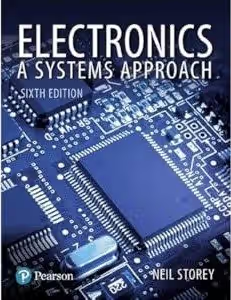
Storey, N. (2017). Electronics: A Systems Approach (6th ed.). Pearson Education.
Chapter Summary
The sixth edition runs to about 840 pages in thirty chapters, divided into two parts, with appendices. Part 1, "Electrical Circuits and Components" (Chapters 1–10), is a self-contained course in electrical circuits and components. Part 2, "Electronic Systems" (Chapters 11–30), opens with electronic systems and then works through the devices and circuits inside them, analogue and then digital. The publisher describes the approach as systems-first: students see what a system is meant to achieve before analysing its parts. Each chapter has objectives, a summary, worked examples and exercises, and a companion website offers more than 100 video tutorials and interactive quizzes.
Chapters 1–3: Basic Electrical Circuits and Components; Measurement of Voltages and Currents; Resistance and DC Circuits
The foundations: an opening chapter on basic circuits and components, a chapter on measuring voltage and current, and a chapter on resistance and the analysis of DC circuits.
Chapters 4–5: Capacitance and Electric Fields; Inductance and Magnetic Fields
The two energy-storing components, each introduced with the field that underlies it.
Chapters 6–9: Alternating Voltages and Currents; Power in AC Circuits; Electric Motors and Generators; Frequency Characteristics of AC Circuits
Alternating current, power in AC circuits, rotating machines and the frequency behaviour of circuits. The motors and generators chapter gives Part 1 the scope of an introductory electrical engineering course, which the publisher cites as one reason the book can stand alone for introductory courses in both electronics and electrical engineering.
Chapter 10: Transient Behaviour
Part 1 closes with the response of circuits to sudden changes.
Chapters 11–13: Electronic Systems; Sensors; Actuators
The systems view is set out here: inputs, outputs and the blocks between them. The sixth edition expands the sensors and actuators chapters, adding image sensors and the devices used in fibre-optic communication.
Chapters 14–16: Amplification; Control and Feedback; Operational Amplifiers
Amplifiers are first treated as system blocks, then used with feedback, and then in their most common integrated form, the operational amplifier.
Chapters 17–21: Semiconductors and Diodes; Field-effect Transistors; Bipolar Junction Transistors; Power Electronics; Internal Circuitry of Operational Amplifiers
Only now does the book open up the devices: semiconductor physics and diodes, the two transistor families, power electronics, and finally what is inside the op-amp used as a block in Chapter 16. This order is the systems approach in practice.
Chapters 22–23: Noise and EMC; Positive Feedback, Oscillators and Stability
Two chapters on practical limits: unwanted signals and electromagnetic compatibility, and the stability problems and oscillators that come with positive feedback.
Chapters 24–27: Digital Systems; Sequential Logic; Digital Devices; Implementing Digital Designs
The digital sequence moves from logic and combinational systems through sequential logic and the devices that implement them to the realisation of digital designs. The sixth edition also adds a section on single-board computers such as the Raspberry Pi and Arduino.
Chapters 28–30: Communications; Data Acquisition and Conversion; System Design
The last chapters return to whole systems: communications, conversion between analogue and digital signals, and system design. The sixth edition adds sections on microwave and fibre-optic communication.
Key Concepts
Part 1: Circuits and components
- DC circuit analysis: relating voltage, current and resistance in networks of components.
- Capacitance and inductance: components that store energy in electric and magnetic fields and give circuits time- and frequency-dependent behaviour.
- AC power: power in circuits driven by alternating voltages and currents.
- Transient behaviour: the response of a circuit as it moves from one steady state to another.
Part 2: Analogue systems
- Systems approach: describing electronics by the function of blocks with inputs and outputs before examining their circuits.
- Sensors and actuators: the devices that connect electronic systems to physical quantities.
- Feedback: feeding part of the output back to the input, negative for control and accuracy, positive for oscillators.
- Operational amplifier: a general-purpose integrated amplifier, used first as a block and later analysed internally.
Part 2: Devices and digital systems
- Semiconductor devices: diodes, field-effect transistors and bipolar junction transistors.
- Noise and EMC: unwanted signals and the electromagnetic compatibility of equipment.
- Combinational and sequential logic: digital circuits without and with memory.
- Data conversion: moving between analogue and digital representations in data acquisition.
Critical Analysis
Strengths
- Function before detail. The publisher's account of the method is that students understand what a system is designed to do before tackling the design or analysis of its components. The table of contents follows this through: amplifiers and op-amps (Chapters 14–16) come before the transistor chapters, and the op-amp's internal circuitry is held back to Chapter 21.
- Electrical and electronic in one volume. Part 1 covers DC and AC circuits, machines and transients. The publisher presents it as complete enough for the book to serve introductory courses in both electronics and electrical engineering, and analogue and digital electronics are treated together.
- Learning support. Chapter objectives, summaries, worked examples and end-of-chapter exercises appear throughout, and the sixth edition expanded the exercises. The video tutorials and quizzes online give students a second route through difficult topics.
- Up-to-date applications. The sixth edition's additions (single-board computers, microwave and fibre-optic communication, image sensors) connect the fundamentals to equipment students are likely to use.
Limitations
- Breadth at the cost of depth. Thirty chapters cover everything from basic DC circuits to communications and system design. Semiconductor devices get one chapter each, so students heading for a specialised electronics degree will need a device-level text later.
- Long for a single module. At about 840 pages the book is more than one course can use, and instructors will need to choose between the analogue, digital and systems chapters.
- Systems-first can feel backwards. Students who prefer to build from components up may find it unsettling to use amplifiers and op-amps several chapters before the transistors that make them work. This is the book's deliberate choice, but it suits some learners better than others.
Where It Fits in the Course
Storey is the structured first-course textbook in the circuits and electronics list. Scherz and Monk's Practical Electronics for Inventors is its practical counterpart: a hands-on guide to components, prototyping and building circuits, best used alongside Storey for bench work. Alexander and Sadiku's Fundamentals of Electric Circuits treats circuit analysis in far more depth than Part 1 and is the natural next step for electrical engineering students. Agarwal and Lang's Foundations of Analog and Digital Electronic Circuits is a unified treatment of circuits, digital abstraction, MOS devices and amplifiers written for electrical engineering majors, a good second book for students continuing in the field.
Later books take single threads of Storey further. Howe and Sodini's Microelectronics: An Integrated Approach develops the semiconductor devices of Chapters 17–19. Hayt and Buck's Engineering Electromagnetics builds the field theory behind Chapters 4–5. Patterson's Computer Organization and Design continues from the digital chapters into processor design.
How to Use This Book
The publisher addresses the book to engineers, scientists and technologists who need a fundamental understanding of electronics, and presents it as a stand-alone text for introductory courses in electronics and in electrical engineering. It starts from basic circuits, so no previous electronics is needed, but confident algebra makes the circuit chapters much easier.
- Electrical engineering emphasis: Part 1 in full (Chapters 1–10), then Chapters 11, 14–16 and 17–19 for a first look at electronics.
- Electronics emphasis: Chapters 1–6 and 9–10 for circuit essentials, then Part 2 in order through Chapter 21, followed by the digital chapters (24–27).
- Mechanical or mechatronics students: Chapters 1–6, 11–16 and 20, with Chapters 24 and 29 for digital interfacing and data conversion.
- Optional by interest: Chapters 22–23 (noise, EMC, oscillators), 28 (communications) and 30 (system design), which suit project work.
Use the worked examples actively: cover the solution and attempt it first. Check each chapter against its objectives and summary, use the online videos when a topic does not click, and try the quizzes before examinations.