01 / Reading Guide
Reading Guide
Citation
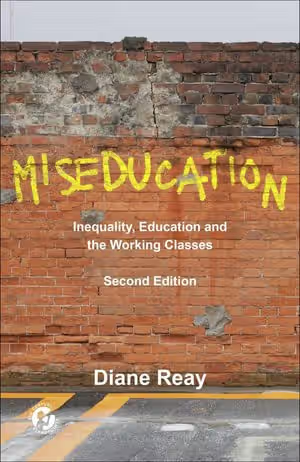
Reay, D. (2025). Miseducation: Inequality, Education and the Working Classes (2nd ed.). Policy Press.
Chapter Summary
The second edition, published in April 2025 in the 21st Century Standpoints series, runs to 304 pages. A review in FORUM (2025) counts eight chapters between an introduction and a conclusion. The publisher describes it as a substantially revised and updated version of the author's earlier bestselling book.
Author and approach
Diane Reay grew up in a working-class coal-mining community and worked for twenty years as an inner-city primary school teacher. She is now Emeritus Professor of Education at the University of Cambridge and visiting professor of sociology at the London School of Economics, and her research covers social class, gender and ethnicity across primary, secondary and post-compulsory education. The book draws on extensive interviews with working-class children and young people, and uses their accounts to show how schooling is experienced by those whom the system serves least well. It is a short, direct work of sociological argument for general readers as well as students.
Class and exclusion
The publisher's opening point is that education is supposed to level the playing field, yet for many working-class children it deepens the divide. It cites the finding that students from disadvantaged backgrounds are almost four times more likely to be excluded from school than wealthier peers, and describes many of them as struggling in an environment increasingly concerned with discipline.
Class identity, social mobility and entrenched inequality
The book offers a critique of how class identity, social mobility and long-standing inequalities shape educational outcomes. It asks why social classes are educated so differently, and examines how the idea of mobility through schooling bears on working-class pupils.
Control, discipline and policy
A further strand is the growing emphasis on control and discipline in schools in the United Kingdom. The book also charts the impact of policies such as academies on working-class students, linking classroom experience to the national policy that shapes it.
New material in the second edition
The edition adds a chapter drawing lessons from educational systems around the world, and a second new chapter that sets out recommendations for building a system that supports every child's potential. These additions extend the argument beyond a critique of the English system.
Key Concepts
The argument
- Class and schooling: the book holds that the education system, which is meant to reduce disadvantage, instead tends to deepen divisions between classes.
- Social mobility: movement upward through education is examined critically, as a promise whose benefits the book weighs against the experience of working-class young people.
- Exclusion and discipline: the unequal use of school exclusion, and the policy emphasis on behaviour, are treated as parts of the same pattern.
- Academies and policy: the book follows the effect of structural reforms such as academies on working-class children.
- Lessons from other systems: other national systems are used as a source of ideas for change.
Critical Analysis
Strengths
- A first-hand voice. The author writes as a sociologist who grew up working class and taught in schools, and builds her case from interviews with young people, which gives the argument direct evidence about how schooling is experienced.
- Short and accessible. The publisher presents the book as insightful reading for anyone interested in education and social equity, and its 304 pages and series position make it a manageable introduction to the sociology of class and education.
- Up to date. The 2025 edition is substantially revised and addresses recent developments such as discipline-focused schooling and academies, and it adds comparative material and recommendations.
- Moves from critique to proposals. The final chapters set out what a different system might do, which makes the book useful for policy discussion, not only for critique.
Limitations
- Focused on England and the UK. The analysis centres on the English system and its policy history, so readers elsewhere need to relate it to their own context. The new chapter on other countries offers some comparison, but it is one chapter.
- A committed argument. The book is a critique written from a clear standpoint. Readers should compare it with more neutral textbooks or with policy analyses that take other views.
- Not a theoretical treatise. It is written for general and student readers, so it is not the place to find the full theoretical apparatus of the sociology of education.
Where It Fits in the Course
Reay is a short, accessible entry in the policy and sociology of education list and a good place to start. Stephen Ball's The Education Debate is the natural companion: it explains the concepts of policy analysis and traces how successive English governments have reshaped schooling, giving the policy background to the developments Reay describes. Ballantine, Stuber and Everitt's The Sociology of Education: A Systematic Analysis is a survey textbook that provides the wider sociological framework and attention to race, class and gender.
Bourdieu and Passeron's Reproduction in Education, Society and Culture supplies the classic theory of how schooling reproduces class relations, which makes a demanding but rewarding follow-up. Rizvi and Lingard's Globalizing Education Policy places national policy in a global frame, and Diane Ravitch's The Death and Life of the Great American School System offers a critique of testing and school choice in the United States that can be read against Reay's English account.
How to Use This Book
No prior background is needed. The book suits first-year undergraduates, teachers and trainee teachers, school leaders, policymakers and general readers interested in educational inequality.
A practical plan:
- Read it first in a sociology or policy of education course, to get a concrete picture of class and schooling before turning to theory.
- Pair it with Ball for the policy history, and with Ballantine and colleagues for the wider sociological framework.
- Move on to Bourdieu and Passeron once the lived examples are familiar, to see the theory behind the patterns described.
- Use the recommendations and the international chapter as prompts for seminar debate: which proposals are practicable, and what would other systems' experience suggest?
- Check the edition. The 2025 second edition contains new chapters, so references and page numbers differ from the first edition.