01 / Reading Guide
Reading Guide
Citation
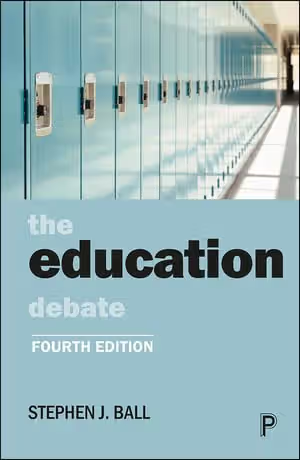
Ball, S. J. (2021). The Education Debate (4th ed.). Policy Press (Policy and Politics in the Twenty-First Century).
Chapter Summary
The fourth edition is a compact book of about 270 pages: a preface, an introduction and five chapters, followed by notes, two reference lists (one for books and articles, one for reports, speeches and papers) and an index. The front matter includes a list of abbreviations. The publisher describes the book as using England, and the UK more broadly, as a "social laboratory" for global education policy: it first sets out key concepts and then examines developments including global policy mobility, edu-business and philanthropy as policy actors, marketisation, the widening performance gap, poverty and austerity, new forms of governance and the impact of COVID-19 on schools and on policy.
Introduction: The Great Education Debate (1976–2021)
The introduction (pages 1–14) frames the book with a period running from 1976 to the year of publication; the third edition used the same frame, ending in 2016. The title signals that the book treats policy since 1976 as one continuing public debate rather than a series of separate reforms.
Chapter 1: Key Concepts: Education Policy, Globalisation and Education Reform
This chapter (pages 15–62) supplies the analytical vocabulary for the rest of the book: what is meant by education policy, how globalisation bears on national policy, and how education reform is understood. In the third edition this chapter's title linked education policy to "economic necessity"; the fourth edition puts globalisation in its place, in line with the publisher's emphasis on global policy mobility.
Chapter 2: Class, Comprehensives and Continuities: A Short History of English Education Policy
The longest chapter, a history of about fifty pages (63–114). Its title points to three threads: the place of social class in English schooling, the comprehensive school, and the continuities that persist beneath successive reforms. It gives the historical background against which the more recent policies in the following chapters are read.
Chapter 3: Policy Technologies and the UK Government's Approach to Public Service Reform
This chapter (115–160) treats education reform as one part of a wider government approach to reforming public services, analysed through the idea of "policy technologies": the means by which reforms are put into practice.
Chapter 4: Policy, Inequality and Advantage
This chapter (161–208) turns to who gains and who loses from education policy. Its title, which in the third edition spoke of "inequity", sets inequality and advantage at the centre.
Chapter 5: A Sociology of Education Policy: Past, Present and Future
A short concluding chapter (209–220) that steps back to consider how education policy can be studied sociologically and where it may be heading.
Key Concepts
Introduction and Chapters 1–2: Concepts and history
- Education policy: the object of study, whose meaning Chapter 1 sets out before the book applies it.
- Globalisation: the process through which international ideas and pressures shape national education reform.
- Policy mobility: the movement of policy ideas and models between countries, one of the publisher's named themes.
- Class and comprehensives: the historical axis of English education policy traced in Chapter 2.
Chapters 3–5: Reform, inequality and analysis
- Policy technologies: the mechanisms through which government reforms public services, including schools.
- Marketisation: the introduction of market forms into education, named by the publisher among the book's themes.
- Edu-business and philanthropy: private companies and charitable foundations acting as participants in policy.
- Inequality and advantage: the ways policy distributes benefits unequally between social groups.
- Sociology of education policy: the study of policy as a social and political process, the subject of Chapter 5.
Critical Analysis
Strengths
- Written by a leading policy sociologist. The author biography notes that Ball is a professor of sociology of education at the UCL Institute of Education, a Fellow of the British Academy, and co-founder and managing editor of the Journal of Education Policy; his research centres on policy analysis and on education and social class, which are the book's two axes.
- Concepts, history and current policy in one place. The structure moves from a conceptual chapter through a historical one to analyses of reform and inequality, so the reader is given tools before applying them.
- Revised for a new period. The fourth edition extends the frame to 2021, changes the conceptual chapter's emphasis from economic necessity to globalisation, and, according to the publisher, adds material on edu-business, philanthropy, austerity and COVID-19.
- Documented. Separate reference lists for scholarly works and for official reports, speeches and papers make it a guide to the primary policy documents as well as to the research literature.
Limitations
- Centred on England. Despite the global framing, the history in Chapter 2 is explicitly English, and readers in Scotland, Wales or Northern Ireland, let alone other countries, will need other sources for their own systems.
- Short and dense. With five chapters in about 220 pages of text, much policy is covered briefly, and the concluding chapter is only twelve pages.
- A critical perspective, not a neutral survey. The book's framing around class, inequality and marketisation reflects the author's sociological position; readers wanting the case for the reforms it analyses should read government and advocacy sources alongside it.
- Time-bound. Education policy in England changes quickly; developments after 2021 are not covered, as the move from a 2016 to a 2021 end date between editions shows.
Where It Fits in the Course
In this course on the policy and sociology of education, Ball's book is the English case study. Diane Reay's Miseducation is a short, accessible account of how English schooling treats working-class children, drawing on interviews and on policy history; it makes a good first read before Ball's Chapters 2 and 4, which cover class and inequality from the policy side. Bourdieu and Passeron's Reproduction in Education, Society and Culture supplies the classic theory of how schooling reproduces class relations, a demanding text best read after Ball has made the policy context concrete.
Rizvi and Lingard's Globalizing Education Policy is a scholarly framework for analysing how global forces shape national policy and develops at length the globalisation themes that Ball's Chapter 1 introduces. Diane Ravitch's The Death and Life of the Great American School System is a critique of test-based accountability and school choice in the United States, a useful comparison with the English reforms. Ballantine, Stuber and Everitt's The Sociology of Education is a broad survey textbook that places policy within the wider sociology of schooling.
How to Use This Book
The book suits undergraduates in education studies, sociology and social policy, trainee teachers who want to understand the policy environment of English schools, and anyone following debates about English education. No prior knowledge of policy studies is required, but a basic grasp of sociological ideas such as social class helps.
A practical reading plan:
- Start with the Introduction and Chapter 1, which give the framing period and the concepts used throughout. Keep the list of abbreviations to hand.
- Read Chapter 2 for the historical background; make a simple timeline of the main Acts and reforms it mentions as you go.
- Then Chapters 3 and 4, the analytical core: how government reforms public services, and how policy produces inequality and advantage. These pair well with Reay's Miseducation for Chapter 4.
- Finish with Chapter 5 and use it to frame an essay or seminar question about where policy is heading.
Use the second reference list to go to the original reports and speeches; reading one primary document alongside Ball's analysis of it is a good way to practise policy analysis. Because the book stops in 2021, check what has changed since and ask whether Ball's concepts still explain it.