01 / Reading Guide
Reading Guide
Citation
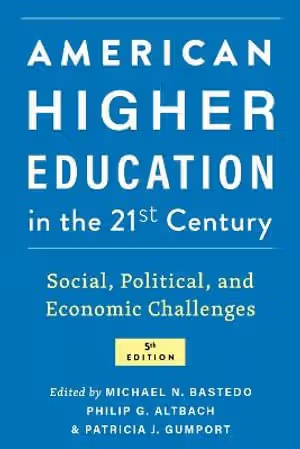
Bastedo, M. N., Altbach, P. G., & Gumport, P. J. (Eds.). (2023). American Higher Education in the Twenty-First Century: Social, Political, and Economic Challenges (5th ed.). Johns Hopkins University Press.
Chapter Summary
This is an edited volume of roughly 576 pages, first published in 1998 and now in its fifth edition. Michael N. Bastedo, Philip G. Altbach and Patricia J. Gumport edit it, and a long list of specialist contributors write the individual chapters, among them Peter Riley Bahr, Joy Blanchard, Charles H. F. Davis III, Hans de Wit, Roger L. Geiger, Adrianna Kezar, Laura W. Perna, Gary Rhoades and many others. The publisher calls it an indispensable reference for anyone concerned with the future of American colleges and universities, and offers it as a comprehensive introduction to the complex realities of American higher education, including its history, financing, governance and relationship with the states and federal government.
The publisher's description does not list chapters. The summary below is therefore organized by the topic areas the publisher names, and it does not attribute content to particular chapters or contributors.
Higher Education as a Lens on Society
The unifying idea is that higher education is a lens for examining significant issues within American society, whether advances in information technology, organized social movements, or racial inequality and social class stratification. Higher education is treated as an institution in society and not as a setting for classroom teaching. The publisher claims that no other book covers such wide-ranging issues under the broader theme of higher education's relationship to society.
History, Financing and Governance
The book offers an introduction to how American higher education came to be what it is and how it operates. The publisher names its history, its financing and its governance as core areas, together with the relationship of colleges and universities to the states and to the federal government. These are the foundations that the more specific topics rest on.
Equity, Diversity and the Responsiveness of the Academy
The edition reflects on the implications of ethnic and socioeconomic diversity within higher education and takes up growing concerns about the responsiveness and future of the academy. Racial inequality and social class stratification are named as issues for which higher education is a lens, and three entirely new chapters in this edition cover broad-access colleges, race and racism, and organized social movements.
Recent Developments in This Edition
Each chapter has been rewritten to address major recent issues in higher education, including the COVID-19 pandemic, the movement for racial justice, and turmoil in the for-profit sector. The publisher says the edition incorporates cutting-edge research and is more useful and engaging than its predecessors.
Key Concepts
Higher Education in Society
- Higher education as a lens on society: the book's frame for reading issues such as technology, social movements, inequality and social class.
- Relationship to states and federal government: the public-policy setting in which American institutions operate.
Institutions and Their Operation
- History, financing and governance: the three areas the publisher names as the book's core introduction.
- For-profit sector: a sector in turmoil that the edition's chapters address.
Equity and Change
- Broad-access colleges: the subject of one of the three new chapters.
- Race and racism: the subject of another new chapter.
- Organized social movements: the subject of the third new chapter.
Critical Analysis
Strengths
- The scope is wide: history, financing, governance and government relations together with equity and social change, within one coherent frame of higher education in society.
- The contributors are specialists, and each chapter is written by someone who works in the area, which gives authority that a single-author survey would lack.
- The book has run to five editions since 1998, and this edition rewrites every chapter to take account of recent events.
- The three new chapters add topics that earlier editions did not cover as separate chapters.
Limitations
- It deals with American higher education. Readers interested in other national systems will need comparative sources.
- As an edited volume with many contributors, it varies in voice, depth and method from chapter to chapter.
- It is an advanced book for readers who already have some grounding in higher education studies, social science or public policy; it is not a first introduction to university teaching.
Where It Fits in the Course
In the higher education group, nearly every other book is about teaching and learning, and this is the one about the institution. Marshall's Handbook for Teaching and Learning in Higher Education covers the policy context, teaching practice, assessment and student support. Biggs, Tang and Kennedy's Teaching for Quality Learning at University builds university teaching around constructive alignment. Lovett and colleagues' How Learning Works, Lang's Small Teaching and Bain's What the Best College Teachers Do are about how students learn and what good teachers do. Bastedo, Altbach and Gumport answer a different question: what American colleges and universities are, how they are funded and governed, and what pressures they face. It is the book to read for context before or after one of the teaching texts.
How to Use This Book
The book suits graduate students in higher education programmes, researchers and policy readers, and academic administrators who want a systematic introduction to higher education as a field of study. Some background in social science or public policy, and a course on higher education, are useful preparation.
A practical plan is to begin with the material on history, financing and governance, which supplies the vocabulary for the rest. Then choose chapters by interest or course topic: relations with state and federal government, equity and diversity, or the newer chapters on broad-access colleges, race and racism, and social movements. Because the volume is a collection, chapters can be read independently and in any order, and they work well as individual assigned readings. Pair it with a teaching text when a course needs both the institutional context and classroom practice, and confirm that you are using the fifth edition, since every chapter was rewritten for it.