01 / Reading Guide
Reading Guide
Citation
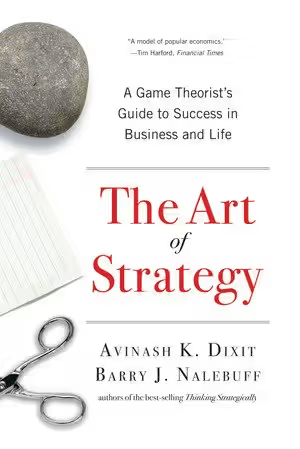
Dixit, A. K., & Nalebuff, B. J. (2010). The Art of Strategy: A Game Theorist's Guide to Success in Business and Life. W. W. Norton & Company.
Chapter Summary
The Art of Strategy (first published in 2008; the paperback appeared in January 2010 at 512 pages) began as a revision of the authors' earlier Thinking Strategically (1991). It has an introduction and fourteen chapters in three parts. Norton describes it as an account of strategic thinking built on case studies from popular culture, television, film, sport, politics and history. In his review for the Indore Management Journal (2010), Krishna Chandra Balodi notes that it assumes no prior knowledge of economics or mathematics, states each principle as a "rule" of strategy, includes questions for readers to work out with answers at the back, and incorporates findings from behavioural game theory.
Introduction: How Should People Behave in Society?
Presents everyone as a strategist facing a stream of interdependent decisions, defines game theory and outlines its range of applications.
Chapter 1: Tales of Strategy
Ten short stories of strategic situations (Balodi mentions "Pick a Number", "Hot Hand" and "Here I Stand") that show how strategic issues arise in very different settings and which strategies work well or badly.
Chapters 2–4: Games Solvable by Backward Reasoning; Prisoners' Dilemmas and How to Resolve Them; A Beautiful Equilibrium
The core concepts. Chapter 2 treats sequential games with game trees under the rule "look forward and reason backward". Chapter 3 is devoted to the prisoners' dilemma and dominant strategies, and ways of resolving dilemmas. Chapter 4 deals with simultaneous games without dominant strategies: eliminating dominated strategies and strategies that are never best responses, and finding Nash equilibria, including games with several equilibria. An epilogue to this part summarises the rule of looking for an equilibrium.
Chapter 5: Choice and Chance
Mixed strategies: why, in a game of pure conflict, it pays not to let the opponent predict one's choice and how to choose proportions that leave the opponent nothing to exploit.
Chapters 6–7: Strategic Moves; Making Strategies Credible
Strategic moves are actions that change the game itself: commitments, threats and promises. Chapter 7 classifies ways of making such moves credible under three principles: changing the payoffs, limiting one's ability to back out, and using others (teams or agents) to help.
Chapter 8: Interpreting and Manipulating Information
Games with asymmetric information: signalling, signal jamming and screening, and how what each player knows shapes the moves available.
Chapter 9: Cooperation and Coordination
Games that mix conflict and common interest, including coordination problems with multiple equilibria.
Chapters 10–13: Auctions, Bidding, and Contests; Bargaining; Voting; Incentives
Applications. Chapter 10 compares auction formats such as English, Japanese and Dutch auctions, with examples including the US Treasury's move to a uniform-price rule. Chapter 11 covers bargaining tactics, including the best alternative to a negotiated agreement (BATNA). Chapter 12 shows that every method of aggregating votes gives voters some incentive to vote strategically. Chapter 13 discusses incentive design for workers and managers and builds the elements of an effective incentive scheme through examples.
Chapter 14: Case Studies
A set of cases similar to those used in the authors' teaching; each sets out a situation and invites the reader to apply the book's principles before reading the analysis. Some cases are open-ended, with no single correct answer.
Key Concepts
Introduction and Chapters 1–5
- Look forward and reason backward: solving sequential games by anticipating where each choice leads.
- Dominant strategy: a strategy that is best whatever the other players do.
- Nash equilibrium: a set of strategies in which each player's choice is a best response to the others'.
- Mixed strategy: deliberately randomising in games of pure conflict.
Chapters 6–9
- Strategic move: a commitment, threat or promise that changes the game to the mover's advantage.
- Credibility: making a strategic move believable by changing payoffs, cutting off retreat or delegating.
- Signalling and screening: revealing or extracting private information through costly actions or designed choices.
Chapters 10–14
- Auction formats: how the rules of an auction, such as English, Dutch or uniform-price formats, shape bidders' strategies.
- BATNA: the best alternative to a negotiated agreement, a key influence on the outcome of bargaining.
- Strategic voting: voting for a less-preferred option to influence the outcome.
- Incentive scheme: rewards and penalties designed to align employees' interests with the organisation's.
Critical Analysis
Strengths
- Accessible and engaging. Norton quotes Steven Levitt's verdict that he could hardly think of another book that matches its combination of practical insight and reading enjoyment, and Balodi stresses that it presupposes neither economics nor mathematics.
- Principles stated as rules. Each core chapter distils its lesson into a rule of strategy (look forward and reason backward; use a dominant strategy; eliminate dominated strategies; look for an equilibrium), which makes the ideas easy to remember and apply.
- Active learning. Questions for readers, with answers at the back, and a final chapter of case studies encourage readers to work problems rather than only read about them.
- Broad applications. Auctions, bargaining, voting and incentives each get a full chapter, so the book covers much of the applied territory of an introductory game theory course.
Limitations
- No formal apparatus. The book uses minimal mathematics; readers who need precise definitions, proofs or mathematical exercises must turn to a textbook.
- Business orientation. The publisher pitches the book at success in business and life, and several examples, such as the US Treasury auctions, are American; readers looking for applications in biology or philosophy will find less here.
- Length. At about 500 pages it is long for a non-technical introduction; readers wanting a brief overview may prefer a shorter book.
Where It Fits in the Course
Within this course list, The Art of Strategy is the narrative introduction to strategic thinking. Ken Binmore's Game Theory: A Very Short Introduction is a much shorter, more conceptual overview that also covers evolutionary biology and philosophical puzzles; the two complement each other. Dixit, Skeath and McAdams's Games of Strategy, by the same lead author, is the corresponding undergraduate textbook with systematic exercises, and is the natural next step for students taking a full course.
Gibbons's Game Theory for Applied Economists and Osborne and Rubinstein's A Course in Game Theory are the formal treatments: Gibbons for economics students who want compact, more mathematical coverage of equilibrium, repeated games and incomplete information, and Osborne and Rubinstein for graduate study with precise definitions and proofs.
How to Use This Book
The book is aimed at general readers, managers and students of business, economics and politics; no mathematics beyond simple arithmetic and tables is needed.
- Core: the Introduction and Chapters 1–7, which build the toolkit (backward reasoning, dominance, Nash equilibrium, mixed strategies, strategic moves and credibility).
- Next: Chapters 8–9 on information and coordination.
- By interest: Chapters 10–13 can be read in any order; business students will gain most from auctions, bargaining and incentives, politics students from voting.
- Practice: attempt the questions before checking the answers at the back, and work through the Chapter 14 cases before reading the solutions.
As a companion to a game theory course, read the relevant chapter before each topic and then do the formal exercises in Games of Strategy or Gibbons.