01 / Reading Guide
Reading Guide
Citation
Dixit, A. K., Skeath, S., & McAdams, D. (2025). Games of Strategy (6th ed.). W. W. Norton.
Chapter Summary
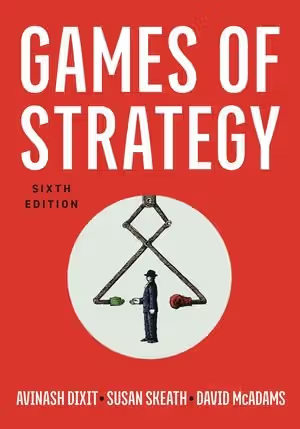
The sixth edition has seventeen chapters in four parts and runs to roughly 800 pages. W. W. Norton describes it as assuming no prior knowledge of game theory, only principles-level economics and high-school algebra, and as taking an empirical approach with examples from politics, economics, education, sport and everyday life. The authors are Avinash Dixit, Susan Skeath and David McAdams.
Chapters 1–2: Basic Ideas and Examples; How to Think about Strategic Games
Part One, "Introduction and General Principles", opens with basic ideas and examples of strategic situations and then sets out how to think about strategic games, preparing the vocabulary used in the rest of the book.
Chapters 3–7: Games with Sequential Moves; Simultaneous-Move Games: Discrete Strategies; Simultaneous-Move Games: Continuous Strategies, Discussion, and Evidence; Combining Sequential and Simultaneous Moves; Simultaneous-Move Games with Mixed Strategies
Part Two, "Concepts and Techniques", is the technical core. It treats games in which players move in turn, then games in which they move at the same time, first with a limited set of strategies and then with continuous strategies. The title of Chapter 5 indicates that it also discusses the evidence on how such games are actually played. Chapter 6 combines the two kinds of move, and Chapter 7 introduces mixed strategies; the publisher notes new material in that chapter on three interpretations of randomness.
Chapters 8–12: Strategic Moves; Uncertainty and Information; The Prisoner's Dilemma and Repeated Games; Collective-Action Games; Evolutionary Games
Part Three, "Some Broad Classes of Strategies and Games", moves from technique to broad categories: strategic moves by which a player tries to shape the game, games with uncertainty and information, the prisoner's dilemma and its repeated versions, collective-action problems, and evolutionary games.
Chapters 13–17: Brinkmanship: The Cuban Missile Crisis; Design of Incentives; Auctions, Bidding Strategy, and Auction Design; Strategy and Voting; Bargaining
Part Four, "Applications to Specific Strategic Situations", turns to particular settings: brinkmanship illustrated by the Cuban missile crisis, the design of incentives, auctions with attention to bidding strategy and auction design, voting, and bargaining. The publisher says the auction material is new in this edition and is written at a level suited to students of all majors.
Key Concepts
Part One: Introduction and General Principles (Chapters 1–2)
- Strategic game: a situation in which each participant's outcome depends on the choices of others as well as their own.
Part Two: Concepts and Techniques (Chapters 3–7)
- Sequential-move games: games in which players choose in turn, each knowing what came before.
- Simultaneous-move games: games in which players choose without knowing the others' choices, with discrete or continuous strategies.
- Mixed strategies: choosing among actions at random with specified probabilities.
Part Three: Broad Classes of Strategies and Games (Chapters 8–12)
- Strategic moves: actions taken to alter the other players' beliefs or choices.
- Uncertainty and information: how a game changes when players know different things.
- Prisoner's dilemma and repeated games: the problem of individually rational choices leading to a poor joint result, and how repetition changes it.
- Collective-action games and evolutionary games: strategic problems among many players and games analysed through the spread of strategies in a population.
Part Four: Applications (Chapters 13–17)
- Brinkmanship: the strategic use of a shared risk of disaster, studied through the Cuban missile crisis.
- Incentive design: arranging rewards and penalties to induce desired choices.
- Auctions and bidding strategy: the rules by which goods are sold competitively and how bidders should respond.
- Voting and bargaining: strategic behaviour under voting rules and in negotiation.
Critical Analysis
Strengths
- Low entry requirements. The publisher states that only a principles level of economics and high-school algebra are assumed, and that decision trees are used throughout to present complex games, so the book is open to students outside economics.
- Concepts first, applications last. Parts One to Three build the vocabulary and techniques in a fixed order, and Part Four then applies them to a series of settings, among them a full chapter on the Cuban missile crisis.
- Attention to evidence. The publisher describes the approach as empirical, and Chapter 5 includes evidence in its title, which suggests the theory is checked against observed behaviour at least in that chapter.
- Practice built in. Every chapter ends with exercises; according to the publisher about half of them are solved to support students, and the remaining solutions go to instructors in a Solutions Manual. Solved exercises make the book easier to use for self-study.
- Revised for the new edition. The publisher lists new examples (digital currency, trade relations, grade inflation, voting rules, interactions between the Fed and Congress), revised problems, and new auction-design material.
Limitations
- Minimal mathematics by design. Because the book assumes only high-school algebra, readers who want a formal, proof-based treatment of solution concepts and information will need a more advanced text afterwards.
- Long for a first course. At about 800 pages and seventeen chapters, a one-semester course must choose among the broad classes in Part Three and the applications in Part Four.
Where It Fits in the Course
Games of Strategy is the main undergraduate textbook among the game theory books listed. Dixit and Nalebuff's The Art of Strategy is a non-technical introduction for general readers, built on stories and cases with worked case studies; it is a good preliminary read, and since Dixit is an author of both, the ideas overlap. Ken Binmore's Game Theory: A Very Short Introduction is a short, lively overview with very little formal mathematics, useful for a first pass before the textbook.
Osborne and Rubinstein's A Course in Game Theory is a concise graduate introduction that states definitions precisely, proves the main results and pays unusual attention to the interpretation of solution concepts. Gibbons's Game Theory for Applied Economists is described as a compact introduction to strategic interaction, equilibrium, repeated games and incomplete information. Either is a natural next step after Dixit, Skeath and McAdams for readers who want a formal treatment.
How to Use This Book
The publisher presents the book as approachable to students of any major and level of preparation, so it suits economics, political science and business students as well as anyone who wants a structured introduction to strategic thinking. The only prerequisites are principles-level economics and high-school algebra.
A practical plan:
- Core: Chapters 1 to 4 and Chapter 7 (sequential moves, simultaneous moves with discrete strategies, mixed strategies), with Chapter 6 to combine the two kinds of move. These supply the standard toolkit.
- Next: Chapter 8 on strategic moves, Chapter 9 on uncertainty and information, and Chapter 10 on the prisoner's dilemma and repeated games.
- Choose by interest: Chapter 5 for continuous strategies and evidence; Chapters 11 and 12 for collective action and evolutionary games; and from Part Four, Chapter 15 on auctions, Chapter 16 on voting, Chapter 17 on bargaining, Chapter 14 on incentives, and Chapter 13 as an extended case study.
Draw the game tree or payoff table for every example before reading the analysis, and work the solved exercises first, checking answers against the book before attempting the unsolved ones. Trying the ideas on real situations, such as a pricing decision or a negotiation, is a good way to learn the subject.