01 / Reading Guide
Reading Guide
Citation
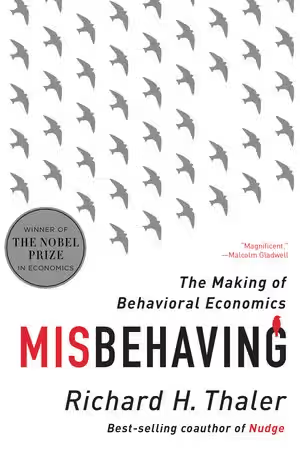
Thaler, R. H. (2016). Misbehaving: The Making of Behavioral Economics. W. W. Norton & Company. (First published 2015.)
Chapter Summary
The book has a preface, thirty-three short chapters in eight parts, an interlude and a conclusion, on about 370 pages of text, followed by a bibliography (pages 373–391) and an index. Each part carries a span of years, and the parts follow Thaler's career roughly in order, from graduate school in the 1970s to policy work after 2004. As Ronald Moy's review in the CFA Institute's Financial Analysts Journal puts it, the book blends the author's life as a research professor, stories of the economists he met, and a history of the field. Chapters are best read as episodes within each part.
Part I. Beginnings: 1970–78 (Chapters 1–6: Supposedly Irrelevant Factors; The Endowment Effect; The List; Value Theory; California Dreamin'; The Gauntlet)
The opening part follows Thaler from graduate study at the University of Rochester, when he became curious about how people actually behave, to the first statements of his ideas. Its first chapter introduces "supposedly irrelevant factors", things that should not matter to a rational decision-maker but do; the second is devoted to the endowment effect, valuing a thing more once one owns it.
Part II. Mental Accounting: 1979–85 (Chapters 7–10: Bargains and Rip-Offs; Sunk Costs; Buckets and Budgets; At the Poker Table)
This part covers mental accounting, the ways people treat money as non-fungible by placing it in separate categories. Adam Oliver's review highlights its discussion of transaction utility, the pleasure of a good deal and the pain of being ripped off, which goes beyond the standard assumption that only the value of the purchase itself matters. Sunk costs and budgeting into "buckets" have chapters of their own.
Part III. Self-Control: 1975–88 (Chapters 11–12: Willpower? No Problem; The Planner and the Doer), followed by Interlude (Chapter 13: Misbehaving in the Real World)
The self-control chapters deal with the heavy weight people place on the present (present bias) and with Thaler's model of a far-sighted planner and a short-sighted doer within one person. An interlude chapter, "Misbehaving in the Real World", closes this stretch of the book.
Part IV. Working with Danny: 1984–85 (Chapters 14–16: What Seems Fair?; Fairness Games; Mugs)
This part covers Thaler's collaboration with Daniel Kahneman. Its chapter titles indicate the topics: perceptions of fairness and the games used to study it, followed by a chapter titled "Mugs".
Part V. Engaging with the Economics Profession: 1986–94 (Chapters 17–20: The Debate Begins; Anomalies; Forming a Team; Narrow Framing on the Upper East Side)
Here the book turns to the arguments with mainstream economists. Moy's review summarises two objections the early behavioural economists faced: Milton Friedman's "as if" argument that people behave as if they could make the optimal calculations, and the claim that mistakes with small stakes do not matter.
Part VI. Finance: 1983–2003 (Chapters 21–26: The Beauty Contest; Does the Stock Market Overreact?; The Reaction to Overreaction; The Price Is Not Right; The Battle of Closed-End Funds; Fruit Flies, Icebergs, and Negative Stock Prices)
This six-chapter part takes the argument to financial markets, where professionals were expected to exploit and eliminate mispricing. According to Moy, Thaler worked with colleagues including Andrei Shleifer, Hersh Shefrin and Shlomo Benartzi and concluded that market professionals make the same kinds of behavioural mistakes as laypeople.
Part VII. Welcome to Chicago: 1995–Present (Chapters 27–30: Law Schooling; The Offices; Football; Game Shows)
Set at the University of Chicago, this part applies behavioural analysis to varied settings. Moy describes the study with Cade Massey showing that National Football League teams overvalue early draft picks, research on contestants in the game show Deal or No Deal whose choices conflict with expected utility theory, and the story of Chicago business professors choosing offices in a new building on the wrong criteria.
Part VIII. Helping Out: 2004–Present (Chapters 31–33: Save More Tomorrow; Going Public; Nudging in the U.K.), and Conclusion: What Is Next?
The final part turns to policy. Moy describes the retirement-saving examples: switching enrolment from opt-in to opt-out, and a default that raises contributions as salaries rise. The part draws on Nudge, Thaler's book with Cass Sunstein, and ends with the British government's use of nudges. The conclusion looks ahead to the field's future.
Key Concepts
Parts I–III: Early anomalies
- Supposedly irrelevant factors: features of a situation that should not affect a rational choice but do.
- Endowment effect: valuing something more highly once it is owned.
- Mental accounting and transaction utility: treating money in separate accounts rather than as interchangeable, and gaining or losing satisfaction from the deal itself.
- Planner and doer: a model of self-control as a conflict between a long-term planner and a present-focused doer.
Parts IV–V: Fairness and the profession
- Fairness: people's judgements of what is fair, which constrain behaviour in ways standard theory ignores.
- Anomalies: empirical regularities that standard theory cannot explain.
- The "as if" defence: Friedman's argument that models can assume optimisation even if people cannot calculate, which the book disputes.
Parts VI–VIII: Markets and policy
- Overreaction and mispricing: evidence that stock prices can depart from fundamental values.
- Nudge: designing choices, such as default options, so that people are more likely to act in their own interest.
- Save More Tomorrow: a retirement-saving scheme in which contributions rise automatically with future pay.
Critical Analysis
Strengths
- The field told by a participant. The book covers ideas Thaler helped establish (the endowment effect, mental accounting, self-control, behavioural finance) from the inside. Oliver's review in the LSE Review of Books (July 2015) finds the material substantive, and judges that the book neither trivialises nor misrepresents the field, a common failing of popular science.
- Readable and memorable. Moy calls it an entertaining journey and praises its weaving of research with stories of how people actually behave. The varied cases in Part VII and the policy stories in Part VIII make concepts easy to remember.
- Takes the objections seriously. Part V and the finance chapters are organised around mainstream objections (the "as if" argument, small stakes, arbitrage in markets) and the evidence assembled against them, which shows how the field won acceptance.
Limitations
- A personal history, not a survey. Oliver describes the book as a personal intellectual history supplemented by anecdotes, centred on American and American-based Israeli research. He notes that it does not mention Maurice Allais and passes over the work of Robert Sugden and Graham Loomes and of continental Europeans such as Ernst Fehr. Students should not take it as a complete account of who built the field.
- Little on why the anomalies arise or on the ethics of nudging. Oliver argues that the book gives little weight to explanations of the phenomena, retains expected utility as the normative ideal, and answers charges of manipulation too briefly.
- No formal treatment. As a book for general readers it explains ideas through stories, without models or exercises.
- Stops in 2015. The story ends before Thaler's 2017 Nobel Prize and later debates about the field.
Where It Fits in the Course
Misbehaving and Michelle Baddeley's Behavioural Economics: A Very Short Introduction are the two general-reader books in this course and complement each other: Baddeley organises the field by topic and covers areas Thaler touches less (social influence, personality and emotion, behavioural macroeconomics), while Thaler shows how the core ideas were discovered and defended. Reading Baddeley for the map and Thaler for the history works well, in either order.
The undergraduate textbooks in the list, Edward Cartwright's Behavioral Economics and Wilkinson and Klaes's An Introduction to Behavioral Economics, set out the models behind the ideas Thaler describes, such as mental accounting, present bias and prospect theory. Many of the papers he recounts belong to the literature collected in Advances in Behavioral Economics, edited by Camerer, Loewenstein and Rabin, and are treated formally in Sanjit Dhami's graduate-level The Foundations of Behavioral Economic Analysis. Oliver's review suggests reading the book alongside Daniel Kahneman's Thinking, Fast and Slow for the psychological side.
How to Use This Book
The book is written for general readers and needs no economics. It suits students before or at the start of a behavioural economics course, finance students curious about behavioural finance, and anyone interested in policy uses of nudges.
Suggested approaches:
- Whole book as background reading: read it straight through in the first weeks of a course. The chapters are short, and the chronological order shows how one finding led to the next.
- Topic-led reading: Parts II–III for mental accounting and self-control, Part VI for behavioural finance, Part VIII for nudges and policy. Read each alongside the corresponding textbook chapter.
- Critical reading: keep Oliver's points in mind. When a chapter credits a finding, check the textbook or survey literature for other contributors, and use the nudge chapters as a starting point for discussing the ethics of choice design.
Keep a list of the anomalies and experiments described in each part, and look up the original papers, many of them by Thaler and his co-authors, when a topic comes up in a course.