01 / Reading Guide
Reading Guide
Citation
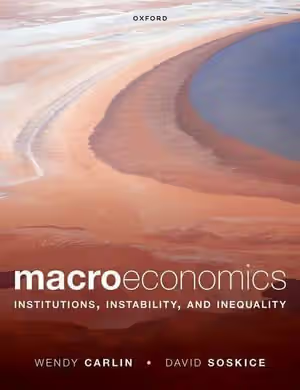
Carlin, W., & Soskice, D. (2024). Macroeconomics: Institutions, Instability, and Inequality (2nd ed.). Oxford University Press.
Chapter Summary
The second edition is a large book: an introduction, 18 chapters in six parts, a bibliography and an index. Google Books gives 982 pages and the publisher's listing 1,024. The parts are of very uneven length. Parts 2, 3 and 5 are about 120-160 pages each, Part 4 on the open economy about 215, Part 1 about 190, and Part 6 a single chapter of about 70 pages. Oxford University Press describes the organising device as a 3-equation model of the demand side, the supply side and the policy maker, which the book extends to the financial system, the open economy and inequality. The first edition was subtitled Institutions, Instability, and the Financial System; the new subtitle puts inequality in that place, and the publisher says inequality is integrated throughout the modelling and applications, while the financial system keeps a part of its own.
Introduction
A short opening section of about ten pages precedes Part 1.
Part 1, Chapters 1-4: The Demand Side; The Supply Side; The 3-Equation Model and Macroeconomic Policy; Expectations and Monetary Policy
The first part builds the core framework in four chapters. The demand side and the supply side come first, followed by their combination in the 3-equation model with the policy maker. The fourth chapter adds expectations to monetary policy.
Part 2, Chapters 5-7: Money, Banking, and the Macro-economy; Monetary Policy; Fiscal Policy
Three chapters on money, banking and the two policy instruments. The monetary policy coverage is described as comprehensive and includes the ample reserves regime; the fiscal chapter treats fiscal policy and debt dynamics.
Part 3, Chapters 8-10: Sources of Financial Sector Instability; Financial Sector Risk and the Global Financial Crisis: Applying the Models; Financial Stability Policy
The financial-instability part takes the models into banking and the 2008-9 crisis. Its chapters move from the sources of instability to an application of the models to the global financial crisis and then to financial stability policy. The publisher highlights the integration of the financial and business cycles and an exploration of hysteresis in the context of the Great Recession.
Part 4, Chapters 11-14: The 3-Equation Model in the Open Economy; The Open Economy: The Demand and Supply Sides; Open Economy Extensions I: Oil Shocks, Imbalances, and Interdependence; Open Economy Extensions II: Fixed Exchange Rates and the Eurozone
Four chapters that extend the core model to open economies under flexible and fixed exchange rates, using the same foundations. The extensions cover oil shocks, external imbalances, interdependence, fixed exchange rates and the Eurozone; the publisher adds climate shocks and the Eurozone crisis to the list of applications.
Part 5, Chapters 15-17: Supply-Side Institutions, Policies, and Performance; Growth and Innovation; The ICT Revolution, Productivity Puzzle, and Political Economy of Uneven Growth
Part 5 turns to the long run: supply-side institutions, growth and innovation, and the effects of information and communication technology on productivity and the future of work and inequality. The publisher describes a unified treatment of exogenous and endogenous growth models, organised around the mechanisms that offset diminishing returns to capital.
Part 6, Chapter 18: Heterogeneous Agent Macroeconomics: Origins, Progress, and Challenges
The final chapter introduces contemporary quantitative macroeconomics, including the Heterogeneous Agent New Keynesian (HANK) model, with attention to both the benefits and the limitations of these methods.
Key Concepts
Parts 1-3: Core model, policy and finance
- 3-equation model: the demand side, the supply side and the policy maker combined to analyse business cycles and stabilisation.
- Incomplete contracts: according to the publisher, features of labor and credit markets that underpin involuntary unemployment and credit constraints.
- Ample reserves regime: a monetary policy framework covered in the monetary policy chapter.
- Financial and business cycles: their integration, with financial stability policy after 2008-9.
Parts 4-6: Open economy, growth and inequality
- Open-economy 3-equation model: the core model under flexible and fixed exchange rates, with the Eurozone as an application.
- Exogenous and endogenous growth: treated together through the mechanisms that offset diminishing returns to capital.
- ICT revolution and the productivity puzzle: technology change and its implications for work and inequality.
- HANK models: heterogeneous-agent macroeconomics, in the last chapter.
Critical Analysis
Strengths
- One model carried through the book. The same 3-equation framework recurs for the closed economy, finance, the open economy and the Eurozone, so students reuse a method rather than learn separate models.
- Inequality and finance inside the core. Reviewers quoted by the publisher stress this. Leila Davis (University of Massachusetts Boston) notes that inequality is woven into the core model and finance into the same framework, rather than treated as extensions. Benjamin Moll calls it the first textbook to integrate the lessons of heterogeneous-agent macroeconomics and HANK models.
- Frontier research at undergraduate level. Olivier Blanchard says the book brings frontier research to the undergraduate level, and Maurice Obstfeld calls it accessible for upper-level undergraduates; Hélène Rey praises its data and historical examples. All three comments are quoted by the publisher.
- Practice and digital tools. Each chapter ends with Checklist questions and Problems; web appendices develop Chapters 1, 4, 7 and 18, and the e-book offers the Macroeconomic Simulator and animated analytical diagrams.
Limitations
- Very long. The text runs from page 11 to page 924, so its 18 chapters average about 50 pages each; the book cannot be covered in one term, and a course must choose parts.
- Demanding final chapter. The HANK material in Part 6 is described as exposing students to the tools researchers currently use; it sits at the edge of undergraduate macroeconomics and is best treated as optional.
- Extra material online. Some supporting material, including the web appendices and simulator, sits outside the printed text.
Where It Fits in the Course
Among the intermediate macroeconomics books on the list, this is the one organised around a single policy-oriented model and extended to finance and inequality. Mankiw's Macroeconomics is a foundational text on national income, growth, unemployment, inflation, monetary policy and economic fluctuations. Krugman and Wells's Macroeconomics and CORE's The Economy 2.0: Macroeconomics are introductory texts, one story-driven and the other starting from data and historical episodes; either can be read before Carlin and Soskice. Wendy Carlin directs the CORE Econ project, and a reviewer quoted by the publisher notes that the book links to CORE Econ, so it follows naturally after the CORE introduction.
Romer's Advanced Macroeconomics and Ljungqvist and Sargent's Recursive Macroeconomic Theory are the graduate-level continuations. They present formal and dynamic models that go well beyond the 3-equation approach, and Carlin and Soskice's final chapter on heterogeneous agents is the natural bridge to them.
How to Use This Book
The book is for undergraduates who have taken introductory macroeconomics and are comfortable with algebra and diagrams; the frontier topics are placed at the end.
A practical plan for a one-term course: Part 1 in full, because the 3-equation model is used everywhere else; then Chapters 5-7 on money and policy and Part 3 for the post-2008 financial material. Part 4 adds the open economy, and Chapters 15-16 supply the long-run growth side. Chapters 17 and 18 are optional extensions for a first course. Use the Checklist questions after each section to test understanding, the Problems for application, and the Macroeconomic Simulator if the course provides access. For a financial-crisis course, pair Parts 2 and 3 with the open-economy extension on the Eurozone.