01 / Reading Guide
Reading Guide
Citation
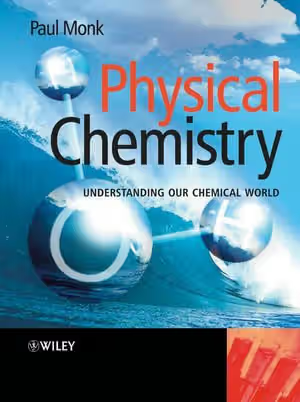
Monk, P. M. S. (2004). Physical Chemistry: Understanding our Chemical World. Wiley.
Chapter Summary
The book runs to about 620 pages in ten chapters, each divided into numbered sections. The publisher describes its approach as examples first: an everyday situation or application is presented, and the chemical and mathematical theory needed to explain it follows. Front matter includes an "Etymological Introduction", a list of symbols and a table of standard prefixes; the book closes with answers to its self-assessment questions (SAQs) and a bibliography. Chapters 7 and 8, on electrochemistry and kinetics, are the longest, at roughly 70 pages each.
Chapter 1: Introduction to physical chemistry
The opening chapter asks what physical chemistry is, framed through variables, relationships and laws, then turns to the practice of thermodynamic measurement. The properties of gases and the gas laws are treated here rather than in a chapter of their own, and the chapter ends with further thoughts on energy.
Chapter 2: Introducing interactions and bonds
This chapter moves from physical and molecular interactions to ways of quantifying them and their influence, and finally to the creation of formal chemical bonds. It is the book's main treatment of bonding; there is no separate chapter on atomic structure or quantum mechanics.
Chapter 3: Energy and the first law of thermodynamics
Thermodynamics proper begins with internal energy, then enthalpy, then the indirect measurement of enthalpy for changes that cannot be measured directly.
Chapter 4: Reaction spontaneity and the direction of thermodynamic change
Entropy is introduced as the guide to the direction of physicochemical change, followed by its dependence on temperature, the Gibbs function, the effect of pressure on thermodynamic variables, the link between thermodynamics and the extent of reaction, and the effect of temperature.
Chapter 5: Phase equilibria
After an energetic introduction, the chapter treats a single-component system first qualitatively and then quantitatively as pressure and temperature change. It then moves to two-component systems through partition, colligative properties and equilibria involving vapour pressure.
Chapter 6: Acids and bases
Lowry–Brønsted acids and bases, the distinction between "strong" and "weak", titration analyses, pH buffers and acid–base indicators. This material overlaps with what many departments teach in analytical chemistry.
Chapter 7: Electrochemistry
Starting from the terminology and background of cells, the chapter introduces half cells and electrode potentials, activity, the Nernst equation, concentration cells and transport phenomena, and closes with batteries.
Chapter 8: Chemical kinetics
Definitions come first, then a qualitative discussion of how concentrations change, integrated rate equations, the kinetic treatment of complicated reactions, and finally the thermodynamic side of kinetics: activation energy, absolute reaction rates and catalysis.
Chapter 9: Physical chemistry involving light: spectroscopy and photochemistry
Spectroscopy and photochemistry share a single chapter. It covers photon absorption and the effect of wavelength, photochemical and spectroscopic selection rules, photophysical emission and loss processes, and other optical effects.
Chapter 10: Adsorption and surfaces, colloids and micelles
The final chapter defines adsorption, then treats colloids and interfacial science, colloid stability and association colloids (micelles).
Key Concepts
Chapters 1–2: Foundations
- Gas laws: the relationships among pressure, volume, temperature and amount that describe gases, introduced in the first chapter.
- Molecular interactions: the forces between molecules, which the book quantifies before turning to formal chemical bonds.
Chapters 3–5: Thermodynamics and phase equilibria
- Internal energy and enthalpy: the energy content of a system and the heat exchanged at constant pressure, the quantities of the first law.
- Entropy and the Gibbs function: the measures that decide the direction of spontaneous change.
- Partition: the distribution of a solute between two immiscible phases, the book's entry point to two-component equilibria.
- Colligative properties: properties of solutions that depend on the amount of solute rather than its identity.
Chapters 6–7: Acids, bases and electrochemistry
- Buffers and indicators: solutions that resist pH change, and substances whose colour reports it.
- Electrode potential and the Nernst equation: how the potential of a half cell depends on the activities of the species involved.
- Activity: the effective concentration that replaces simple concentration in non-ideal solutions.
Chapters 8–10: Kinetics, light and surfaces
- Integrated rate equations: expressions giving concentration as a function of time for a given reaction order.
- Activation energy and catalysis: the energy barrier to reaction and how a catalyst changes the rate.
- Selection rules: the rules that decide which spectroscopic and photochemical transitions are allowed.
- Micelles: aggregates formed by surfactant molecules in solution, the association colloids of the last chapter.
Critical Analysis
Strengths
- Applications before theory. The publisher's stated approach is to present real-life examples and applications first and the theory afterwards, in short, self-contained chapters. For a student who finds abstract derivations off-putting, this order gives a reason to care about each topic before the equations arrive.
- Readable, according to reviewers. Excerpts quoted by the publisher describe the book as interesting, easy to read and comprehensible (Journal of Chemical Education, May 2006), credit the author with handling the "thorny issues" of the subject without unnecessary mystery (Clinical Chemistry, June 2005), and call the approach original and refreshing (Chemistry and Industry, September 2004).
- Built-in self-testing. The self-assessment questions, with answers at the back, let a reader check understanding section by section without a separate solutions manual.
- Practical chemistry in the core. Titrations, buffers, indicators, batteries, colloids and micelles all have their own sections, so the book connects physical chemistry to the laboratory and to everyday materials more than a theory-first text does.
Limitations
- No quantum chemistry or statistical thermodynamics. The contents have no chapter on quantum mechanics, atomic structure or statistical mechanics; bonding is handled within Chapter 2 and spectroscopy in a single chapter shared with photochemistry. Courses that include these topics need another text.
- One edition, from 2004. The book has not been revised, so applications such as the section on batteries reflect the technology and data of the early 2000s.
- Breadth over depth. Ten chapters cover the whole first-course syllabus from gases to colloids, which means each topic receives an introductory treatment; students going on in physical chemistry will need a fuller text for derivations and harder problems.
Where It Fits in the Course
Monk is the gentlest full textbook in this course list. Peter Atkins's Physical Chemistry: A Very Short Introduction is a brief, almost equation-free tour of the subject's central ideas; reading it first gives a map of the territory, and Monk then supplies the working equations and practice through the SAQs. Raymond Chang's Physical Chemistry for the Chemical and Biological Sciences is an accessible treatment written for students across chemistry and biology that also covers quantum concepts and molecular structure, so it is a natural next step for the topics Monk leaves out.
Atkins, de Paula and Keeler's Physical Chemistry is the comprehensive, mathematically demanding main text for a full physical chemistry sequence, including quantum mechanics and statistical mechanics; Monk works well as a preparatory or companion reader for its thermodynamics, equilibrium, electrochemistry and kinetics chapters. McQuarrie and Simon's Molecular Thermodynamics approaches thermodynamics from the molecular side through statistical mechanics and belongs much later, after the classical thermodynamics of Monk's Chapters 3–5 is secure.
How to Use This Book
The publisher aims the book at undergraduates taking a first course in physical chemistry and describes it as starting from first principles. It suits first-year chemistry students, students from neighbouring subjects (biology, environmental science, materials, pharmacy) who need a single physical chemistry course, and anyone returning to the subject who wants explanations tied to familiar situations. Since the publisher describes it as starting from first principles, school chemistry and mathematics should be enough to begin.
A practical plan:
- Core sequence: Chapters 1, 3, 4 and 5 in order. They build the thermodynamics (energy, enthalpy, entropy, the Gibbs function) on which the rest depends; Chapter 4's sections on pressure, temperature and extent of reaction are the bridge to equilibrium.
- Next: Chapter 8 on kinetics; its final section ties rates back to thermodynamics through activation energy and absolute reaction rates, so read it after Chapter 4.
- By course emphasis: Chapters 6 and 7 for courses that include solution equilibria and electrochemistry; Chapter 9 for an introduction to spectroscopy and photochemistry; Chapter 10 for students in materials, formulation or pharmaceutical science.
- Chapter 2 can be read early as a bridge from general chemistry or skipped by students with a recent course on bonding.
Work the SAQs as they appear rather than at the end of a chapter, and check them against the answers at the back. Because the book stops short of quantum chemistry and statistical mechanics, pair it with Chang or Atkins, de Paula and Keeler when a course moves on to those topics, and use those books' end-of-chapter problems for harder practice.