01 / Reading Guide
Reading Guide
Physical chemistry: equilibrium depends on the imposed constraint
Compare thermodynamics texts and derive ideal-gas conversion at fixed pressure and volume, with dimensionless activities and explicit minimum criteria.
Study route and exercise: University Reading List editorial project.
Citation
Atkins, P., de Paula, J., & Keeler, J. (2022). Physical Chemistry (12th ed.). Oxford University Press.
Chapter Summary
The twelfth edition (published by Oxford University Press with the title Atkins' Physical Chemistry) is a single large volume of about 930 pages. It is organised not into chapters but into nineteen "Focus" sections, each divided into lettered "Topics" (for example, Topic 1A, Topic 1B). Each Focus carries its own integrated activities, and each Topic has discussion questions, exercises and problems. A resource section and an index follow. The order runs from the macroscopic (gases and thermodynamics), through quantum theory and molecular structure and spectroscopy, to statistical thermodynamics, molecular interactions, solids and finally dynamics: transport, kinetics, reaction dynamics and surfaces. The book is also issued in two volumes.
Focuses 1–3: The Properties of Gases; The First Law; The Second and Third Laws
Focus 1 covers the perfect gas, the kinetic model and real gases. Focus 2 develops the first law through internal energy, enthalpy, thermochemistry, state functions and exact differentials, and adiabatic changes. Focus 3 treats entropy, entropy changes in specific processes, the measurement of entropy, concentrating on the system, and combining the first and second laws.
Focuses 4–6: Physical Transformations of Pure Substances; Simple Mixtures; Chemical Equilibrium
Focus 4 deals with phase diagrams of pure substances and the thermodynamics of phase transitions. Focus 5 moves to mixtures: their thermodynamic description, the properties of solutions, binary phase diagrams (liquids and solids), ternary systems and activities. Focus 6 covers the equilibrium constant, the response of equilibria to conditions, electrochemical cells and electrode potentials.
Focuses 7–9: Quantum Theory; Atomic Structure and Spectra; Molecular Structure
Focus 7 introduces the origins of quantum mechanics, wavefunctions, operators and observables, and translational, vibrational and rotational motion. Focus 8 covers hydrogenic atoms, many-electron atoms and atomic spectra. Focus 9 builds molecular structure through valence-bond theory and molecular orbital theory for the hydrogen molecule-ion, homonuclear and heteronuclear diatomic molecules, and polyatomic molecules.
Focuses 10–12: Molecular Symmetry; Molecular Spectroscopy; Magnetic Resonance
Focus 10 covers shape and symmetry, group theory and applications of symmetry. Focus 11 presents the general features of molecular spectroscopy, then rotational, vibrational (diatomic and polyatomic) and electronic spectra, the symmetry analysis of vibrational spectra and the decay of excited states. Focus 12 covers the principles of magnetic resonance, the features of NMR spectra, pulse techniques and electron paramagnetic resonance.
Focuses 13–15: Statistical Thermodynamics; Molecular Interactions; Solids
Focus 13 introduces the Boltzmann distribution, molecular partition functions, molecular energies, the canonical ensemble, the internal energy and entropy, and derived functions. Focus 14 covers the electric properties of molecules, interactions between molecules, liquids, macromolecules and self-assembly. Focus 15 treats crystal structure, diffraction techniques, bonding in solids, and their mechanical, electrical, magnetic and optical properties.
Focuses 16–19: Molecules in Motion; Chemical Kinetics; Reaction Dynamics; Processes at Solid Surfaces
Focus 16 covers transport properties of a perfect gas, motion in liquids and diffusion. Focus 17 covers rates of reaction, integrated rate laws, reactions approaching equilibrium, the Arrhenius equation, reaction mechanisms and examples of them, and photochemistry. Focus 18 treats collision theory, diffusion-controlled reactions, transition-state theory, the dynamics of molecular collisions and electron transfer in homogeneous systems. Focus 19 closes the book with solid surfaces, adsorption and desorption, heterogeneous catalysis and processes at electrodes.
Key Concepts
Focuses 1–6: Thermodynamics
- The laws of thermodynamics: internal energy and enthalpy, entropy, and their combination.
- Phase diagrams and mixtures: the equilibrium behaviour of pure substances and solutions.
- Chemical equilibrium and electrochemical cells: equilibrium constants and electrode potentials.
Focuses 7–12: Quantum Theory, Structure and Spectroscopy
- Wavefunctions, operators and observables: the formal language of quantum mechanics.
- Valence-bond and molecular orbital theory: the two models of bonding developed in Focus 9.
- Group theory and symmetry: used to analyse molecular properties and vibrational spectra.
- Magnetic resonance: NMR, pulse techniques and EPR.
Focuses 13–19: Statistics, Interactions, Solids and Dynamics
- Boltzmann distribution and partition functions: linking molecular energies to thermodynamics.
- Intermolecular interactions and self-assembly: forces between molecules and the structures they form.
- Rate laws, mechanisms and the Arrhenius equation: the language of kinetics.
- Transition-state theory and surface processes: how reactions proceed and how surfaces and catalysts affect them.
Critical Analysis
Strengths
- Full coverage in one book. The nineteen Focus sections span thermodynamics, quantum theory, spectroscopy, statistical thermodynamics, kinetics, solids and surfaces. One text can therefore serve a two- or three-semester physical chemistry sequence.
- Modular layout. The Focus and Topic structure divides the material into short lettered units, each with its own questions and problems, so instructors can assign Topics selectively. The publisher also describes new learning features and a refreshed writing style in this edition.
- Topics beyond the basics. Dedicated Topics on macromolecules and self-assembly (Focus 14), pulse techniques in NMR (Focus 12), photochemistry (Focus 17) and processes at electrodes (Focus 19) extend the core syllabus.
- Problem sets of several kinds. Discussion questions, exercises, problems and integrated activities appear throughout the structure.
Limitations
- Length. At about 930 pages, the book far exceeds what one course can cover. Instructors and students must choose Focuses, and the order in the book (thermodynamics first, quantum theory later, kinetics last) will not match every syllabus.
- Mathematical load. Group theory, operators and statistical ensembles appear in the contents, so students need calculus and some linear algebra beyond general chemistry.
- Not always self-sufficient for a single course. The CHEM 360 quantum chemistry course described below designates this book as its text, yet marks perturbation theory, polyatomic VOMELDs, nucleophiles/electrophiles and resonance, and rovibronic energy levels as not in the text, giving them instructor-created labels instead. Students in that course need supplementary material for those topics.
Where It Fits in the Course
Within the physical chemistry course, this is the comprehensive undergraduate reference. Several books can come before it or be read beside it:
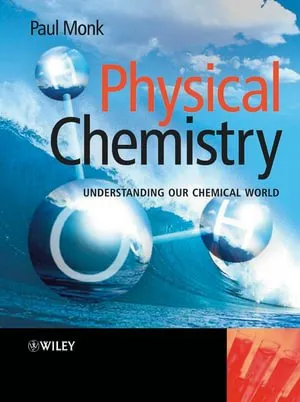
- Monk's Physical Chemistry: Understanding our Chemical World is written for first-year students and introduces each principle through an everyday situation.
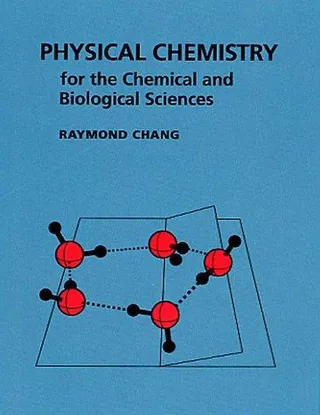
- Chang's Physical Chemistry for the Chemical and Biological Sciences is an accessible treatment for students working across chemistry and biology.
- Atkins's own Physical Chemistry: A Very Short Introduction is a brief, almost equation-free tour of the central ideas.
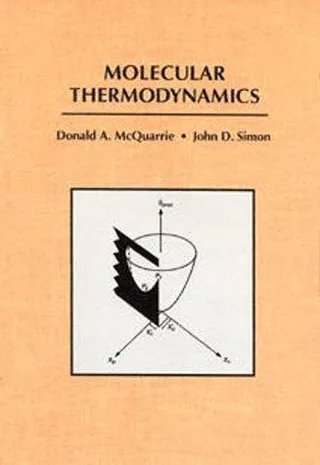
McQuarrie and Simon's Molecular Thermodynamics covers only the thermodynamics portion, with the statistical interpretation introduced early. It is a good second source for Focuses 1–6 and 13 when a course needs more depth there.
The two Fall 2025 syllabi described below illustrate complementary selective use: thermodynamics and kinetics in one course, quantum chemistry and spectroscopy in the other. Each plans to use a portion of the book, and neither assigns the whole of it.
How to Use This Book
The book is for chemistry and related science students taking a physical chemistry sequence of a year or more; general chemistry and calculus are the practical prerequisites. It can be used selectively: the lettered Topics are short enough to be assigned individually.
A practical plan:
- Thermodynamics semester: Focuses 1–6 in order, with Focus 13 (statistical thermodynamics) as a molecular interpretation once entropy and free energy are in place.
- Quantum and spectroscopy semester: Focuses 7–9 first, then Focus 10 (symmetry) before Focus 11 (spectroscopy), with Focus 12 on magnetic resonance.
- Dynamics: Focus 17 (kinetics) can be taken early if a course needs it, with Focuses 16 and 18–19 afterwards.
- Optional: Focus 14 (molecular interactions), Focus 15 (solids) and the more specialised Topics.
- Use the problems actively: work the exercises topic by topic and use the Focus-level integrated activities to combine ideas across Topics.
Common course assignments
This guide describes the twelfth edition. Southern Utah University's course requires the eleventh edition; CHEM 360 accepts the eleventh edition or Volume 2 of the twelfth, with a separate chapter map for the tenth. The assignments below follow each course's edition-specific numbering.
Thermodynamics and kinetics (required text, 11th edition). Southern Utah University's CHEM 3610-01, Physical Chemistry–Thermodynamics and Kinetics (Fall 2025; syllabus), is the first of two physical-chemistry portions and is followed by CHEM 3620. It requires the 11th edition (ISBN 978-0-19-876986-6), and its tentative schedule covers chapters 1–6, 13 and 17:
- gases and the kinetic model;
- the first and second laws;
- phase diagrams, mixtures and activities;
- equilibrium and electrochemical cells;
- introductory statistical thermodynamics and partition functions;
- rate laws and the Arrhenius equation.
This plan matches the thermodynamics-plus-early-kinetics route suggested above. Homework combines textbook problems with instructor-written problems. The course lists CHEM 1220, CHEM 1225 and MATH 1220 (minimum grade C) as prerequisites and the CHEM 3615 lab as a corequisite. No page ranges are given.
Quantum chemistry (designated text). CHEM 360: Quantum Chemistry (Fall 2025; syllabus hosted at uregina.ca) accepts either the 11th edition or Volume 2 of the 12th edition and gives more precise section-level navigation than the Southern Utah course. Its plan covers:
- Topics 7A–7F: quantum origins through the particle in a box, harmonic oscillator and rigid rotor;
- 8A–8C: atoms, spectra and term symbols;
- 9B and 9C–D: LCAO molecular orbitals and diatomics;
- 9E.3: an introduction to computational chemistry;
- 11B–11D: microwave and infrared transitions.
The 10th edition is also accepted, but its chapter list (7, 8, 9, 10, 12) differs from the 11th/12th list (7, 8, 9, 11), so readers using the 10th edition must translate the numbering.
Edition, preparation and a reading test
The twelfth-edition paperback (ISBN 9780198847816) is also available through OUP Australia; regional release dates vary, but it is the same edition.
The two Fall 2025 courses above use the eleventh edition or Volume 2 of the twelfth, so check which edition your course names before relying on chapter or Topic numbers.
Focus 5 covers mixtures, Focus 6 equilibrium and Focus 13 statistical thermodynamics. Prepare with general chemistry, partial derivatives, logarithms and stoichiometric balances. For equilibrium practice, derive mole fractions when the total amount changes, then form activities relative to a standard pressure. Ebook learning resources and instructor materials have their own access conditions.