01 / Reading Guide
Reading Guide
Citation
Teixeira, M. B. (2020). Design Controls for the Medical Device Industry (3rd ed.). CRC Press.
Chapter Summary
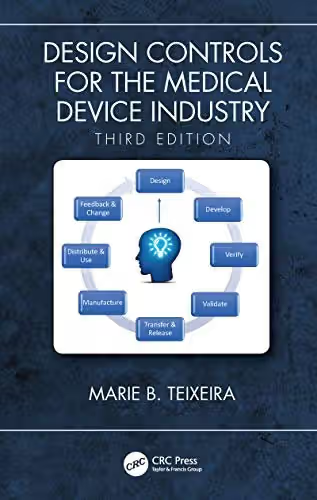
The book is a practical, compliance-oriented guide to the design control requirements that govern how medical devices are developed. The publisher describes the third edition as a review of current design control requirements, with proven tools and techniques for building a design control programme that satisfies the US FDA Quality System Regulation and ISO 13485:2016 and meets the expectations of Notified Body auditors and FDA investigators. It runs to about 250 to 260 pages in sixteen chapters, followed by twelve appendices of templates and forms (Appendices A to L). The chapters follow the order of the design control elements, from classification and planning through verification, validation, transfer and change, ending with the history file and the FDA inspection technique. The publisher also notes new coverage of ISO 13485:2016 design control requirements and a reference to MDSAP.
Chapters 1–3: Introduction; Device Classification; Overview of Design Controls
The opening chapters set the context. The publisher says the book includes medical device regulations and classes in the US, Canada and Europe; the classification chapter is where a reader places a device before deciding what controls apply. The overview chapter introduces design controls as a whole.
Chapter 4: Design and Development Planning
The first design control element in the sequence: planning the project and its stages.
Chapters 5–6: Design Inputs: Part I; Design Inputs: Part II
Two chapters on design inputs, the requirements a design must meet, split into two parts. The appendices include a design input document and a product claims sheet that support these chapters.
Chapter 7: Design Outputs
How the design is expressed in outputs that can be traced back to the inputs. Appendix D provides an input/output design traceability matrix.
Chapters 8–9: Design Review; Design Verification
Two controls that check the work: formal review at the end of design phases (supported by a design phase review meeting record in the appendices) and verification that outputs meet inputs.
Chapter 10: Risk Management
The chapter covers risk management. The publisher says the book's treatment of risk includes human factors and usability. An appendix on risk analysis accompanies it.
Chapters 11–12: Design Validation; Biocompatibility
Validation confirms that the device meets user needs and intended uses; the separate chapter on biocompatibility treats the biological safety evaluation of devices.
Chapters 13–15: Design Transfer; Design Change; Design History File
The last design controls: handing the design to production (with a design transfer checklist among the appendices), controlling changes (design change form, engineering change order form) and keeping the design history file.
Chapter 16: The FDA Inspection Technique
The closing chapter explains how design controls are inspected. The publisher refers to the FDA Quality System Inspection Technique (QSIT) for design controls.
Appendices A–L
Template procedures and forms: design controls procedure, design input document, product claims sheet, input/output traceability matrix, project approval form, design phase review meeting record, risk analysis, clinical evaluation report, design transfer checklist, design change form, approval for sale form and engineering change order form.
Key Concepts
Chapters 1–4: Classification and Planning
- Device classification: the class of a device in the US, Canada and Europe determines the regulatory path.
- Design and development planning: the plan that structures the project.
Chapters 5–9: Inputs, Outputs and Checks
- Design inputs: requirements the design must satisfy.
- Design outputs: results of design that must trace to inputs.
- Design review and verification: the checks applied during development.
Chapters 10–12: Risk, Validation and Biocompatibility
- Risk management: including human factors and usability.
- Design validation: confirmation that the device meets user needs.
- Biocompatibility: the biological safety evaluation of the device.
Chapters 13–16: Transfer, Change, History and Inspection
- Design transfer and design change: moving to production and controlling modifications.
- Design history file: the record of the design.
- FDA inspection technique: how auditors examine design controls.
Critical Analysis
Strengths
- One element per chapter. Chapter titles map directly onto the design control elements named in the publisher's description (planning, input, output, review, verification, validation, change, transfer and history), so a reader can look up a requirement quickly.
- Templates for implementation. Twelve appendices of procedures and forms, including a design input document, traceability matrix, transfer checklist and change forms, give a starting point for a real quality system.
- Regulatory scope. The book covers both the US QSR and ISO 13485:2016 and refers to MDSAP, with classification across the US, Canada and Europe.
- Practitioner author. The publisher's biography presents the author as a consultant in quality and regulatory affairs who has worked in industry, so the book is written from compliance practice.
Limitations
- Tied to the regulations of its date. It is written around the QSR and ISO 13485:2016 as of 2020. Readers should check the current text of each regulation before using the templates.
- Procedural rather than creative. The contents are about documenting and controlling a design, not inventing one; design thinking, needs finding and engineering design methods are in other books.
- Compact. At about 250 pages including the appendices of forms, it gives each control a short treatment, and a reader will need other sources for detailed methods in risk management or human factors.
Where It Fits in the Course
Within the medical device design course, this is the book on the regulated side of development. Biodesign: The Process of Innovating Medical Technologies is a process-oriented guide to inventing and bringing medical technologies to patients, from need finding through regulatory and business strategy; Biomedical Engineering Design by Tranquillo, Goldberg and Allen walks students through designing a device as a team project; and Medical Device Design: Innovation from Concept to Market by Ogrodnik follows a design project from the first statement of need to market release, including the quality-management standards and regulations that apply. Design of Biomedical Devices and Systems by King, Fries and Johnson is a comprehensive guide to development covering the design process and regulatory requirements.
Teixeira belongs after or beside one of those. Her book goes into the design control requirements themselves, and is the place to learn what the quality system must document once a concept becomes a project, and it connects with Elahi's Safety Risk Management for Medical Devices, a detailed guide to risk management across the device life cycle, which expands the single risk management chapter here.
How to Use This Book
The book is for graduate students preparing for industry, engineers and project managers in medical device companies, quality and regulatory staff setting up or auditing a design control system, and start-up teams moving from prototype to a regulated product. Some product development experience or an introductory design course helps, and familiarity with quality management concepts is useful.
A practical plan:
- Read first: Chapters 1 to 3 for classification and the overall system, then Chapter 4.
- Core sequence: Chapters 5 to 9 and 11 in order, since inputs, outputs, review, verification and validation build on each other.
- Specialist chapters: Chapter 10 on risk management and Chapter 12 on biocompatibility, with a dedicated risk text for depth.
- Closing the loop: Chapters 13 to 16 for transfer, change, the history file and inspection.
- Working use: adapt the appendix templates to a project, and trace each requirement from input through output to verification.
Pair a design project with the chapters: write inputs for a simple device, trace them through outputs and verification, and file the results in a mock design history file.