01 / Reading Guide
Reading Guide
Citation
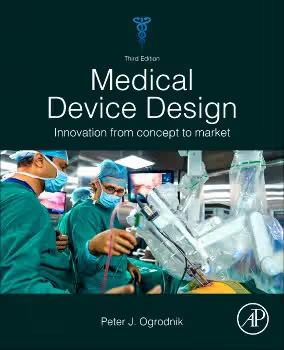
Ogrodnik, P. J. (2026). Medical Device Design: Innovation from Concept to Market (3rd ed.). Academic Press.
Chapter Summary
The third edition has eighteen chapters and six appendices, about 470 pages in the e-book. The author is a chartered mechanical engineer who has founded medical device companies and leads a master's programme in medical engineering design. The publisher describes the book as the bridge between engineering design and medical device development, following a device from its earliest conceptualization to commercialization on the global market, and lists a step-by-step approach to the "flow" of a design project, updated references to ISO 13485:2016, FDA regulations and the European Medical Device Regulation, and case studies. The chapter order traces that flow: classification and process first, then the design stages in sequence, then manufacture and life after launch, specialised device types, sustainability, intellectual property and regulatory approval.
Chapters 1–2: Introduction; Classifying Medical Devices
The opening chapters set the scene and introduce classification, which the book places before any of the design chapters. Appendix D gives generic codes for Class I devices from the UK regulator (MHRA) and a list of FDA Class I and II exempt devices.
Chapters 3–4: The Design Process; Implementing Design Procedures
Chapter 3 presents the design process itself, and Chapter 4 deals with implementing it as design procedures.
Chapters 5–6: Developing Your (Product) Design Specification – (X)DS; Generating Ideas and Concepts
The specification comes before concept generation. Chapter 5 covers writing the product design specification, and Appendix F adds further worked examples of one. Chapter 6 then covers generating ideas and concepts to meet it.
Chapters 7–10: Enhancing Quality in Design; Design Realization/Detailed Design; Risk Management, Risk Analysis and ISO 14971; Evaluation (Validation and Verification)
The middle of the book takes the selected concept through detailed design. Quality and risk get chapters of their own: Chapter 9 is built around ISO 14971, the risk management standard, and Appendix C reproduces a pre-risk-analysis questionnaire from that standard's Annex C. Chapter 10 covers validation and verification, and Appendix E supplies basic material properties for materials selection.
Chapters 11–13: Manufacturing Supply Chain; Labeling and Instructions for Use; Postmarket Surveillance
Responsibility continues beyond the drawing board: these chapters deal with manufacturing and suppliers, labelling and instructions, and monitoring a device once it is on the market.
Chapters 14–16: Active Medical Devices and IVDs; Software, AI, and Medical Devices; Sustainable Healthcare
Three chapters address particular classes of product and newer concerns: powered (active) devices and in vitro diagnostics, software and artificial intelligence in medical devices, and sustainability in healthcare.
Chapters 17–18: Protecting Your IP; Obtaining Regulatory Approval to Market
The book closes with protecting intellectual property and with the route to regulatory approval, in keeping with the publisher's emphasis on FDA and EU requirements. Appendix A lists useful websites.
Key Concepts
Chapters 1–4: Classification and process
- Device classification: assigning a device to a regulatory class, which sets the level of control required.
- Design procedures: the design process put into practice as procedures within an organization.
Chapters 5–10: Designing the device
- Product design specification: the statement of requirements that guides and judges all later design work.
- Concept generation: producing and selecting candidate solutions to the specification.
- Risk management (ISO 14971): identifying, analysing and controlling the risks of a device.
- Validation and verification: showing that the device meets its specification and the user's needs.
Chapters 11–18: After design
- Postmarket surveillance: monitoring a device's performance and safety after it reaches the market.
- Active devices, IVDs and software: device types with requirements of their own, including AI.
- Intellectual property: protecting the novelty of a design.
- Regulatory approval: the route to market in the United States and Europe.
Critical Analysis
Strengths
- A complete arc from idea to market. The table of contents follows a device from classification and specification through detailed design, risk, evaluation and manufacture to postmarket surveillance and approval, so a student sees how regulatory demands shape each design stage rather than meeting regulation as a separate subject.
- Practitioner's perspective. The author has founded two device companies, is a named inventor on patents and has long clinical research experience in orthopaedics. The publisher presents the book as combining that real-world experience with academic design methods.
- Practical reference material. The appendices (regulatory websites, the ISO 14971 questionnaire, Class I and exempt device codes, material properties and worked specification examples) make the book usable during a project as well as for study.
- Current topics. This edition includes chapters on software and AI, active devices and IVDs, and sustainable healthcare, and the publisher lists updated references to ISO 13485:2016, the FDA regulations and the EU Medical Device Regulation.
Limitations
- Regulatory focus on the US, EU and UK. The publisher's description centres on FDA and EU requirements, and the appendices cite the FDA and the MHRA; readers in other jurisdictions need their own regulatory sources.
- Regulation dates quickly. Standards and regulations change faster than editions, so specific requirements should be checked against current official texts.
- Little on clinical need-finding and business strategy. The table of contents has no chapter on identifying clinical needs, reimbursement or funding, topics central to the biodesign approach.
- No published reviews of this edition yet. The edition appeared in 2026, so independent assessments of its new chapters are not yet available.
Where It Fits in the Course
This is a good first book for the course when the aim is to learn how a device is designed under regulation. Tranquillo, Goldberg and Allen's Biomedical Engineering Design is written for student team projects, from finding a clinical need to preparing for market, with ethics and business included; it pairs well with Ogrodnik for a capstone course, with Tranquillo on the project process and Ogrodnik on specification, risk and regulation. Biodesign (Yock, Zenios and colleagues) concentrates on identifying and screening clinical needs and on implementation strategy, including reimbursement, business and funding, which fills the gaps noted above. King, Fries and Johnson's Design of Biomedical Devices and Systems is a broader engineering treatment of device design and its requirements.
Two specialised books follow naturally from particular chapters. Bijan Elahi's Safety Risk Management for Medical Devices is a detailed guide to ISO 14971 across the device life cycle and is the next step after Chapter 9. Marie Teixeira's Design Controls for the Medical Device Industry explains the design control requirements of the FDA Quality System Regulation and ISO 13485 with template procedures, extending Chapters 4 and 10.
How to Use This Book
The book suits engineering undergraduates in a medical device design course, graduate students, and engineers moving into the device industry. A first-year engineering background is enough to start; some exposure to engineering design and materials selection helps with Chapters 6–8.
A practical plan:
- Core: Chapters 1–10 in order, the design process from classification to evaluation. If a design project runs alongside the course, write its specification with Chapter 5 and Appendix F, and use the Appendix C questionnaire when starting the risk analysis.
- Life after design: Chapters 11–13 and 18, which complete the picture of a device on the market.
- Topic chapters: Chapters 14–16 according to the project (an electronic or diagnostic device, a software or AI product, sustainability requirements), and Chapter 17 for any project that may lead to a patent.
Keep the official texts of the standards and regulations at hand when reading Chapters 9 and 18, and check the current versions. For need-finding and the business side of innovation, add Biodesign; for deeper risk management, Elahi.