01 / Reading Guide
Reading Guide
Citation
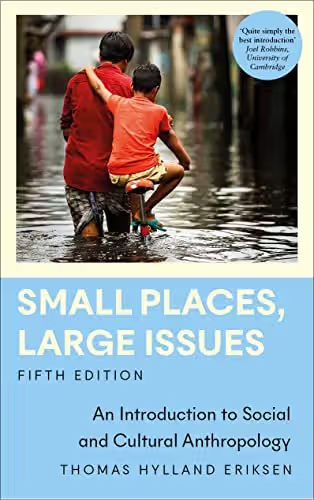
Eriksen, T. H. (2023). Small Places, Large Issues: An Introduction to Social and Cultural Anthropology (5th ed.). Pluto Press.
Chapter Summary
The fifth edition has twenty-two chapters and a short epilogue, in about 440 pages of text followed by a bibliography and index. The publisher describes a comparative introduction that focuses on central topics such as kinship, ethnicity, ritual and political systems, with many examples showing the scope of anthropology, and says it uses reviews of key works to illustrate its arguments. New in this edition are chapters on medical anthropology and on climate change, rewritten sections on ecology, nature and the Anthropocene, and a more systematic treatment of gender and digitalisation throughout.
Chapters 1–3: Anthropology: Comparison and Context; A Brief History of Anthropology; Fieldwork and Ethnography
The first part sets up the discipline: a short opening chapter (about eleven pages) on comparison and context, a history of the subject (about nineteen pages), and a chapter on fieldwork and ethnography (about twenty-three pages).
Chapters 4–6: The Social Person; Local Organisation; Person and Society
These chapters turn to the basic questions of social life: the person, the organization of local communities, and the relation of the individual to society. Each runs to roughly fifteen to twenty-three pages.
Chapters 7–8: Kinship as Descent; Marriage and Relatedness
Two chapters of about seventeen and nineteen pages cover kinship, which the publisher names as one of the central topics: descent in the first, marriage and relatedness in the second.
Chapters 9–10: Social Differentiation 1: Gender and Age; Social Differentiation 2: Caste and Class
The pair deals with the ways societies sort people into categories: gender and age first, then caste and class. The publisher says gender is also treated more systematically throughout the edition.
Chapters 11–12: Religion and Ritual; Language and Cognition
Ritual is another of the publisher's named central topics. The second chapter in this pair, on language and cognition, turns to the relation between speech and thought.
Chapters 13–15: Politics and Power; Political Identity 1: Ethnicity and the Politics of Identity; Political Identity 2: Nationalism and Minorities
Political systems, ethnicity and nationalism form a block of three chapters. The author's earlier book Ethnicity and Nationalism is named in the publisher's biography.
Chapters 16–17: Economic Anthropology 1: Exchange and Consumption; Economic Anthropology 2: Production and Technology
The economic chapters are split into exchange and consumption, and production and technology.
Chapters 18–19: Humanity and the Biosphere; Complexity and Change
Chapter 18's title points to the relation between people and the natural environment; the publisher says that sections on ecology, nature and the Anthropocene were rewritten, without saying in which chapter. Chapter 19 addresses complexity and change.
Chapters 20–22: Medical Anthropology; Anthropology and the Paradoxes of Globalisation; The Anthropology of Climate Change
The last three chapters take up contemporary issues. Medical anthropology (new) and climate change (new) bracket a long chapter of about twenty-seven pages on globalisation. An Epilogue, "Making Anthropology Matter," closes the book in three pages.
Key Concepts
Chapters 1–6: Foundations
- Comparison and context: the discipline's method of placing particular societies in a wider comparative frame.
- Fieldwork and ethnography: the research method and the written product on which the discipline rests.
- The social person and local organization: the individual and the community as the starting point for analysis.
Chapters 7–12: Kinship, Differentiation, Religion and Language
- Descent and marriage: the two chapters on kinship and relatedness.
- Social differentiation: gender, age, caste and class as ways of ranking and dividing people.
- Religion and ritual: one of the central topics named by the publisher.
- Language and cognition: the relation between speech, thought and culture.
Chapters 13–22: Politics, Economy and the Contemporary World
- Political identity: ethnicity, nationalism and minorities.
- Exchange and production: the two main strands of economic anthropology.
- Complexity and change: the topic of Chapter 19.
- Globalisation, climate and medicine: the contemporary topics that structure the last chapters.
Critical Analysis
Strengths
- Wide coverage in a coherent order. The contents run from history and method through kinship, differentiation, religion, language, politics, economy and change to contemporary issues, which makes the book usable as a single-volume course.
- Use of key works. The publisher says the text illustrates its arguments with reviews of key works, giving students entry points into the classic literature.
- Updated for current issues. New chapters on medical anthropology and climate, rewritten sections on the Anthropocene and a more systematic treatment of gender and digitalisation make the edition current. Published endorsements from Ursula Rao, Tim Ingold and Vered Amit praise the book as a summary of key ideas, a library in one book and a masterful introduction.
- Consistent author. A single author with a long record in the field wrote the book, which has been used as an undergraduate introduction for over twenty-five years, according to the publisher.
Limitations
- Length. With twenty-two chapters and about 440 pages of text, the book is more than most one-semester courses can use, and instructors will need to select.
- Social and cultural anthropology only. The contents list has no chapters on archaeology or biological anthropology, so these subfields need separate sources.
- Compact treatment of many topics. Several chapters (1, 18, 22) run to only eleven to thirteen pages, which allows an overview rather than a case-by-case analysis.
- Little independent review. No independent journal review of the fifth edition was found, so its reception rests mainly on the publisher's page and endorsements.
Where It Fits in the Course
Within this course list, Eriksen is a broad, topic-by-topic introduction to social and cultural anthropology. Kenneth Guest's Cultural Anthropology: A Toolkit for a Global Age is a student-centered introduction for a first course that uses ethnographic research to examine everyday life and public issues, and is the natural alternative for readers who want a more guided textbook format. Margaret Mead's Coming of Age in Samoa is a classic ethnography from 1928, useful as a case to read alongside the chapters on the social person and on gender and age, with the reminder that the book is a historical text.
Alan Barnard's History and Theory in Anthropology traces anthropological theory and goes much further into theory than Eriksen's single history chapter, while Eric Wolf's Europe and the People without History is a major work of historical anthropology that questions the picture of separate, timeless societies; it is best read after an introduction like this one.
How to Use This Book
The book is for students beginning anthropology; no previous study is required, though reading in the social sciences helps.
A practical plan:
- Core: Chapters 1–3 for the discipline and method, then 7–8 on kinship, 11 on religion and ritual, and 13–15 on politics and identity. These topics recur across the rest of the book.
- By course emphasis: Chapters 4–6 and 9–10 for social structure and differentiation; 16–17 for economic anthropology; 12 for language and cognition.
- Contemporary issues: Chapters 18 to 22 are the newest and the most likely to need updating, so read them for current debates.
Read the three-page Epilogue, "Making Anthropology Matter," for the author's closing argument about the discipline's relevance. Because the book uses reviews of key works, take note of the books it discusses and read at least one of them in full for each major topic. Because the book is long, assign it in sections and pair each with an ethnography from the course list.