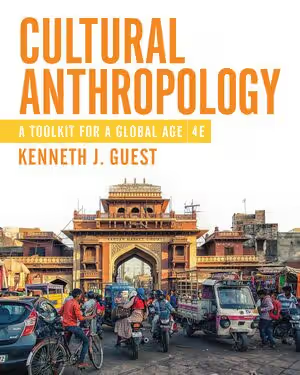
01 / Reading Guide
Reading Guide
Citation
Guest, K. J. (2023). Cultural Anthropology: A Toolkit for a Global Age (4th ed.). W. W. Norton & Company.
Chapter Summary
The fourth edition is a large introductory textbook of 824 pages in seventeen chapters, arranged in three parts. The publisher sums up the approach in the book's opening claim that anthropology "may be the most important course you take in college", and describes its "toolkit" idea as the everyday skill of entering a new group and working out its unwritten norms and power dynamics, sharpened into the analytical habits of the discipline. According to the publisher, the book draws on more than 144 ethnographic studies (21 of them new to this edition) to illustrate its concepts, and adds six new "Anthropologists Engage the World" interviews and new learning objectives for each chapter. The text is sold with Norton's online materials (an interactive ebook with Check Your Understanding questions, InQuizitive adaptive quizzes, and "Practicing Ethnography" activities on fieldnotes, research ethics, ethnographic writing, reading ethnography and analysing ethnographic film).
Part 1, Anthropology for the 21st Century — Chapters 1–4: Anthropology in a Global Age; Culture; Fieldwork and Ethnography; Language
The opening part defines the discipline and its main tools. It moves from what anthropology is and why globalization frames it, to the concept of culture, to the method of fieldwork and ethnography, and then to language. Earlier editions also had a chapter on human origins in this part; it does not appear in the fourth-edition contents, so the book now concentrates on cultural anthropology.
Part 2, Unmasking the Structures of Power — Chapters 5–10: Race and Racism; Ethnicity and Nationalism; Gender; Sexuality; Kinship, Family, and Marriage; Class and Inequality
The second part is organised around systems of power and difference. Each chapter takes one axis of social classification, from race and ethnicity through gender, sexuality and kinship to class, and the part title signals the book's aim of showing how these categories are produced and how they shape unequal lives. The publisher identifies racial justice and shifting ideas of sexuality, gender and power among the issues the new edition addresses.
Part 3, Change in the Modern World — Chapters 11–17: The Global Economy; The Environment and Sustainability; Migration; Politics and Power; Religion; Health and Illness; Arts and Media
The final part applies the toolkit to institutions and processes of change: the global economy, environment and sustainability, migration, politics, religion, health and the arts. The environment chapter is a later addition; library records of the first two editions show the same part without it. The publisher names environmental change, climate change and the unequal impact of the Covid-19 pandemic as issues the fourth edition takes up, which fall within the environment and health chapters.
Key Concepts
Part 1: Anthropology for the 21st Century
- Anthropology in a global age: the book's framing of the discipline through globalization and its effects on everyday life.
- Culture: the central concept of the field, given its own chapter before the methods and language chapters.
- Fieldwork and ethnography: the immersive research method that the publisher places at the heart of the book.
- Language: language as part of culture, treated as one of the discipline's basic tools.
Part 2: Unmasking the Structures of Power
- Race and racism; ethnicity and nationalism: categories of difference examined as social constructions with real consequences.
- Gender and sexuality: two chapters on how bodies, identities and desire are culturally ordered.
- Kinship, family, and marriage: the classic anthropological topic of relatedness.
- Class and inequality: stratification as a structure of power.
Part 3: Change in the Modern World
- The global economy: economic systems and their connections across the world.
- Environment and sustainability: the relations between human societies and environmental change.
- Migration: the movement of people and its effects on communities.
- Politics, religion, health, arts and media: institutions examined in the light of global change.
Critical Analysis
Strengths
- Ethnography at the centre. Concepts are illustrated through more than 144 ethnographic studies, according to the publisher, and fieldwork and ethnography have a chapter of their own in Part 1. Students meet anthropology through what anthropologists have found, not only through definitions.
- Organised around power and contemporary issues. Part 2's six chapters on race, ethnicity, gender, sexuality, kinship and class give the book a clear argument about inequality, and the new edition explicitly addresses racial justice, climate change and the pandemic. This makes it easy to connect the course to current debates.
- Extensive teaching apparatus. Learning objectives, interviews with practising anthropologists, and the online Check Your Understanding questions, InQuizitive quizzes and "Practicing Ethnography" activities give structured practice in skills such as writing fieldnotes and conducting ethical research. The book has been revised regularly: earlier editions appeared in 2014, 2017 and 2020.
Limitations
- Very long. At 824 pages and seventeen chapters it holds more than most one-semester courses can cover. Norton also publishes a shorter Essentials of Cultural Anthropology under the same subtitle; it is a different book, so students should check which one a course uses.
- Cultural anthropology only. The human origins chapter of earlier editions has been dropped, and the book does not cover archaeology or biological anthropology. Courses taught as a four-field introduction will need other material.
- Designed around a commercial digital package. Several of the hands-on features (the adaptive quizzes, ethnographic film activities and Check Your Understanding questions) sit in the online platform rather than in the printed text, so readers with only the print book will miss part of the learning design.
Where It Fits in the Course
In the introductory cultural anthropology course, Guest is the comprehensive textbook: the one book that covers the discipline's tools and its standard topics with structured study aids. Thomas Hylland Eriksen's Small Places, Large Issues is a more compact, essayistic introduction to social and cultural anthropology, moving from the discipline's history and methods through classic topics to global issues; it suits students who prefer a shorter book built around a continuous argument, and it can serve as a second voice on the same topics.
The remaining books are best read alongside or after Guest rather than instead of him. Margaret Mead's Coming of Age in Samoa is a classic ethnography that shows the arguments about culture in Chapter 2 being made in a single study, and it is a good companion to the fieldwork chapter. Alan Barnard's History and Theory in Anthropology traces the development of anthropological theory and explains the main schools in relation to one another; it fills the historical and theoretical background that a topic-based textbook covers only briefly. Eric Wolf's Europe and the People without History is a major work of historical anthropology on how peoples across the world were drawn into trade, conquest and capitalism from 1400; it deepens Guest's global framing, especially the chapters on the global economy, migration and politics.
How to Use This Book
The book is written for a first course in anthropology and assumes no previous study of the subject. It suits first-year students, non-majors fulfilling a social science requirement, and prospective majors.
- Core: Chapters 1–3 (anthropology in a global age, culture, fieldwork and ethnography) set out the toolkit everything else uses; read them first and in order. Chapter 4 on language belongs with them if the course has no separate linguistic anthropology unit.
- Power and difference: choose from Part 2 to match the course. Chapters 5–6 (race, ethnicity and nationalism) and Chapters 7–8 (gender, sexuality) pair naturally; Chapter 9 on kinship is the classic anthropological topic, and Chapter 10 on class links Part 2 to Part 3.
- Global change: Chapter 11 on the global economy is the hinge of Part 3; add the environment, migration, politics, religion, health or arts chapters according to the course's themes.
- Alongside the text: use the learning objectives as a checklist before each chapter, and work through the ethnographic examples rather than skimming them, since they carry the argument. If the online package is available, the "Practicing Ethnography" activities on fieldnotes, ethics and ethnographic film are the most direct preparation for a small fieldwork exercise.
Pairing the textbook with one full-length ethnography, such as Mead's study from the course list, shows how the concepts in the textbook look when worked out in a single place and argument.