01 / Reading Guide
Reading Guide
Citation
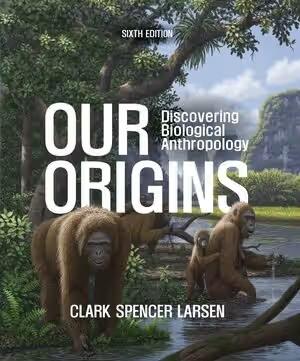
Larsen, C. S. (2025). Our Origins: Discovering Physical Anthropology (6th ed.). W. W. Norton & Company.
Chapter Summary
The sixth edition has fourteen chapters. An opening chapter on the discipline is followed by three parts, each named for a direction in time: Part I, "The Present—Foundation for the Past"; Part II, "The Past—Evidence for the Present"; and Part III, "The Future—The Shape of Things to Come". Each chapter carries an "Anthropology Matters" box (eight of them with videos), and the edition expands the "Anthropology at Work" feature on anthropologists' careers. The ebook adds 3D models of bones and fossils and end-of-section Check Your Understanding questions.
Chapter 1: What Is Biological Anthropology?
An introduction to the discipline: what biological anthropologists study and how the field relates to the rest of anthropology. The publisher says the edition adds new material on research ethics, including the ethics of research and colonialism, which belongs naturally at this point in a course.
Chapter 2: Evolution: Constructing a Fundamental Scientific Theory
The first chapter of Part I presents evolution as a scientific theory and traces how it was built up.
Chapters 3–4: Genetics: Reproducing Life and Producing Variation; Genes and Their Evolution: Population Genetics
Two chapters on heredity. The first covers how genetic information is reproduced and how variation is produced. The second moves to the population level and the forces that change gene frequencies over time.
Chapter 5: Biology in the Present: Living People
Human biological variation today. According to the publisher, the book's coverage of race and human variation, of health and disease, and of direct-to-consumer genetic testing gives students a link between the course and their own lives.
Chapters 6–7: Biology in the Present: The Other Living Primates; Primate Sociality, Social Behavior, and Culture
The living primates: their biology and diversity, then their social lives and behaviour, including the question of culture among nonhuman primates. These chapters close Part I.
Chapter 8: Fossils and Their Place in Time and Nature
Part II opens with the evidence itself: how fossils form and how they are placed in time and in their environments.
Chapter 9: Primate Origins and Evolution: The First 50 Million Years
The fossil record of the primates before the human lineage.
Chapters 10–11: Early Hominin Origins and Evolution: The Roots of Humanity; The Origins and Evolution of Early Homo
The earliest hominins and the genus Homo. The publisher notes updated discussions of Australopithecus, Homo naledi and Homo floresiensis, reflecting fossil discoveries that bear on human origins.
Chapter 12: The Origins, Evolution, and Dispersal of Modern People
The origin of anatomically modern humans and their spread around the world.
Chapter 13: Our Last 10,000 Years: Agriculture, Population, and the Bioarchaeology of a Fundamental Transition
The shift to farming and its consequences for human populations, studied through bioarchaeology: the analysis of human skeletal remains from archaeological sites, Larsen's own research field.
Chapter 14: Evolution: Today and Tomorrow
The single chapter of Part III looks at human evolution as an ongoing process. The publisher's list of topics includes global threats such as food security, biodiversity and pandemics.
Key Concepts
Chapters 1–4: The discipline, evolution and genetics
- Biological anthropology: the study of humans as biological organisms, in the present and through evolutionary time.
- Evolution as a scientific theory: an explanation built up from evidence and testing, presented in Chapter 2 as the foundation of the field.
- Population genetics: the study of how frequencies of genetic variants change across generations.
Chapters 5–7: The present
- Human variation: biological differences among living people and how they should be interpreted, including in relation to race.
- Primate sociality: the social organization and behaviour of nonhuman primates, used as a comparative basis for understanding humans.
Chapters 8–14: Past and future
- Fossil record: preserved remains that, placed in time and context, document primate and hominin evolution.
- Hominins: the human lineage after its split from the other apes, from early forms to Homo.
- Bioarchaeology: reading health, diet and lifestyle from human skeletons recovered archaeologically, used here for the transition to agriculture.
Critical Analysis
Strengths
- A clear organizing idea. The part titles set out the book's logic: the living world (evolution, genetics, people, primates) comes first as the basis for interpreting the past, then the fossil evidence, then a look ahead. Students know at each point why they are reading what they are reading.
- Current in a fast-moving field. The publisher stresses updates on recent fossil discoveries (Homo naledi, Homo floresiensis, Australopithecus) and new coverage of research ethics. For a field where interpretations change quickly, a 2025 edition is an advantage.
- Connects to students' lives. The "Anthropology Matters" boxes in every chapter and the topics the publisher highlights (genetic ancestry testing, race and variation, health, pandemics) tie the science to questions students meet outside class. The "Anthropology at Work" profiles show what anthropology graduates do.
- A distinctive chapter on the last 10,000 years. Many introductions end with the emergence of modern humans. Chapter 13 continues into the agricultural transition and uses bioarchaeology to study it, drawing on the author's own specialism.
Limitations
- Tied to a digital package. Much of what the publisher emphasizes (3D models, embedded videos, Check Your Understanding feedback, the InQuizitive adaptive quizzes) belongs to the Norton Illumine ebook and online tools rather than the printed text. Students using a print copy alone will miss these features.
- A single forward-looking chapter. Part III has one chapter. Readers interested in ongoing human evolution or the biology of present-day populations in detail will need further reading.
Where It Fits in the Course
Our Origins is a mainstream first textbook for the course. Stanford, Allen and Antón's Biological Anthropology: The Natural History of Humankind covers the same ground at a similar level, with the addition of biocultural anthropology. Courses normally choose one or the other. Explorations: An Open Invitation to Biological Anthropology, published by the American Anthropological Association, is a free, openly licensed alternative with chapters written by specialists. It is a useful second view of any topic, or a no-cost substitute. Bernard Wood's Human Evolution: A Very Short Introduction is a brief account of the evidence for human evolution and of how uncertain interpretations remain. It makes a good preview before Part II or a summary after it.
For students continuing beyond the introductory course, Foley and Lewin's Principles of Human Evolution treats the human lineage within evolutionary and ecological theory. Richard Klein's The Human Career is a large, densely referenced synthesis of the fossil and archaeological evidence. Both are natural next steps after Larsen's Chapters 9–12.
How to Use This Book
The book is written for first- and second-year undergraduates in an introductory biological or physical anthropology course. The publisher describes it as written to show students how biological anthropology applies to their lives and communities. The author, a bioarchaeologist and paleoanthropologist at Ohio State University, teaches introductory physical anthropology himself.
A suggested reading plan for one semester:
- Weeks 1–4: Chapters 1–4. Spend time on the genetics chapters; the later chapters on variation and evolution depend on them.
- Weeks 5–7: Chapters 5–7 on living people and primates. If the course includes a lab, this is the place for comparative anatomy of primate skeletons.
- Weeks 8–12: Chapters 8–12 on the fossil record, read in order. Make a timeline of the hominin species named in Chapters 10–12 and update it as you go.
- Weeks 13–14: Chapters 13–14. These suit discussion-based classes on agriculture, health and the human future.
If your course uses the ebook, work through the 3D models when the text discusses skulls and fossils, and treat the end-of-section questions as a check before moving on. Read each "Anthropology Matters" box as a prompt for a short written reflection. Because fossil interpretations change, compare the book's account of a recent find with a current news report or research summary.