01 / Reading Guide
Reading Guide
Citation
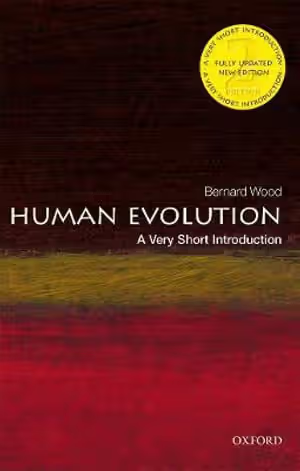
Wood, B. (2019). Human Evolution: A Very Short Introduction (2nd ed.). Oxford University Press.
Chapter Summary
The second edition, published in June 2019, is a pocket-sized book of about 160 pages with sixteen black-and-white illustrations: nine chapters, a timeline of important events and discoveries relevant to human origins and evolution, further reading and an index. Bernard Wood, a palaeoanthropologist at George Washington University whose research centres on taxonomy, phylogeny reconstruction and comparative morphology, traces palaeoanthropology from its beginnings in the eighteenth century to recent fossil finds. According to the publisher, the new edition discusses how ancient DNA studies have changed views of human evolution after about 550,000 years ago and of the process of speciation, including the recognition of new taxa and of "ghost" taxa known from DNA but not yet from fossils. The book also draws on palaeoclimatology, geochronology, systematics, genetics and developmental biology.
Chapter 1: Introduction
The opening chapter defines the book's scope: the last stage of the human evolutionary journey, from the most recent common ancestor shared with chimpanzees and bonobos, some six to eight million years ago, to present-day people. Its stated aims are to explain how palaeoanthropologists work, to summarise current understanding and to identify the main gaps in knowledge.
Chapter 2: Finding our place
How humans came to be seen as part of the natural world: from philosophers to scientists, and then the comparative and molecular evidence that places modern humans next to chimpanzees and bonobos and dates their split to six to eight million years ago.
Chapters 3–4: Fossil hominins: their discovery and context; Fossil hominins: analysis and interpretation
Two chapters on method. The first covers how fossils are found and dated, the setting in which the publisher places geochronology and palaeoclimatology. The second, according to its abstract, explains that the first task with a new fossil is to assign it to a taxon, then to work out that taxon's relationships with others, and then to infer behaviour and habitat; it also deals with reconstructing whole fossils from fragments, determining sex and age, models of speciation, the gaps and biases in the fossil record, and, in this edition, a section on fossil DNA.
Chapter 5: Early hominins: possible and probable
The earliest part of the record: candidates for the first hominins, sorted, as the title signals, into those that probably belong to the human lineage and those that only possibly do.
Chapter 6: Archaic and transitional hominins
Fossil species that are still far from modern humans in form, and a group that appears to be partly archaic hominin and partly Homo, which Wood calls "transitional".
Chapters 7–8: Pre-modern Homo; Modern Homo
The genus Homo before anatomically modern humans, then the origin and spread of modern humans. This is the period, after about 550,000 years ago, for which the publisher says ancient DNA has changed the picture most.
Chapter 9: The future of human evolution
A closing chapter whose title looks ahead. Oxford's online listing gives ancient DNA, cultural evolution and imaging among its keywords, which suggests the new evidence and techniques it considers.
Key Concepts
Chapters 1–2
- Hominins: the human lineage after its split from the line leading to chimpanzees and bonobos.
- Last common ancestor: the shared ancestor of chimpanzees, bonobos and modern humans, placed six to eight million years ago.
- Molecular evidence: genetic comparisons used to establish humans' place among the great apes.
Chapters 3–4
- Taxonomy: the assignment of fossils to species and genera, the first step of interpretation.
- Phylogeny: the relationships between taxa, reconstructed after classification.
- Gaps and biases in the fossil record: why the record is incomplete and uneven.
- Fossil (ancient) DNA: genetic material recovered from remains, a new source of evidence for recent human evolution.
Chapters 5–9
- Early, archaic and transitional hominins: Wood's grades of hominin from the earliest candidates to forms intermediate with Homo.
- Pre-modern and modern Homo: the genus before and after the appearance of anatomically modern humans.
- "Ghost" taxa: populations inferred from DNA whose fossils have not yet been found.
Critical Analysis
Strengths
- Method as well as results. Two of the nine chapters explain how fossils are found, dated, classified and interpreted before the hominin record is surveyed, and the introduction promises to show how palaeoanthropologists work. Students learn how claims are made, which helps them judge new discoveries.
- Candid about uncertainty. Titles such as "possible and probable" and the stated aim of identifying the main gaps in knowledge reflect an author who separates what is known from what is guessed.
- An authoritative short guide. Endorsements quoted by the publisher from Chris Stringer (Natural History Museum), Peter Ungar and Zeray Alemseged describe it as concise but comprehensive, and Ungar comments on the authority with which Wood writes.
- Updated for ancient DNA. The second edition adds the evidence that has transformed the study of the last half-million years.
Limitations
- Very short. About 160 pages cannot give detail on individual fossils, sites or debates; the book is an orientation, not a reference.
- Fossil-centred. The emphasis is on the hominin fossil record and its interpretation. Primate behaviour, human variation and the biology of living populations, which full biological anthropology courses also cover, are outside its scope.
- Fast-moving field. The edition dates from 2019; later fossil finds and ancient DNA results will need to be followed in other sources.
Where It Fits in the Course
In the biological anthropology list, Wood is the shortest and most accessible book, and a good first read before the textbooks. Clark Spencer Larsen's Our Origins, Craig Stanford, John Allen and Susan Antón's Biological Anthropology, and the openly licensed Explorations: An Open Invitation to Biological Anthropology (edited by Beth Shook and colleagues) are full introductory textbooks that cover genetics and evolutionary mechanisms, primates, the fossil record and modern human variation. Wood corresponds to their fossil-record chapters and can serve as a compact overview before or while reading them.
Two books go much further on human evolution specifically. Roger Lewin and Robert Foley's Principles of Human Evolution sets out evolutionary and ecological theory first and then uses it to interpret the primate and hominin record; it is the natural next step after Wood for students who want theory. Richard Klein's The Human Career is a large, densely referenced synthesis of the fossil and archaeological evidence, specimen by specimen, best used as a reference once Wood's overview is familiar.
How to Use This Book
The book assumes no more than school biology and suits first-year students, students from other disciplines taking a single course on human origins, and general readers.
- Read it in full early in the course: it can be read in a few sittings.
- Core for method: Chapters 3–4 explain the reasoning behind every later claim; reread them before essays that evaluate a new fossil or species.
- Core for the record: Chapters 5–8 give the sequence from the earliest candidates to modern humans; use the timeline at the back to keep the order of discoveries and ideas clear.
- Chapter 9 closes the book and makes a natural starting point for a seminar on where research is heading.
Pair each of Chapters 5–8 with the corresponding chapter of a full textbook for detail and illustrations, and use the further-reading list to move on to specialist sources. Because new fossils and ancient DNA results appear often, check recent reviews before relying on any date or species list.