01 / Reading Guide
Reading Guide
Citation
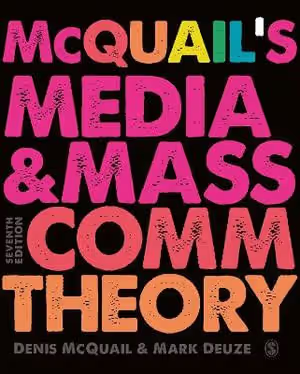
McQuail, D., & Deuze, M. (2020). McQuail's Media and Mass Communication Theory (7th ed.). SAGE Publications.
Chapter Summary
This is a comprehensive textbook and reference on theories of media and mass communication, about 670 pages in eighteen chapters grouped into eight parts, with a preface, a "How to Use this Book" section, a glossary and author and subject indexes. The publisher describes it as a uniquely comprehensive and balanced guide that carries the narrative of earlier editions into a world of pervasive, mobile, social and always-online media. According to the publisher, the new edition gives more attention to conceptualizing "mass" media and communication in an age of big data, algorithmic culture, AI, platform governance, streaming services and mass self-communication; discusses ethics in all chapters; includes a more diverse and global range of voices and examples; and adds a closer look at how media industries work, including journalism, advertising, film, television and digital games.
Preface; How to Use this Book
The front matter includes a section on how to use the book, which is the place to start for a reader planning a route through its eighteen chapters.
Part 1, Chapters 1–2: Preliminaries
Chapter 1, Introduction to the Book, and Chapter 2, The Rise, Decline and Return of Mass Media, open the book: the first introduces the book itself, and the second treats the rise, decline and return of mass media.
Part 2, Chapters 3–6: Theories
Chapter 3, Concepts and Models for Mass Communication, supplies the basic vocabulary. Chapter 4, Theories of Media and Society, and Chapter 5, Media, Mass Communication and Culture, present the main bodies of thinking about media in relation to society and culture. Chapter 6, New Media Theory, deals with the theory of digital and networked media.
Part 3, Chapters 7–9: Structures
Chapter 7, Media Structure and Performance: Principles and Accountability, concerns the principles by which media are organized and held to account. Chapter 8, Media Economics and Governance, addresses the economic and regulatory side. Chapter 9, Global Mass Communication, extends the discussion across borders.
Part 4, Chapters 10–11: Organizations
Chapter 10, The Media Organization: Structures and Influences, and Chapter 11, The Production of Media Culture, look at media institutions and how culture is made inside them, the area the publisher says now receives more detailed attention.
Part 5, Chapters 12–13: Content
Chapter 12, Media Content: Issues, Concepts and Methods of Analysis, introduces the approaches to analysing content. Chapter 13, Media Genres, Formats and Texts, turns to the forms media content takes.
Part 6, Chapters 14–15: Audiences
Chapter 14, Audience Theory and Research Traditions, covers how audiences have been theorized and studied. Chapter 15, Audience Formation and Experience, covers how audiences form and what they experience.
Part 7, Chapters 16–17: Effects
Chapter 16, Processes and Models of Media Effects, presents the models. Chapter 17, A Canon of Media Effects, is new to this edition; the publisher says it brings together social-cultural effects and news, public opinion and political communication to rethink and reframe the idea of media effects and influence.
Part 8, Chapter 18: Epilogue
Chapter 18, The Future, closes the book.
Key Concepts
Parts 1–2
- Mass media and mass communication: the notion whose rise, decline and return Chapter 2 traces, and which the new edition re-examines.
- Concepts and models: the basic tools presented in Chapter 3.
- New media theory: Chapter 6's approach to digital media.
Parts 3–4
- Media structure and performance: principles and accountability in Chapter 7.
- Media economics and governance: Chapter 8's focus.
- The media organization and the production of media culture: Chapters 10–11.
Parts 5–7
- Content analysis, genres, formats and texts: Chapters 12–13.
- Audience formation and experience: Chapter 15.
- Canon of media effects: Chapter 17's reframing of effects.
Critical Analysis
Strengths
- Comprehensive coverage by plan. The eight parts follow the communication process from structures and organizations through content and audiences to effects, so each topic has a home and a reader can find it quickly.
- Updated for digital media. The publisher's list of new material (big data, algorithmic culture, AI, platform governance, streaming, mass self-communication) and the dedicated chapter on new media theory show an effort to extend the book beyond twentieth-century mass communication.
- Ethics and a global range of voices. The publisher states that ethics are discussed in all chapters and that the examples are drawn from a diverse and global range.
- Reading aids. A "How to Use this Book" section, a glossary and separate author and subject indexes help the book work as a reference.
- Endorsement. The publisher quotes Sonia Livingstone, who calls it an invitation to the field full of lively debate and relevant examples, carefully balanced and comprehensive.
Limitations
- Size. At about 670 pages with eighteen chapters, it is a reference to dip into rather than a text to read straight through.
- Breadth over depth. Because each chapter covers a broad area, a specialist in one subfield, such as audience research or effects, will need monographs and articles for detail.
- A fast-moving subject. The new material on AI, platforms, streaming and algorithmic culture concerns developments that continue to change after 2020, so those parts will date sooner than the established theory.
Where It Fits in the Course
McQuail and Deuze is the comprehensive theory reference in the media-and-culture course. For a first encounter, Croteau, Hoynes and Childress's Media/Society is an introductory sociology of media organized around technology, industries, content and users, and Pollard and McDougall's Media Studies: The Basics is a brief introduction to concepts and methods; both are easier starting points. Fuchs's Social Media: A Critical Introduction takes a critical view of social media in particular, and Couldry and Hepp's The Mediated Construction of Reality is a theoretical study of how media shape social reality. Goffman's The Presentation of Self in Everyday Life is a classic study of face-to-face interaction rather than of media, and gives a micro-level complement to McQuail and Deuze's macro-level survey.
Within this list, McQuail and Deuze is the one to consult for an overview of the theoretical traditions and as a map to the more specialised books.
How to Use This Book
The book is meant for students and scholars of media, communication and cultural studies who need a systematic account of the field; an introductory course in these areas is the sensible preparation.
A practical plan:
- Start with "How to Use this Book" and Chapters 1–3, which give the map and the vocabulary.
- Core theory: Chapters 4–6.
- By topic: the parts on structures, organizations, content, audiences and effects can be read in whichever order the course needs; use the glossary and the indexes for cross-reference.
- Effects and the future: Chapters 16–18 for the newly framed treatment of media effects and the closing discussion.
When using the book for essays, treat each chapter as a starting map and follow its references into primary literature.