01 / Reading Guide
Reading Guide
Citation
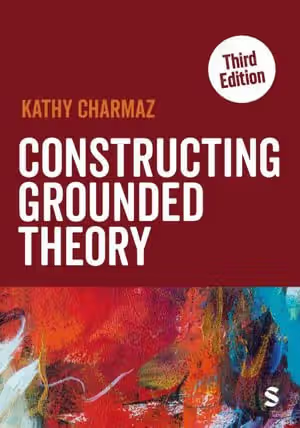
Charmaz, K. (2024). Constructing Grounded Theory (3rd ed.). SAGE Publications. Introducing Qualitative Methods series.
Chapter Summary
The third edition has twelve chapters and runs to about 400 pages. The publisher describes it as a guide to doing constructivist grounded theory that takes the reader through all the steps of a study, from gathering rich data and conducting interviews to coding and writing up. The chapters follow that order of work. The edition adds nine new case studies of grounded theory research in action from scholars in countries including Australia, Canada, Japan and the United States, learning objectives at the start of each chapter, and further reading suggestions in every chapter.
Chapter 1: An Invitation to Grounded Theory
The opening chapter invites the reader into grounded theory and introduces the constructivist version of it that the book teaches.
Chapters 2–4: Gathering Rich Data; Crafting and Conducting Intensive Interviews; Interviewing in Grounded Theory Studies
The first working chapters deal with data collection. Chapter 2 is about gathering rich data in general, and Chapters 3 and 4 concentrate on interviewing: crafting and conducting intensive interviews, and the use of interviews specifically within grounded theory studies.
Chapters 5–6: The Logic of Grounded Theory Coding Practices and Initial Coding; Focused Coding and Beyond
Coding is covered in two chapters. Chapter 5 sets out the logic of grounded theory coding and the first stage, initial coding; Chapter 6 moves to focused coding and what follows from it.
Chapter 7: Memo-writing
A chapter devoted to memos, the writing done during analysis, which the contents place between coding and sampling.
Chapter 8: Theoretical Sampling, Saturation, and Sorting
This chapter treats theoretical sampling, saturation and sorting.
Chapter 9: Reconstructing Theorizing in Grounded Theory Studies
The ninth chapter turns from coding and sampling to theorizing; its title points to a reconsideration of what theorizing means in grounded theory studies.
Chapter 10: Symbolic Interactionism and Grounded Theory
The chapter takes up the relation between grounded theory and symbolic interactionism.
Chapters 11–12: Writing the Draft; Reflecting on the Research Process
The final two chapters cover writing up the study and reflecting on the research process as a whole.
Key Concepts
Chapters 1–4
- Constructivist grounded theory: the version of grounded theory the book teaches, step by step, according to the publisher.
- Rich data: the kind of material Chapter 2 asks the researcher to gather.
- Intensive interviewing: the interview method taken up in Chapters 3 and 4.
Chapters 5–9
- Initial coding and focused coding: the two coding stages named in Chapters 5 and 6.
- Memo-writing: the writing practice of Chapter 7.
- Theoretical sampling and saturation: the sampling and stopping ideas of Chapter 8.
- Sorting: named with theoretical sampling and saturation in the title of Chapter 8.
- Theorizing: the subject of Chapter 9.
Chapters 10–12
- Symbolic interactionism: the perspective discussed in Chapter 10.
- Writing the draft: the writing stage of Chapter 11.
- Reflecting on the research process: the subject of Chapter 12.
Critical Analysis
Strengths
- A step-by-step design. The contents follow the order in which a study is carried out: data, interviews, coding, memo-writing, sampling, theorizing, writing and reflection. A reader can begin a project with the book beside them.
- An accessible voice. The publisher describes the book as retaining Kathy Charmaz's "characteristic warm and accessible style" and as written for undergraduates, postgraduates and researchers alike.
- Features for learning. The new edition adds learning objectives and further-reading suggestions in every chapter, and nine case studies from scholars in several countries, so each technique can be seen in a completed study.
- Reception of the earlier edition. The publisher lists praise for the second edition, including from Norman K. Denzin, who called it a major accomplishment, and Paul Webb in the Social Research Association's Research Matters, who described it as easy to read and full of practical advice.
Limitations
- A single approach. The book teaches constructivist grounded theory and is not a survey of social research as a whole. Readers who want a survey of qualitative traditions, or other versions of grounded theory, need other texts.
- Reviews are of the earlier edition. The endorsements the publisher prints are for the second edition, so they say little about the changes in the third.
Where It Fits in the Course
In the research methods course, this is the specialist text for qualitative analysis through grounded theory. Babbie's The Practice of Social Research and Walliman's Research Methods: The Basics are introductions to research design and method as a whole, and Bryman's Social Research Methods is a comprehensive British textbook covering quantitative, qualitative and mixed methods. Any of these provides the context for deciding when a grounded theory study is the right choice.
Creswell and Creswell's Research Design is a compact guide to planning a study and writing a proposal across qualitative, quantitative and mixed approaches, and a useful complement when a grounded theory project must be written up as a proposal. Morgan and Winship's Counterfactuals and Causal Inference stands at the other end of the methods range, a graduate textbook on causal inference from observational data, and offers a contrast with Charmaz's interpretive aims.
How to Use This Book
The book is for graduate students and researchers who are about to carry out a qualitative study and for advanced undergraduates doing a research project. A general research methods course, including basic qualitative interviewing and research design, is the helpful preparation.
A practical plan:
- Read Chapters 1 and 2 first to understand the approach and the kind of data it wants, then Chapters 3 and 4 before starting interviews.
- Read Chapters 5 to 8 as you analyse. Treat them as a working manual: code your first interviews as you read about coding, write memos as you read Chapter 7, and read Chapter 8 when you are deciding what data to collect next.
- Read Chapters 9 and 10 once you have categories. They help with turning analysis into theory and with relating it to symbolic interactionism.
- Finish with Chapters 11 and 12 when drafting, and use the case studies and learning objectives in every chapter as checks on your own project.