01 / Reading Guide
Reading Guide
Citation
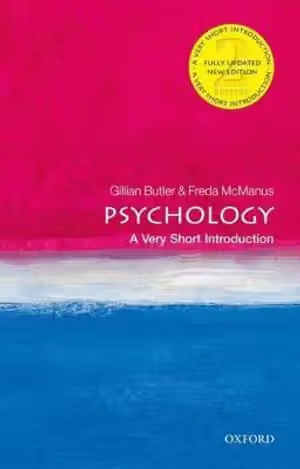
Butler, G., & McManus, F. (2014). Psychology: A Very Short Introduction (2nd ed.). Oxford University Press.
Chapter Summary
The second edition runs to 148 pages and ten chapters, followed by references, a short further-reading list and an index. Oxford's description frames the book around the question of what psychologists are trying to do and what scientific grounding their approach has, and says the new edition adds topics and ways of studying the brain, as neuroscience and improved technology allow brain activity to be observed and measured. Several chapter titles are phrased as questions, which gives the book the shape of a guided tour of the field.
Chapter 1: What is psychology? How do you study it?
The opening chapter sets out the subject and how psychologists investigate it. It is the place to meet the book's stance that psychological claims rest on evidence and method, and it prepares for the topic chapters that follow.
Chapter 2: What gets into our minds? Perception
The first topic chapter covers perception, the route by which information from the senses reaches the mind. Sensory signals and the Necker cube are among the terms the book uses repeatedly.
Chapter 3: What stays in the mind? Learning and memory
This chapter pairs learning with memory. Reinforcement and reward are among the terms the book uses repeatedly.
Chapter 4: How do we use what is in the mind? Thinking, reasoning and communicating
The fourth chapter moves from what is stored to how it is used: thinking, reasoning and communication. Together with the two before it, it makes up the cognitive core of the book.
Chapter 5: Why do we do what we do? Motivation and emotion
The fifth chapter turns to the reasons behind behaviour, treating motivation and emotion together.
Chapter 6: Is there a set pattern? Developmental psychology
This chapter looks at change over time. Attachment and caregivers are among the terms the book uses repeatedly.
Chapter 7: Can we categorize people? Individual differences
The seventh chapter asks whether, and how, people can be grouped. Intelligence tests, personality and traits are among the terms the book uses repeatedly.
Chapter 8: What happens when things go wrong? Abnormal psychology
Chapter 8 deals with psychological distress and disorder. Symptoms, distress, treatments and therapy are among the terms the book uses repeatedly.
Chapter 9: How do we influence each other? Social psychology
The ninth chapter covers social behaviour. Conformity, obedience, prejudice and social facilitation are among the terms the book uses repeatedly.
Chapter 10: What is psychology for?
The final chapter steps back to ask about the uses of psychology. Oxford's description stresses the relevance of the leading ideas to everyday life, from education and intelligence to relationships, emotions, advertising and criminality.
Key Concepts
Chapters 1–4: Method, perception, memory and thought
- Psychological research: the question of how psychologists study the mind, raised in the title of Chapter 1.
- Perception: how sensory information is interpreted, the subject of Chapter 2.
- Learning and memory: the subject of Chapter 3.
- Thinking, reasoning and communicating: how stored knowledge is put to use, as in Chapter 4.
Chapters 5–8: Motivation, development, differences and disorder
- Motivation and emotion: why people act as they do (Chapter 5).
- Developmental psychology: how people change across the lifespan (Chapter 6).
- Individual differences: whether people can be categorized, and on what basis (Chapter 7).
- Abnormal psychology: what happens "when things go wrong" (Chapter 8).
Chapters 9–10: Social life and purpose
- Social psychology: how people influence each other (Chapter 9).
- Uses of psychology: what the discipline is for (Chapter 10).
Critical Analysis
Strengths
- Whole-discipline coverage in a small space. In 148 pages the book touches perception, learning and memory, thinking, motivation and emotion, development, individual differences, abnormal psychology and social psychology, so a reader gets the outline of a full introductory course in a few sittings.
- Question-driven structure. Most chapter titles are questions ("What stays in the mind?", "Can we categorize people?"), which organises the topics around what psychologists are trying to explain.
- Updated for the brain-imaging era. The publisher states that the second edition adds new topics and new ways of studying the brain, including the observation and measurement of brain activity.
Limitations
- Brevity limits depth. Ten chapters in 148 pages leave little room for detailed experiments, theory comparison or statistics; it orients the reader but cannot replace a course textbook.
- No sustained practice material is advertised. The publisher's description lists no exercises or review questions, so readers who want self-testing need to pair it with a larger text.
- Neuroscience is one thread among many. The publisher presents brain-observation methods as an addition to the second edition, but with ten chapters spread across the whole discipline, a reader wanting detail on neural mechanisms needs a dedicated biological or cognitive neuroscience text.
Where It Fits in the Course
This is the shortest entry point among the introductory psychology books for this course. Psychology 2e from OpenStax is a freely available full textbook that covers the same territory at textbook length, and Myers and DeWall's Psychology and Gleitman, Fridlund and Reisberg's Psychology are comprehensive introductory textbooks. The Butler and McManus volume works as a map to read before, or in parallel with, any of them.
After the survey, Brysbaert and Rastle's Historical and Conceptual Issues in Psychology steps back to ask what kind of science psychology is, and Weiskopf and Adams's An Introduction to the Philosophy of Psychology takes that questioning into philosophy. Those are follow-ups for readers who finish a broad introduction and want to examine the discipline itself, not alternatives to this small book.
How to Use This Book
The book suits first-year or prospective psychology students, students of neighbouring subjects who take a single psychology module, and general readers. No background is needed.
A practical plan:
- First pass: read Chapter 1 and then the topic chapters in order. At roughly 15 pages a chapter, one chapter per sitting is realistic, and the whole book takes a few evenings.
- Choose by interest: each topic chapter has its own title and question, so readers heading into a specific course can begin with Chapter 2 or 3 for a cognition module, Chapter 9 for social psychology, or Chapters 7 and 8 for personality and clinical topics.
- Follow-up: after each chapter, find the same topic in a full introductory textbook for definitions, studies and review questions, and use the book's further-reading list for the next step.
- Reread Chapter 10 last: it is a short reflection on what the earlier chapters add up to, and it reads better with the topics fresh.