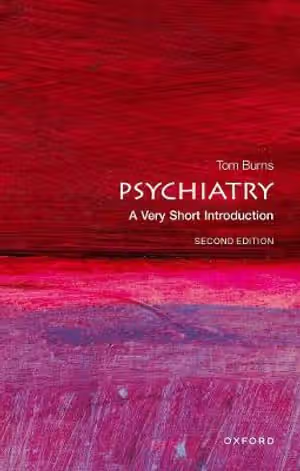
01 / Reading Guide
Reading Guide
Citation
Burns, T. (2018). Psychiatry: A Very Short Introduction (2nd ed.). Oxford University Press.
Chapter Summary
A short Oxford "Very Short Introduction" of seven chapters (about 124 pages of text). The publisher describes it as exploring what psychiatry can and cannot do, why its history has been marked by dramatic shifts in emphasis and treatment, how it differs from and overlaps with psychology and psychotherapy, and the mistakes and blind alleys of its past, before looking ahead to ageing populations and the possible effects of artificial intelligence and virtual reality. The summaries follow the publisher's chapter abstracts.
Chapter 1: What is psychiatry?
Defines psychiatry as the branch of medicine that deals with mental illnesses, and stresses that the definition rests on practice rather than on theory as in psychology or psychoanalysis. The interview is the hallmark of the psychiatrist's trade, and diagnosis depends on a judgement about why someone is doing something, not only on what they do. The most common psychiatric disorders, organic and functional, are described.
Chapter 2: Asylums and the origins of psychiatry
Outlines the historical care of the mentally ill, from family care to private madhouses and workhouses, and the asylum movement that began in earnest in the 1820s with moral therapy in calm rural settings. Overcrowding degraded conditions. The chapter names Kraepelin, Bleuler and Freud as three of the most influential figures of nineteenth-century research, mostly in German-speaking Europe, and notes that specific effective treatments did not arrive until the 1920s.
Chapter 3: The move into the community
Considers deinstitutionalisation. Nearly every large mental hospital in the UK, and most in the US and Western Europe, has closed, because of antipsychotic and antidepressant drugs, changed social attitudes, radical rethinking inside psychiatry and financial considerations. The first twenty years of community care were relatively successful, but closures ran ahead of alternative provision, and stigma, exaggerated fear of risk, family break-up, mobility and drug and alcohol use made care harder.
Chapter 4: Psychoanalysis and psychotherapy
Examines how psychoanalysis and psychotherapy relate to psychiatry. It covers Freud's free association and his id, ego and superego, Jung's "shadow self", and the range of therapies: existential, psychodynamic and behavioural therapies, group therapy, counselling, family therapy, crisis intervention, self-help and cognitive behaviour therapy.
Chapter 5: Psychiatry under attack—inside and out
Concerns the contradictions in psychiatry, above all the mind–brain relationship: many mental illnesses involve brain disorders, but not all brain diseases are mental illnesses. It follows the shift from inherited weakness towards nurture with Freud and his followers, and the anti-psychiatry movement of the 1960s and 1970s led by Szasz, Foucault and Laing, which condemned psychiatry as confusing at best and an instrument of social oppression at worst.
Chapter 6: Open to abuse
Explains why the nature of psychiatric practice invites misuse: unequal power with dependent and vulnerable patients, and subjective diagnosis without concrete indicators such as blood tests. It recalls political abuse, bad theories and dangerous treatments, and names public visibility, an informed public, willingness to admit mistakes and evidence-based medicine as safeguards.
Chapter 7: Into the 21st century
Looks forward. Attention is turning to how the body, not only the brain, influences mental health; computer technology, including artificial intelligence and virtual reality, offers new treatments; imaging, genetics and epigenetics provide new tools. The chapter observes that the core dilemmas of psychiatry are not shrinking and that the field is changing rather than disappearing.
Key Concepts
Chapters 1–4
- Psychiatry as a practice-based definition: the field is defined by what psychiatrists do with mental illness, with the interview as its main tool.
- Moral therapy and the asylum: the nineteenth-century response to mental illness and its decline.
- Deinstitutionalisation: the closure of large mental hospitals and the move to community care.
- Psychotherapies: psychoanalytic, psychodynamic, behavioural and cognitive behaviour therapy, among others.
Chapters 5–7
- The mind–brain problem: why psychiatry is not simply a branch of brain medicine.
- Anti-psychiatry: the 1960s–70s critique by Szasz, Foucault and Laing.
- Abuse and safeguards: unequal power, subjective diagnosis, and the role of evidence-based practice.
- New technologies: artificial intelligence, virtual reality, imaging, genetics and epigenetics.
Critical Analysis
Strengths
- Balanced on the controversies. Two chapters are given to attacks on psychiatry and its capacity for abuse, and the book's own description speaks of mistakes and blind alleys; Chapter 6 recalls political abuse and dangerous treatments directly.
- A clear historical arc. Chapters 2–5 go from the asylum to community care, psychotherapy and the anti-psychiatry movement, so that today's practice and public attitudes make sense.
- Looks ahead. The final chapter considers the body as well as the brain, artificial intelligence, virtual reality and epigenetics.
Limitations
- Little on individual disorders and treatments. Common disorders are described in the first chapter, and no chapter is devoted to drug treatment, which appears within the historical chapters.
- Short. About 124 pages mean that each issue is introduced rather than analysed in depth, and it contains no chapter on child and adolescent or forensic psychiatry.
Where It Fits in the Course
This is one of two Very Short Introductions in the abnormal and clinical course, and a gentle first book on the medical side of mental health. Llewelyn and Aafjes-van Doorn's Clinical Psychology: A Very Short Introduction is its natural companion, since it tells the story of the neighbouring profession. Pomerantz's Clinical Psychology: Science, Practice, and Diversity is a fuller undergraduate text on that profession.
For the disorders themselves, the Comers' Psychopathology: Science and Practice is the broad undergraduate survey of disorder categories, models and treatments, Maddux and Winstead's Psychopathology is an edited graduate textbook, and Barlow's Clinical Handbook of Psychological Disorders gives session-by-session treatment manuals. Burns's book is best read before them to understand the institutions and debates around the disorders.
How to Use This Book
No medical or psychological background is assumed. The book suits first-year psychology and health-related students, readers who want to understand public debates about mental illness, and anyone preparing for a course on abnormal psychology.
A practical plan: read Chapter 1 for the definition of the field, Chapters 2–4 for the history of treatment, Chapters 5 and 6 for the critical debates, and Chapter 7 for the outlook. The chapters stand fairly well alone, so a reader mainly interested in controversy can start with Chapter 5. Follow with a disorder-based textbook when the aim is to study particular conditions.