01 / Reading Guide
Reading Guide
Citation
Chmiel, N., Fraccaroli, F., & Sverke, M. (Eds.). (2017). An Introduction to Work and Organizational Psychology: An International Perspective (3rd ed.). Wiley-Blackwell.
Chapter Summary
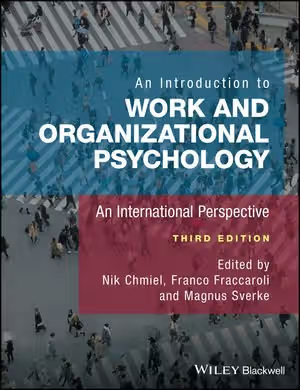
An edited volume of about 560 pages: a foreword by Wilmar Schaufeli, an introduction by the editors, 30 chapters by different authors, and an index. Every chapter title is a question that an employee or manager might ask. The contents page groups Chapters 1–24 into three parts (Job-Focused, Organization-Focused and People-Focused), followed by a fourth part, Advising the Organization, that ends with five case studies. Wiley's description speaks of a "six part structure", so the part count is stated differently in the two places. The Chapter 1 sample shows the chapter format: an overview, numbered sections, a summary, discussion points, suggested further reading and an online resource. Descriptions below rely on the published contents and that sample; they stay close to the titles.
Part I, Chapters 1–4: Job-Focused (the content and design of work)
Chapter 1, "What Do People Really Do at Work? Job Analysis and Design", introduces job analysis, distinguishes work-oriented from worker-oriented analysis, describes data-collection methods and uses in training needs analysis, and ends with competency profiling and work analysis as modern alternatives. Chapters 2–4 move to "How Do I Get a Job, What Are They Looking For? Personnel Selection and Assessment", "How Can I Shape My Job to Suit Me Better? Job Crafting for Sustainable Employees and Organizations" and "What Am I Supposed to Do in My Job? Set Goals and Appraise Your People", covering selection, employee-initiated redesign of jobs, and goal setting with appraisal.
Part I, Chapters 5–8: stress, technology and careers
Chapter 5, "Why Is My Job So Stressful? Characteristics, Processes and Models of Stress at Work", covers job stress. Chapters 6 and 7 take up technology: "Digital Technologies at Work Are Great, Aren't They? The Development of Information and Communication Technologies (ICTs) and Their Relevance in the World of Work" and "Whose Side Is Technology on, Really? On the Interdependence of Work and Technology". Chapter 8, "Why Did I Choose That Career Path? Approaches to Vocational Choices and People's Readiness to Self-Manage their Own Career Paths", closes the part.
Part II, Chapters 9–12: entry, power, leadership, teams
"How Do We Get New Entrants 'On Board'? Organizational Socialization, Psychological Contracts, and Realistic Job Previews"; "How Does Power Affect Those Who Have It and Those Who Don't? Power Inside Organizations"; "Does It Matter Who Leads Us? The Study of Organizational Leadership"; and "Why Are We in a Team? Effects of Teamwork and How to Enhance Team Effectiveness".
Part II, Chapters 13–16: change, non-standard work, fairness, healthy workplaces
"How Do We React When Our Organization Changes? Perspectives on Employees' Appraisal of Change, Consequences and Mitigating Factors"; "How Do We Feel and Behave When We're Not Permanent Full-Time Employees? The Case of the Diverse Forms of Non-Standard Work"; "Why Should Organizations Treat their Employees Fairly? Definition, Relevance, and Consequences of Justice at Work"; and "What Does Our Organization Do to Help Our Well-Being? Creating Healthy Workplaces and Workers".
Part III, Chapters 17–20: personality, training, motivation, computer-based technology
"Does It Matter Who We Are? Personality at Work"; "How Do I Learn What to Do? How the Science of Training Supports Learning"; "How Much Effort Will I Put into My Work? It Depends on Your Type of Motivation"; and "How Do We Handle Computer-Based Technology? What Is the Cost/Benefit Ratio of Technology for Workers?".
Part III, Chapters 21–24: safety, commitment, work–life balance, ageing
"Why Do I Put Myself and Others in Danger or Help Increase Safety? Person- and Situation-Related Causes of Safety Behaviours"; "Does It Matter Whether I Am a Happy and Committed Worker? The Role of Identification, Commitment and Job Satisfaction for Employee Behaviour"; "How Does Work Fit with My Life? The Relation Between Flexible Work Arrangements, Work–Life Balance and Recovery from Work"; and "What Happens When I Get Older? Older Workers, Late Careers and Transitions to Retirement".
Part IV, Chapter 25 and Case Studies 26–30: advising the organization
Chapter 25, "How Do We Work with Organizations?", is the practitioner chapter. The five case studies are "A Strategic Approach to Improving Well-Being in a Large Railway Company", "Humiliation: Why We Deserve Respect at Work", "Resilience Development Through an Organization-Led Well-Being Initiative", "Positive Action: Effectively Increasing Diversity at the Top" and "Age Management".
Key Concepts
Part I
- Job analysis: the systematic study of a job, in work-oriented and worker-oriented forms (the latter described in terms of knowledge, skills, abilities and other attributes).
- Competency profiling: a more flexible alternative to traditional job analysis.
- Job crafting, stress and career self-management: the employee-side topics of Chapters 3, 5 and 8.
Parts II–IV
- Socialization and psychological contracts: how newcomers are brought on board.
- Organizational justice, power and leadership: the organization-focused chapters' core topics.
- Work–life balance and recovery: the concern of Chapter 23.
- Safety behaviour: person- and situation-related causes.
- Advising organizations: the subject of Chapter 25, illustrated by the case studies.
Critical Analysis
Strengths
- Question-led chapters. Each title poses a practical question, and the Chapter 1 sample opens with an overview and puts a summary and discussion points at the end, which gives students a way into the research.
- International and multi-author. The subtitle and Wiley's description stress an international perspective; the three editors work in the UK, Italy and Sweden, and the case studies in Part IV are practice-based.
- Broad, clear structure. Thirty chapters in four parts cover selection, stress, leadership, teams, change, justice, safety, well-being and ageing, and Wiley presents the new Job-, Organization- and People-Focused structure as a headline feature of the third edition.
Limitations
- Uneven depth as an edited book. With 30 chapters in about 530 pages, the main chapters run to roughly 15–25 pages each (Chapter 1 is 22) and the case studies to about 7 to 8. Readers needing depth on one topic must use the further reading.
- Not a single narrative. Because chapters are written by different authors, theory is not built up cumulatively, and the order across parts need not be followed.
Where It Fits in the Course
This is the broadest introductory option in the organizational psychology list for students who want one book to survey the field with a European and international slant. Furnham's The Psychology of Behaviour at Work and Spector's Industrial and Organisational Psychology: Research and Practice are single-author textbooks that cover similar ground in a continuous voice; the OpenStax Organizational Behavior is a free introductory text.
For deeper reading on single themes, Haslam's The New Psychology of Leadership and Psychology in Organisations develop an identity-based view, Dawson and Andriopoulos's Managing Change, Creativity and Innovation and Hayes's The Theory and Practice of Change Management extend the change material of Chapter 13, and Schein's, Weick's and Morgan's books offer organizational theory beyond what an individual-centred text provides.
How to Use This Book
The publisher presents it as a complete introduction for undergraduate and graduate students with no prior knowledge of the field; an introductory psychology course helps but is not required. It is well suited as a course text for a first course in work and organizational psychology.
A practical plan: read the editors' introduction and Chapter 1 to see the format, then choose by interest, because the parts can be read independently. A selection-focused course would use Chapters 1, 2, 4 and 17; a well-being focused one Chapters 5, 16, 21, 23 and the Part IV case studies; leadership and change Chapters 11–13. Treat the discussion points and further reading in each chapter as the route to more depth, and use the case studies at the end to see how the research is applied.