01 / Reading Guide
Reading Guide
Citation
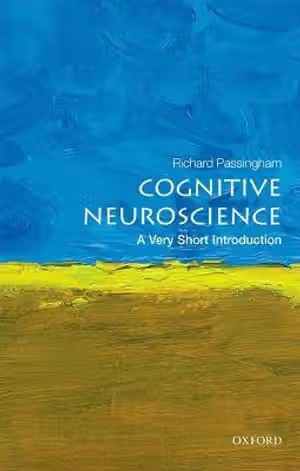
Passingham, R. (2016). Cognitive Neuroscience: A Very Short Introduction. Oxford University Press.
Chapter Summary
The book has nine short chapters, a preface and a list of illustrations, covering about 110 pages. After a first chapter on the field and its methods, seven chapters follow a chain of mental functions: perceiving, attending, remembering, reasoning, deciding, checking and acting. A final chapter looks at what methods might come next. The summaries follow the publisher's chapter abstracts.
Chapter 1: A recent field
Explains that cognitive neuroscience dates from the late 1970s and was transformed by techniques such as positron emission tomography and functional magnetic resonance imaging, which let researchers visualise brain activity in healthy people doing psychological tasks. The chapter discusses how to interpret brain images and how imaging can advance psychology in three ways: accounting for human capacities, considering human limitations, and explaining the psychological effects of disorders of the nervous system.
Chapter 2: Perceiving
Starts from puzzles such as why amputees may still feel a missing arm and why some people see colours when they read or hear words. It explains that the brain is not a single pathway from input to output, but has separate and diverging pathways, with regions such as the ventral and dorsal systems and primary sensory areas contributing to recognising and classifying objects and to perceptual awareness.
Chapter 3: Attending
Asks why some patients neglect the left side of space after a stroke, why attending elsewhere can reduce pain, and why using a mobile phone while driving is dangerous. It argues that the brain's capacity to take in information is not strictly limited, but at any moment only some of the available information is of interest, and describes the anatomical systems for looking and attending, focused and divided attention, and multitasking.
Chapter 4: Remembering
Considers amnesia, the forgetting of names in middle age and the navigation difficulties in Alzheimer's disease. It distinguishes episodic from semantic memory, stresses the role of the hippocampal region, and explains that a medial system supports memory for events while a ventral and lateral system supports knowledge about objects. The effects of ageing, dementia and Alzheimer's disease are discussed.
Chapter 5: Reasoning
Examines non-verbal problem solving, spatial relations, thought and language. The chapter links fluid reasoning, the kind needed for IQ tests, to the dorsal executive system, and verbal reasoning to the semantic system and parietal cortex. It proposes that human intelligence owes much to cumulative teaching through language and to the expansion of non-primary areas of the brain.
Chapter 6: Deciding
Starts from absent-minded mistakes, choosing immediate over larger later rewards and the basis of moral reasoning. The chapter shows the prefrontal cortex occupying a unique position in the processing hierarchy, with access to information about the current situation, current needs and aims, and the motor system, and describes its role in preparing, deciding and planning for the future.
Chapter 7: Checking
Concerns monitoring one's own behaviour after a decision: how awareness of intentions influences action, how people learn from mistakes in difficult tasks, and how they infer the intentions of others. Studies cited in the chapter show that people are aware of what they intend to do and can compare it with what they actually do, and are aware of their own and others' mental states.
Chapter 8: Acting
Looks at the link between handedness and the hemisphere specialised for language, hemispheric specialisation for gestures, spoken language and learning skills such as playing the violin, and why we cannot tickle ourselves. It concludes that vocal and manual skills both depend on cerebellar mechanisms and that the cerebellum has expanded along with the neocortex.
Chapter 9: The future
Argues that having mapped where activity occurs, the next task is to find out how activity makes cognition possible. That requires methods sensitive to the timing of neural activity, which neither PET nor fMRI provide. The methods listed include magnetoencephalography, electrode arrays, single-neuron recording and biologically plausible computational models.
Key Concepts
Chapters 1–4
- Functional brain imaging: PET and fMRI as ways to see which regions are active while people perform tasks, and how to read the resulting images.
- Parallel and diverging pathways: the idea that perception relies on several pathways, including ventral and dorsal systems.
- Neglect: loss of attention to one side of space after a stroke, used to study attention.
- Episodic and semantic memory: memory for personal events versus knowledge, supported by different brain systems.
Chapters 5–9
- Fluid reasoning and the dorsal executive system: the capacity behind IQ-test problems and the system linked to it.
- Prefrontal cortex: the region the chapter on deciding places in a unique position for planning and choice.
- Monitoring of intentions: comparing what one intends with what one does.
- Cerebellar mechanisms: the shared basis the chapter on acting proposes for vocal and manual skills.
- Temporal resolution: the need for methods that follow the timing of neural activity.
Critical Analysis
Strengths
- Teaches how to read brain scans. The first chapter is devoted to interpreting images and what they can answer, and the publisher's description states that the book explains what imaging shows and points out common misconceptions.
- Organised by mental function. The sequence from perceiving to acting gives a coherent route through the field, and each chapter opens with concrete questions that patients' symptoms or everyday experience raise.
- A clear forward look. The final chapter honestly notes that PET and fMRI are poorly suited to temporal questions and lists the methods that could answer them. A Manhattan Book Review notice (2017) found the short chapters suited to reading in pieces and said the book makes clear how much is still unknown.
Limitations
- Very compact. At about 110 pages of text, each function gets one short chapter; there is no separate chapter on emotion, and the imaging and recording techniques are explained only as far as the argument needs.
- Some anatomy is assumed. The chapter abstracts use region names such as ventral and dorsal systems, hippocampus, prefrontal cortex and cerebellum, so some familiarity with brain regions helps.
Where It Fits in the Course
This is a short bridge between psychology and neuroscience. Winn and Grealy's Biopsychology: The Basics is a concise introduction to the nervous system and its links to behaviour and is the better first book for someone who needs the underlying anatomy and physiology; Passingham's book then adds a focused account of how imaging and patient studies link brain systems to cognition. Kalat's Biological Psychology and Pinel and Barnes's Biopsychology are full-length undergraduate textbooks that cover the same territory far more comprehensively.
For further study, Nelson and Kriegsfeld's An Introduction to Behavioral Endocrinology turns to hormones and behaviour, and Kandel and colleagues' Principles of Neural Science is the comprehensive reference for the whole field of neuroscience. This volume is best read before or alongside a textbook, as a map of the cognitive side.
How to Use This Book
No prerequisites are needed beyond curiosity, though a first acquaintance with brain regions will make the chapters easier. It suits first-year psychology students, students of related subjects, and general readers who encounter brain-scan stories in the news.
A practical plan: read Chapter 1 carefully, because its guidance on interpreting images applies to the rest; then read Chapters 2–8 in order or choose the functions of most interest, since each chapter has its own questions. Finish with Chapter 9 for the methodological outlook. For a course, use the book to frame lectures and a textbook for detail on anatomy and methods.