01 / Reading Guide
Reading Guide
Citation
Paterson, M. (2021). In Search of Climate Politics. Cambridge University Press.
Chapter Summary
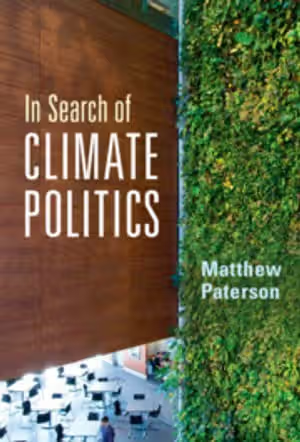
The book asks in what ways climate change is political, a question its description calls key but oddly neglected. Matthew Paterson answers by understanding politics in three ways at once: as a site of authoritative public decision-making, as a question of power and as a conflictual phenomenon. Recurring themes are depoliticization and repoliticization, and a tension between treating climate change as a single problem to be solved and recognizing its intrinsic complexity. These dynamics are linked to processes of capital accumulation and their associated subjectivities. The argument is developed through the city of Ottawa, which the book treats as a microcosm of the broader processes. It has ten chapters in about 160 pages of text, and several of the case chapters are co-authored with researchers who worked on the Ottawa studies.
Chapter 1: Introduction
The book opens with a decision by the University of Ottawa in April 2016. Students and some academics had campaigned for the university to divest from fossil fuels; the university announced that it would not divest, but then stated that it would withdraw money from fossil-fuel companies and move it into "clean energy" investments. The episode, which returns in Chapter 8, is used in Chapter 2 as a sketch of the book's argument about depoliticization and repoliticization.
Chapter 2: In Search of Climate Politics
The conceptual core. The chapter defines what is meant by politics, proposes that the drivers of and obstacles to climate action can be understood through a notion of cultural political economy, and sets out two dynamics: depoliticization and repoliticization, and a tension described as "purification versus complexity", between the wish for simple solutions or enemies and the multidimensional character of the high-carbon world. It begins by examining how climate change is commonly framed in public discourse and across academic disciplines.
Chapter 3: Making Climate Policy in the City of Ottawa
This chapter, written with Kofi Agyapong Adomako, traces the history of the City's response. Ottawa took an early interest and set ambitious targets, then scaled back, and it responded to city networks mainly by meeting their minimal expectations of inventories, plans and monitoring. The bursts of activity around 1991, 2004 and 2012–13 did not become sustained attention. The analysis runs to the adoption of the 2014 Air Quality and Climate Change Management Plan.
Chapter 4: Networked Governance and Carbon Accounting in Ottawa
Also written with Adomako, the chapter argues that political sites are historical creations that are constantly remade. It looks at two entangled aspects of how Ottawa is constituted as a political arena: the City's membership in networks of municipalities, and the main strategy of those networks, carbon accounting, which is widely understood as depoliticizing.
Chapter 5: Complete Streets and Its Discontents
Written with Louis Machabée, the chapter turns to conflict. Complete Streets are attempts to remake urban infrastructure so as to enable low-carbon pathways, and they have generated strong conflicts over transport and planning, in contrast to the low-conflict technical arena of carbon accounting.
Chapter 6: Intensifying Conflicts: Agonism and the Politics of Urban Spatial Transformations
Written with Merissa Mueller, this chapter extends the analysis from how people move to where they live. It examines conflicts over "intensification", the planning term for increasing urban density, and over what is built, where, and who decides.
Chapter 7: Mapping Climate Experimentation in Ottawa
Written with Xavier P-Laberge, the chapter moves beyond the City Council. It maps the governance initiatives on climate change taken by other institutions, including the city's two universities, two colleges and two school boards, which are central to initiatives on infrastructure and energy management.
Chapter 8: The University of Ottawa: Strategic Energy Management, Experimentation, and Repoliticization
The chapter examines climate politics within the most active of those institutions, the University of Ottawa, the subject of the divestment story in Chapter 1.
Chapter 9: Renewing Democratic Politics: The Ottawa Renewable Energy Cooperative
Written with Bora Plumptre, the chapter studies a community initiative, the Ottawa Renewable Energy Cooperative (OREC), as an example of efforts focused on changing energy supply rather than demand.
Chapter 10: Conclusions
The conclusion links the Ottawa findings to the wave of protest in early 2019, including Extinction Rebellion, the school strikes for climate, the Sunrise Movement, municipal declarations of climate emergency and the Green New Deal. It reads these as repoliticizing climate change by bringing it into public collective decision-making and emphasizing conflict.
Key Concepts
Chapters 1–2: Framing the Politics
- Three senses of politics: politics as authoritative public decision-making, as a question of power, and as conflict.
- Depoliticization and repoliticization: the recurring movement by which climate change is made to appear technical and then returned to contestation.
- Purification versus complexity: the tension between simple solutions or enemies and the complexity of a high-carbon society.
- Cultural political economy: the notion used to understand the drivers of and obstacles to climate action.
Chapters 3–6: Policy, Accounting and Conflict
- Carbon accounting: the main governance strategy of municipal climate networks, treated as depoliticizing.
- Complete Streets and intensification: the two planning issues around which conflict in Ottawa is analyzed.
- Agonism: the concept named in the subtitle of Chapter 6 for productive political conflict.
Chapters 7–10: Experiments and Renewal
- Climate experimentation: initiatives by institutions other than the City Council.
- Repoliticization: the focus of the chapters on the University of Ottawa and the energy cooperative, and of the conclusion on protest movements.
Critical Analysis
Strengths
- A framework carried through the case. The conceptual chapter introduces its three senses of politics and two dynamics, and the case chapters return to them, so the empirical material is organized by the argument.
- Depth in one setting. Concentrating on Ottawa allows the book to follow a single city from council policy through carbon accounting, planning conflicts, institutional initiatives and a community cooperative.
- Attention to the unglamorous parts of climate policy. By treating transport, planning and energy management as climate politics, the book draws attention to decisions that are not labeled as climate policy but shape emissions.
Limitations
- One city. The generalizations about capital accumulation and depoliticization rest on a single Canadian city. Readers who need comparison across countries will need other books.
- Theoretical background assumed. The argument uses concepts from political theory and political economy, such as power and depoliticization, without teaching them from scratch.
- Written before the later developments. The author finished a first draft in early 2019, and the conclusion ends with the protests of that year; events since then are not covered.
Where It Fits in the Course
Most of the environmental politics books on this list are textbooks. Chasek, Downie and Allan's Global Environmental Politics and Kate O'Neill's The Environment and International Relations concentrate on international negotiations, regimes and actors. Neil Carter's The Politics of the Environment covers green ideas, activism and policy, and Robyn Eckersley's Environmentalism and Political Theory is an introduction to environmental political theory. Paterson's monograph asks a more specific question, in what sense climate change is political, and answers it at the scale of a city.
Read it after one of the textbooks and after some political theory. It makes a good contrast with Ostrom's Governing the Commons, which studies how small communities solve resource problems through rules they design themselves, whereas Paterson studies how a global problem is depoliticized and fought over in an urban setting.
How to Use This Book
The book suits graduate students and advanced undergraduates with a course in environmental politics behind them and some familiarity with concepts such as power and depoliticization.
A practical plan:
- Core: Read Chapters 1 and 2 first, since the vocabulary of the whole book is set there, and then the conclusion.
- Cases: Read Chapters 3 and 4 for the policy and governance story, then Chapters 5 and 6 for the conflicts over planning. Chapters 7 to 9 can be read selectively, according to interest in institutions or community energy.
- Application: Choose a local climate initiative, ask which of the three senses of politics it involves, and note where it is presented as technical.