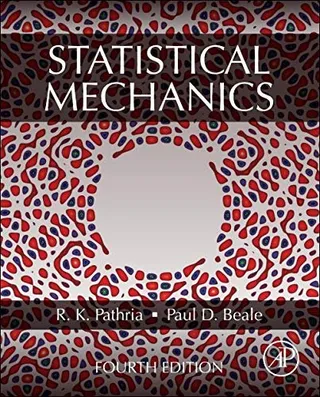
01 / Reading Guide
Reading Guide
Who this book is for
For advanced undergraduates and beginning graduate students learning statistical mechanics as a framework for collective behaviour. The book develops the standard ensembles while showing how ideas about entropy, scaling and fluctuations travel across scientific subjects. It is especially useful for readers who want physical reasoning and computational experiments to support formal derivations rather than treating the subject as a catalogue of partition functions.
Prerequisites
University calculus, introductory probability, classical mechanics and basic quantum physics. Some exercises benefit from programming and linear algebra; review distributions and derivatives of thermodynamic potentials.
What it covers
Random walks, equilibrium, entropy, free energies and quantum statistics lead into computation, order parameters, broken symmetry, correlations and phase transitions. Examples connect these tools with information, biological processes, networks and complexity. Exercises are a substantial part of the learning route and vary considerably in mathematical and computational demands.
How to use it
For each ensemble, identify the allowed exchanges with the environment and the corresponding controlled quantities. Derive one observable from a partition function, then check its low-temperature or high-temperature limit. Use a small simulation to compare fluctuations with the average prediction. Keep finite-size behaviour separate from a thermodynamic-limit argument, and draw the order parameter before interpreting a phase diagram. Choose exercises matching your mathematical preparation before tackling research-oriented extensions.
Edition and sources
The Cornell author page links the complete published second edition, available from Oxford University Press in January 2021, and separate corrections and computational exercises. Free author-hosted reading does not by itself grant an unrestricted reuse licence. No print-format ISBN is assigned here.