01 / Reading Guide
Reading Guide
Citation
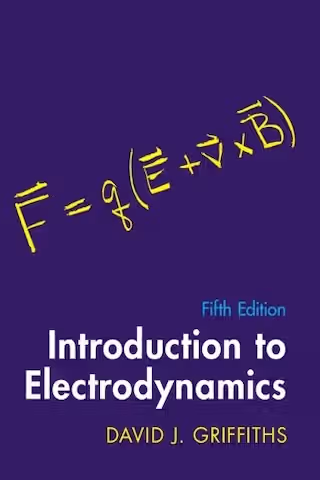
Griffiths, D. J. (2024). Introduction to Electrodynamics (5th ed.). Cambridge University Press.
Chapter Summary
The book has twelve chapters and three appendices, with a short "Advertisement" before Chapter 1 that places electrodynamics among the four realms of mechanics and the four fundamental forces. The first chapter is mathematical preparation; Chapters 2–6 treat static fields; Chapters 7–12 treat fields that change in time. In-chapter problems are meant to be done at once, longer problems come at chapter ends, and a few answers are given at the back.
Chapter 1: Vector Analysis
Vector algebra and triple products, differential calculus (gradient, divergence, curl, product rules, second derivatives), integral calculus and the fundamental theorems for gradients, divergences and curls, curvilinear coordinates, the Dirac delta function, and the theory of vector fields including the Helmholtz theorem and potentials.
Chapter 2: Electrostatics
Coulomb's law and the electric field of discrete and continuous charge, the divergence and curl of E with Gauss's law and its applications, the electric potential with Poisson's and Laplace's equations and boundary conditions, work and energy in electrostatics, and conductors and capacitors.
Chapter 3: Potentials
Laplace's equation in one, two and three dimensions, uniqueness theorems, the method of images, separation of variables in Cartesian and spherical coordinates, and the multipole expansion with the field of a dipole.
Chapter 4: Electric Fields in Matter
Polarization of dielectrics and bound charges, the field of a polarized object, the electric displacement D and its boundary conditions (including a new section on the crystal ambiguity), and linear dielectrics: susceptibility and permittivity, boundary-value problems, energy and forces.
Chapter 5: Magnetostatics
The Lorentz force law and currents, the Biot-Savart law, the divergence and curl of B with Ampère's law, a comparison of magnetostatics and electrostatics, and the magnetic vector potential, its boundary conditions and multipole expansion.
Chapter 6: Magnetic Fields in Matter
Magnetization, diamagnets, paramagnets and ferromagnets, bound currents and the field of a magnetized object, the auxiliary field H, and linear and nonlinear media.
Chapter 7: Electrodynamics
Electromotive force: Ohm's law and motional emf. Electromagnetic induction: Faraday's law, the induced electric field, inductance and energy in magnetic fields. Maxwell's equations, including how Maxwell repaired Ampère's law, magnetic charge, the equations in matter and boundary conditions. The fifth edition adds a section on the field of a rotating magnet.
Chapter 8: Conservation Laws
Charge and energy (the continuity equation and Poynting's theorem); momentum, including Newton's third law in electrodynamics, Maxwell's stress tensor and angular momentum; and why magnetic forces do no work.
Chapter 9: Electromagnetic Waves
Waves in one dimension, electromagnetic waves in vacuum and their energy and momentum, waves in matter with reflection and transmission at normal and oblique incidence, absorption and dispersion in conductors and in the frequency dependence of permittivity, and guided waves in waveguides and coaxial lines.
Chapter 10: Potentials and Fields
The potential formulation, gauge transformations, Coulomb and Lorenz gauges, retarded potentials for continuous distributions, Jefimenko's equations, and the Liénard-Wiechert potentials and fields of a moving point charge.
Chapter 11: Radiation
Dipole radiation, with electric dipole, magnetic dipole and arbitrary sources; the power radiated by a point charge (the Larmor and Liénard formulas); and the radiation reaction, with the Abraham-Lorentz formula and the self-force on a charged particle.
Chapter 12: Electrodynamics and Relativity
The special theory of relativity, relativistic mechanics, and relativistic electrodynamics: magnetism as a relativistic effect, how fields transform, the field tensor, tensor notation and relativistic potentials.
Appendices
A. Vector Calculus in Curvilinear Coordinates; B. The Helmholtz Theorem; C. Units. The book uses SI units, and Appendix C provides a "dictionary" for converting the main results into Gaussian units.
Key Concepts
Chapters 1–4: Mathematics and Electrostatics
- Gauss's law and the curl of E: the two equations that determine the static electric field.
- Boundary-value methods: uniqueness theorems, images and separation of variables for Laplace's equation.
- Multipole expansion: representing a distant potential as a series of monopole, dipole and higher terms.
- Bound charge and D: how polarization is handled in Gauss's law.
Chapters 5–6: Magnetostatics
- Ampère's law and the vector potential: the curl equation for B and the potential from which it follows.
- Bound current and H: the magnetic analogue of polarization.
Chapters 7–8: Maxwell's Equations and Conservation
- Faraday's law and displacement current: the two corrections that give the full set of equations.
- Poynting vector and stress tensor: how fields carry energy and momentum.
Chapters 9–12: Waves, Radiation and Relativity
- Wave equation for E and B: electromagnetic waves and their speed.
- Retarded potentials: fields that depend on conditions at an earlier time.
- Larmor formula: the power radiated by an accelerating charge.
- Field tensor: the unified relativistic description of E and B.
Critical Analysis
Strengths
- An informal, readable approach. In the preface Griffiths describes his approach as "perhaps less formal than most" and aims to make difficult ideas interesting and accessible. The book is written for a junior or senior undergraduate course.
- Careful problem design. Problems come in two kinds: those placed within a chapter, which should be worked straight after the relevant section, and longer ones at the chapter end. Unusually hard problems are flagged, and the new edition adds problems that need a computer, keyed to Mathematica, for plotting fields and field lines or following a particle's trajectory.
- Honest treatment of subtle points. The fifth edition adds commentary on the crystal ambiguity in defining polarization, on problems with electric and especially magnetic field lines, and on the awkward role of intrinsic spin in a classical account of magnetic materials.
- Standard sequence with a good route in. Chapters 1–7 can be a one-semester course, as the preface says; the whole book fits two semesters. References to the American Journal of Physics point to readable literature on points in the text.
Limitations
- Heavy on vector calculus from the start. Chapter 1 is a full chapter of mathematics, and later chapters (separation of variables in spherical coordinates, Chapter 12's tensors) rely on it. Readers without fluency in multivariable calculus will struggle.
- Classical only. The Advertisement states that, apart from the last chapter's relativity, the book stays within classical mechanics, and that the photon barely appears and there is no real treatment of the quantum behaviour of fields.
- Few answers. Answers to problems are given only "when this seems particularly appropriate"; the complete solution manual is available to instructors only, so self-study needs a classmate or another source.
- Unusual notation. Griffiths writes the Cartesian unit vectors as x̂, ŷ, ẑ, uses s for the distance from the axis in cylindrical coordinates, and uses a script letter for the vector from source point to field point. This is easy to follow once noticed, but the script letter can be mistaken for the ordinary distance r, as the preface itself warns.
Where It Fits in the Course
Griffiths is the intermediate, upper-level undergraduate textbook in this electromagnetism list. Before it, a first course in electricity and magnetism comes from the introductory physics sequence, such as OpenStax's University Physics Volume 2 (a free calculus-based course from Coulomb's law to electromagnetic waves), or Purcell and Morin's Electricity and Magnetism, a calculus-based first serious course known for deriving magnetic forces from electrostatics and special relativity. Fleisch's A Student's Guide to Maxwell's Equations is a short companion that explains the four equations one at a time and can be read before or alongside Chapters 2, 5 and 7.
The graduate-level continuation is Jackson's Classical Electrodynamics, a rigorous treatment of fields, radiation and charged-particle dynamics. Bittencourt's Fundamentals of Plasma Physics is an advanced follow-on for those whose interest lies in charged-particle dynamics and plasma waves.
How to Use This Book
The book is for physics, engineering and mathematics students who have finished calculus-based introductory physics and multivariable calculus, with some familiarity with differential equations. It can serve as the main text for a two-semester course in electricity and magnetism.
A practical plan:
- Core, in order: Chapters 1–5. Treat Chapter 1 as a reference to be learned while using it; the fundamental theorems of vector calculus are used on every page that follows.
- First semester endpoint: finish with Chapters 6 and 7, culminating in Maxwell's equations.
- Second semester: Chapters 8–12 in order. A student who needs only the basics of waves can stop after Chapter 9; Chapters 10–12 (potentials, radiation, relativity) are the most advanced part of the book.
- Optional: the Chapter 3 treatments of multipoles and separation of variables in spherical coordinates, and the guided-wave material in Chapter 9.5, can be left for a second reading.
Work the in-chapter problems immediately, attempt the problems flagged with an exclamation mark only after the rest, and use the computer problems if you have Mathematica or an equivalent. Check the answers that are printed, and read the American Journal of Physics references when a problem sparks curiosity. Appendix C is a useful conversion guide for books that use Gaussian units.