01 / Reading Guide
Reading Guide
Citation
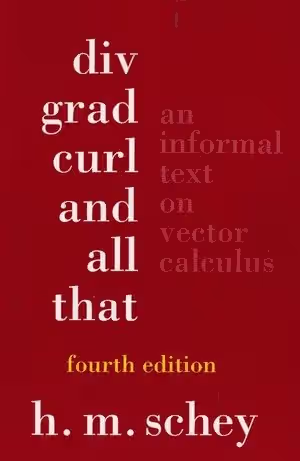
Schey, H. M. (2005). Div, Grad, Curl, and All That: An Informal Text on Vector Calculus (4th ed.). W. W. Norton.
Chapter Summary
The book is short, about 163 pages according to library records, and has four chapters followed by solutions to the problems. Each chapter ends with a set of problems. The catalogue contents list the sections within each chapter, and they show a clear plan: electrostatics supplies the physical setting, and each new operator or theorem is introduced as a way of describing electric fields.
Chapter I: Introduction, Vector Functions, and Electrostatics
The first chapter has three sections: an introduction, vector functions and electrostatics. It sets up the language of vector fields and the electric field that the rest of the book keeps returning to.
Chapter II: Surface Integrals and the Divergence
The chapter begins from Gauss' law and the unit normal vector, then defines and evaluates surface integrals and introduces flux. After using Gauss' law to find the field, it defines the divergence, gives its form in cylindrical and spherical coordinates, introduces the Del notation and proves the divergence theorem, with two simple applications of the theorem.
Chapter III: Line Integrals and the Curl
The third chapter starts from work and line integrals, treats line integrals involving vector functions and path independence, and defines the curl, including its form in cylindrical and spherical coordinates and its meaning. It then gives the differential form of the circulation law, Stokes' theorem, an application of the theorem, the role of simply connected regions, and the relation between path independence and the curl.
Chapter IV: The Gradient
The last chapter returns to line integrals to introduce the gradient. It uses the gradient to find the electrostatic field and to work with Laplace's equation, then covers directional derivatives, the geometric significance of the gradient and its form in cylindrical and spherical coordinates.
Solutions to Problems
The book closes with solutions to the problems.
Key Concepts
Chapters I–II: Fields, flux and divergence
- Vector functions and the electric field: the setting of Chapter I.
- Flux and surface integrals: the tools of Chapter II.
- Divergence and the divergence theorem: Gauss' law expressed locally and then in integral form.
Chapters III–IV: Circulation, curl and gradient
- Line integrals and path independence: the starting point of Chapter III.
- Curl and Stokes' theorem: the circulation counterpart of the divergence material.
- Gradient and Laplace's equation: the content of Chapter IV.
Critical Analysis
Strengths
- Compact and ordered. Four chapters take the reader through divergence, curl and gradient in turn, each tied to an integral theorem or an integral quantity.
- A physical running example. The contents show electrostatics (the electric field in Chapter I, Gauss' law in Chapter II, finding the field and Laplace's equation in Chapter IV) as the thread, so the operators are met as tools for describing fields before they are treated abstractly.
- Coordinate systems are not left until later. Divergence, curl and gradient each include a section on their form in cylindrical and spherical coordinates, which is where students often meet them in physics courses.
- Problems and solutions. Every chapter ends with problems, and the book ends with solutions to problems, which supports self-study.
Limitations
- Narrow in scope. The contents are limited to divergence, curl, gradient and the related integral theorems; curvilinear coordinates in general, tensors and differential forms are not listed.
- Electrostatics as the only setting. Readers meeting vector calculus for fluid flow or mechanics will see few examples from their field.
- Informal by design. The subtitle describes the book as an informal text, so it is not a replacement for a rigorous multivariable calculus course.
Where It Fits in the Course
Schey's book is a short, targeted supplement to the larger mathematical methods texts rather than a full course. Riley and Hobson's Foundation Mathematics for the Physical Sciences covers the same operators and theorems in Chapters 11 and 12 of a much longer, broader text, and the two can be read side by side. Boas's Mathematical Methods in the Physical Sciences and Hassani's Mathematical Methods include vector calculus among many other topics, and Schey's chapters make a focused preparation for those sections.
Arfken, Weber and Harris is a reference and graduate text for later use, and Strogatz's Nonlinear Dynamics and Chaos is a subject text on a different topic. Of the books on this list, Schey is the one to open first when divergence, curl and Stokes' theorem are the immediate obstacle.
How to Use This Book
The page metadata lists single-variable calculus and partial derivatives as prerequisites, with some familiarity with electric fields helping. The book suits physics and engineering students who are about to start, or are struggling with, electromagnetism.
A practical plan:
- Read in order. The four chapters build on each other, and Chapter IV's use of the gradient draws on the line integrals of Chapter III.
- Work the problems. The problems close each chapter; try them before looking at the solutions at the end of the book.
- Pair it with a course. Read Chapter II alongside the study of Gauss' law, and Chapters III and IV alongside circulation and potential.
- Check the coverage against the course. The contents list no topics beyond the three operators and their integral theorems, so note which parts of a vector calculus syllabus (for example general curvilinear coordinates) still need another source.
- Move on. After finishing, use a broader text such as Riley and Hobson, Boas or Hassani for the remaining methods.