01 / Reading Guide
Reading Guide
Citation
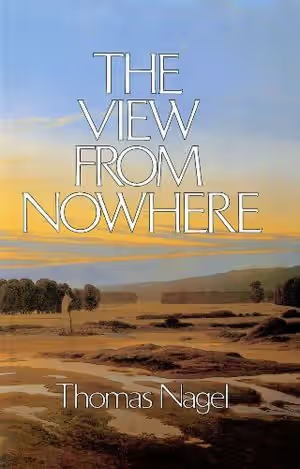
Nagel, T. (1989). The View from Nowhere. Oxford University Press. (First published 1986.)
Chapter Summary
The book runs to about 250 pages and is organised around a single issue rather than as a survey. Its contents list an introduction, chapters on mind, mind and body, knowledge, thought and reality, and freedom, then value and ethics, and a closing chapter on birth, death and the meaning of life, followed by a bibliography and an index. The publisher's description supplies the thread that links them: human beings can view the world in a detached way, from a vantage point that is, in Nagel's phrase, "nowhere in particular", while each of us is also a particular person in a particular place with a personal view of the world. The book asks how these two standpoints can be reconciled intellectually, morally and practically, and how far they can be integrated or remain irreconcilable.
Introduction
The book opens with an introduction beginning on page 3. The publisher describes Nagel's claim, which the whole book develops, that our divided nature is the root of a whole range of philosophical problems, touching every aspect of human life.
Mind; Mind and Body
Two parts of the contents, beginning on pages 13 and 28, take up the philosophy of mind. The publisher records Nagel's charge that excessive objectification has been a malady of recent analytic philosophy and has produced implausible forms of reductionism in the philosophy of mind and elsewhere. The mind–body problem and personal identity are among the issues the book addresses.
Knowledge
The contents then turn to knowledge (page 67). The publisher lists knowledge and skepticism among the topics the book treats.
Thought and Reality
This part, which begins on page 90, carries the title of one of the topics the publisher lists, thought and reality.
Freedom
The part on freedom (page 110) corresponds to the publisher's listing of free will among the book's topics.
Value
The contents continue with a chapter on value (page 138) and, within the later part of the book, sections headed Personal Values and Impartiality, Agents and Victims, and Moral Progress. The publisher says the book treats ethics and the relation between moral and other values.
Birth, Death, and the Meaning of Life
The final chapter (page 208) turns to the meaning of life and to death, the last of the topics in the publisher's list.
Key Concepts
Introduction through Knowledge
- Subjective and objective standpoints: the personal view from inside a particular life and the detached view that tries to leave that position behind.
- Objectification and reductionism: the publisher says excessive objectification has led to implausible forms of reductionism in the philosophy of mind and elsewhere.
- Personal identity and the mind–body problem: topics the publisher names among those the book addresses.
Thought and Reality through Freedom
- Thought and reality: one of the book's named topics, listed alongside knowledge and skepticism.
- Free will: another named topic, approached from the same standpoints.
Value and Meaning
- Impartiality and personal values: a pairing named in a section heading of the ethics part.
- Agents and victims; moral progress: topics named in the contents list of the ethics part.
- The meaning of life and death: the subject of the closing chapter.
Critical Analysis
Strengths
- A single organising problem. The publisher presents the book as ambitious and lively, tackling one question and showing how it underlies the problems of mind, knowledge, freedom, ethics and the meaning of life.
- A clear position. The book does not just report views; it argues that the objectifying impulse should be kept but taught to live alongside perspectives that cannot be discarded.
- Compact scope for the reach. The book covers mind, knowledge, freedom, ethics and the meaning of life in about 250 pages, with a bibliography of six pages, so the argument is economical.
- Engagement with major figures. Descartes, Wittgenstein and Parfit are among the names that recur in the text, so the book also serves as a route into those debates.
Limitations
- Not a survey or introduction. The book argues for one outlook across several fields, as the publisher's description indicates, and does not aim to cover each topic evenly, so a reader unfamiliar with the standard debates will find the argument harder to place.
- Unresolved by design. The publisher's description closes by saying that reconciliation between the two standpoints is not always possible, so a reader hoping for a single settled answer will not find one.
- Date. The book appeared in 1986, so later work on consciousness, free will and ethics falls outside it.
Where It Fits in the Course
Nagel is the one monograph in this introductory philosophy course list. Russell's The Problems of Philosophy and Blackburn's Think are short first introductions, built around knowledge and a handful of enduring problems, and the OpenStax Introduction to Philosophy is a broad open textbook with primary sources. Kenny's A New History of Western Philosophy supplies the historical background to figures such as Descartes that Nagel engages with. Read Nagel after one of the introductions, once the standard positions on mind, knowledge, free will and ethics are familiar, because he treats those topics as parts of one question rather than as separate chapters of a survey.
How to Use This Book
The book suits upper-level undergraduates and beginning graduate students who have finished an introductory course, ideally with some philosophy of mind and ethics. It is also a good choice for readers in other fields interested in the limits of scientific objectivity.
A practical plan:
- Start with the Introduction. It opens the book and sets up the central issue that the publisher describes.
- Core: Mind and Body, Knowledge and Thought and Reality, then Freedom and Value, in the book's order, since the publisher presents each field as one manifestation of the same divide between the two standpoints.
- Optional: the closing chapter on birth, death and the meaning of life can be read on its own once the earlier parts are familiar.
- Along the way: after each chapter, write a short statement of how the subjective and objective standpoints conflict in that field and what Nagel concludes. Read his essay "What Is It Like to Be a Bat?" with the mind chapters, and consult Kenny's history where a historical figure is invoked.