01 / Reading Guide
Reading Guide
Citation
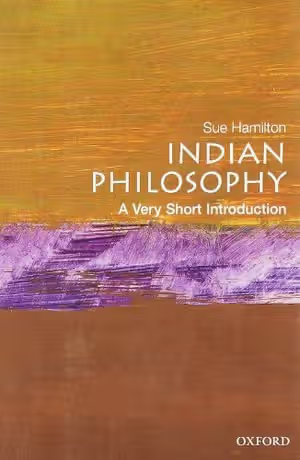
Hamilton, S. (2001). Indian Philosophy: A Very Short Introduction. Oxford University Press. Very Short Introductions.
Chapter Summary
The book has eight chapters and a postscript on about 140 pages, with a note on languages and pronunciation, maps, recommended further reading and an index. The preface describes the challenge of presenting Indian philosophy in some 35,000 words: technical terms are kept to a minimum and explained in text boxes, a few Sanskrit and Pāli words are left untranslated, and longer extracts from primary texts are given in the author's own translations or paraphrases in contemporary English. Chapter 1 explains the plan: after two chapters on the early period, the book follows the six classical darśanas in their traditional pairs (Nyāya and Vaiśeṣika, Yoga and Sāṃkhya, Mīmāṃsā and Vedānta), with chapters on Buddhist thought placed where they belong chronologically.
Chapter 1: Reason and Belief: Richness and diversity in Indian thought
The opening chapter argues that in India philosophy has traditionally been bound up with one's personal destiny, an attempt to understand reality as part of an inner or spiritual quest, closer to Socrates than to the Western separation of faith and academic philosophy that Hamilton dates to Kant. Text boxes explain terms such as soteriology and ontology, and the chapter introduces karma and rebirth, the term darśana, and the selection of material. Hamilton explains that the label "Hindu" is anachronistic and will not be used, and names notable omissions, including Jainism and the materialist Cārvāka school, which appears only in passing.
Chapter 2: The Brahmanical Beginnings: Sacrifice, cosmic speculation, oneness
The early Vedic tradition of sacrifice and the speculation of the early Upaniṣads, which teach that self and cosmos are one: the identification of ātman with Brahman and the formula "you are that" from the Chāndogya Upaniṣad.
Chapter 3: Renouncing the Household: The Buddha's Middle Way
The Buddha, set in the milieu of renouncers who rejected brahminical authority, and his teachings, including the Four Noble Truths, dependent origination and the analysis of the person into constituents (khandhas).
Chapter 4: Issues and Justifications: Language, grammar, and polemics
How the brahminical tradition defended its sources under challenge, through grammar, the study of language and debate. The chapter introduces the criteria of knowledge known as pramāṇa, including testimony (śabda-pramāṇa).
Chapter 5: Categories and Method: Vaiśeṣika and Nyāya
Vaiśeṣika's categories of existent things, including the later addition of absence or non-existence as a real category, and the logical method of Nyāya, which Hamilton presents as grounded in the world and in human experience rather than as formal logic in the modern Western sense.
Chapter 6: Things and No-things: Developments in Buddhist thought
The scholastic Abhidharma analysis of phenomena (dharmas), Nāgārjuna's Madhyamaka teaching that all phenomena are empty (śūnyatā), and the Yogācāra school's focus on mental processes, together with the question whether it should be read as idealism.
Chapter 7: The Witness and the Watched: Yoga and Sāṃkhya
Classical Sāṃkhya's distinction between knowing subjects (puruṣa) and the material principle (prakṛti), as set out in the Sāṃkhya Kārikā, and the Yoga Sūtras, with a closing note on how prakṛti's manifestation should be understood.
Chapter 8: The Word and the Book: Bhartṛhari, Mīmāṃsā, and Vedānta
The grammarian Bhartṛhari's view of language as continuous with reality, the Mīmāṃsā exegetes of Vedic ritual injunctions and their categories, and two forms of Vedānta: Śaṅkara's non-dualism, on which Brahman is an unchanging absolute and plurality is only apparent, and Rāmānuja's theistic view, on which Brahman has real qualities and the world is a real transformation of it.
Postscript: From Classical Thought to the Modern Day
A brief look at how Indian thought has been received since the classical period, including the way modern Western philosophers have engaged mainly with Nyāya and Buddhist work on terms of interest to themselves.
Key Concepts
Chapters 1–3: Frameworks and beginnings
- Soteriology: a system concerned with salvation or liberation, in which one's destiny depends on one's beliefs and practices.
- Darśana: a "view" or school of Indian philosophy; six Brahmanical darśanas came to be regarded as classical.
- Karma and rebirth: the idea that actions determine future existences within a cycle from which liberation is sought.
- Ātman and Brahman: the self and the universal reality, identified in the early Upaniṣads.
- Dependent origination: the Buddhist teaching that phenomena arise in dependence on conditions.
Chapters 4–5: Knowledge and categories
- Pramāṇa: a means of valid knowledge, such as perception, inference or testimony.
- Categories: Vaiśeṣika's enumeration of the kinds of existent things.
- Ontology: the account of what really exists, explained in one of the book's text boxes.
Chapters 6–8: Later schools
- Emptiness (śūnyatā): Nāgārjuna's teaching that no phenomenon has independent existence.
- Puruṣa and prakṛti: Sāṃkhya's two principles, conscious witnesses and the material world they observe.
- Non-dualism: Śaṅkara's view that the self is Brahman and plurality is only apparent.
- Qualified non-dualism: Rāmānuja's view that Brahman has real qualities and the world is real.
Critical Analysis
Strengths
- A clear organising principle. The traditional pairing of the six darśanas gives the book a firm structure, and placing the Buddhist chapters chronologically shows how the schools developed by arguing with one another, as Chapter 1 promises.
- Sensitive to context. Hamilton begins by explaining why Indian philosophy cannot simply be measured against Western academic philosophy, and the text boxes on terms such as soteriology and ontology give beginners the vocabulary to follow.
- Primary sources in readable form. Extracts from texts such as the Upaniṣads, Nāgārjuna's verses, Śaṅkara and Rāmānuja are paraphrased into plain contemporary English, as the preface explains, so readers meet the arguments in the original thinkers' terms.
- Buddhism given its due. Two chapters on Buddhism reflect Hamilton's point that Buddhism thrived in India for more than a thousand years and shaped the debates of the other schools.
Limitations
- Admitted omissions. Jainism is a notable omission, by the author's own statement, and the Cārvāka materialists appear only in passing; students interested in these traditions need other sources.
- Very compressed. At about 35,000 words, chapters run to between about 11 and 23 pages, often covering two schools each, so arguments are sketched rather than reconstructed in detail.
- Paraphrase rather than translation. The author's preference for paraphrase in the interests of clarity makes the extracts readable but less suitable for close textual work; the preface itself invites readers to consult other published translations for comparison.
- Published in 2001. The further reading reflects the scholarship available at that date.
Where It Fits in the Course
Hamilton's book is the broadest short starting point for the Indian part of this course. Peter Adamson and Jonardon Ganeri's Classical Indian Philosophy covers the same schools and their debates in many short chapters at much greater length, and is the natural next book. Mark Siderits's Buddhism as Philosophy goes deeper into the Buddhist material of Chapters 3 and 6, pairing translated passages with reconstructions of the arguments and asking whether they succeed. Michael Carrithers's The Buddha: A Very Short Introduction is a companion to Chapter 3, setting the Buddha in his historical context.
The Chinese texts on the list, Bryan Van Norden's Introduction to Classical Chinese Philosophy and A. C. Graham's Disputers of the Tao, cover a different tradition; reading Hamilton alongside Van Norden gives a balanced first view of the two main Asian traditions in the course.
How to Use This Book
No prior knowledge of Indian religions or philosophy is needed. The book suits first-year students, students of religion who want a philosophical angle, and philosophy students meeting non-Western traditions for the first time.
- Read Chapter 1 carefully: it explains the book's plan, its key terms and what it leaves out.
- Core sequence: Chapters 2–3 on the early Brahmanical and Buddhist material, then Chapters 5 and 6, which contain the most argument-heavy material on categories, method and emptiness.
- Rest of the classical schools: Chapters 4, 7 and 8, with Chapter 8 on Vedānta closing the classical story.
- Alongside: use the note on pronunciation and keep a glossary of the untranslated terms; for each school, read a short passage in a full published translation and compare it with Hamilton's paraphrase.
The recommended further reading at the end points to fuller histories and translations for each school.