01 / Reading Guide
Reading Guide
Citation
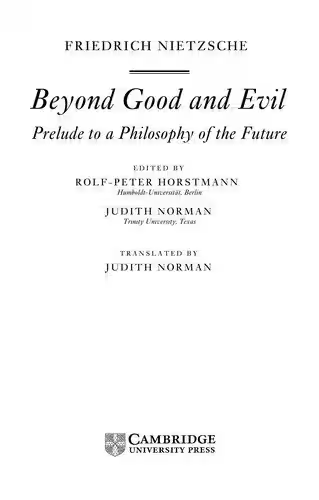
Nietzsche, F. (2001). Beyond Good and Evil: Prelude to a Philosophy of the Future (R.-P. Horstmann, Ed.; J. Norman, Ed. & Trans.). Cambridge University Press. (Original work published 1886.) Free public-domain translation by Helen Zimmern: https://www.gutenberg.org/ebooks/4363
Chapter Summary
Context and Argument
The book consists of a preface, 296 numbered sections (aphorisms, some a line long and some several pages) in nine parts, and a closing poem. The preface in the public-domain translation is dated Sils Maria, June 1885. It treats dogmatic philosophy, with Plato's "Pure Spirit and the Good in Itself" as its worst error, as something Europe is now overcoming, and addresses "good Europeans" and "free spirits". The book as a whole questions philosophers' prejudices, the value of truth and the morality inherited from Christianity and Platonism, and sketches the philosophers of the future. The Cambridge edition adds an introduction by Rolf-Peter Horstmann (about twenty pages), a chronology, further reading, a note on the text and a glossary of names. Part titles below follow the Cambridge contents; the Zimmern translation words several differently.
Part 1: On the Prejudices of Philosophers (sections 1–23)
Section 1 asks what the will to truth is and what it is worth: "why not rather untruth?" Nietzsche then argues that metaphysicians share a belief in opposite values, that philosophy is "the confession of its originator" (section 6), and that the philosophical self-certainties "I think" and "I will" (sections 16–19) conceal a bundle of assumptions. Kant's "synthetic judgments a priori" are mocked in section 11, and the part ends with psychology reimagined as the study of the will to power.
Part 2: The Free Spirit (24–44)
The part begins with the claim that human knowledge rests on simplification and falsification. It moves to the "free spirit", whom Nietzsche separates from democratic "levelers" (section 44), to the idea that truth may be harmful (39), and to the need for masks (40). Section 42 introduces the philosophers of the future as "tempters", and section 32 sketches a pre-moral, moral and "ultra-moral" history of human valuation.
Part 3: The Religious Character (45–62)
Religion is treated as a subject for psychology. The part discusses the faith of early Christianity and Pascal, the "religious neurosis" with its regimens of solitude and fasting, why atheism has spread, a "ladder of religious cruelty" (55), and the pessimism of Schopenhauer and Buddha, which Nietzsche wants to take beyond morality (56). It ends on how a philosopher might use religion as a tool of discipline, and on what religions cost when they rule outright (61–62).
Part 4: Epigrams and Entr'actes (63–185)
A long run of short sayings and miniature observations on love, vanity, knowledge, friendship, character, women and men, and morality, among them "there are no moral phenomena, only a moral interpretation of phenomena" (108) and the warning that one who fights monsters may become one (146).
Part 5: On the Natural History of Morals (186–203)
Here Nietzsche proposes a comparative study of moralities, asks what a moral claim reveals about whoever makes it (the categorical imperative, section 187), and presents morality as a long constraint (188). The part also covers the "slave revolt" in morals (195), the "herd" instinct and the moral outlook of modern Europe (199–202), and a call for new philosophers (203).
Part 6: We Scholars (204–213)
The scholar and the philosopher are separated. Nietzsche is critical of the "objective" man of science, discusses skepticism and the philosophers of the future as critics and experimenters (208–210), and distinguishes philosophical workers from philosophers who create values (211–213).
Part 7: Our Virtues (214–239)
Honesty is claimed as the virtue the "free spirits" cannot shed (227), the historical sense is examined (224), and the measuring of worth by pleasure and pain in hedonism and utilitarianism is rejected (225). The closing sections (231–239) contain Nietzsche's statements about women, which many readers find offensive and which are better read with critical commentary.
Part 8: Peoples and Fatherlands (240–256)
Culture and nationality in Europe: Wagner and German music, the German, English and French "souls", and the "good European" against nationalism. Section 242 reads the democratic movement as part of a larger European process of assimilation, and section 256 argues that "Europe wishes to be one".
Part 9: What Is Noble? (257–296)
Section 257 holds that every elevation of the human type has come from an aristocratic society, and section 260 sets out the distinction between master morality and slave morality. Later sections describe the noble soul, its sense of rank and "signs of nobility" (272), solitude, and the philosopher. The last numbered section is a farewell to the author's own "written and painted thoughts", which have started to turn into truths.
From High Mountains
The closing poem, called "From the Heights" in the Zimmern translation, is an aftersong that opens with "Midday of Life" and a search for friends.
Key Concepts
Parts 1–2
- Will to truth: the drive to know, which Nietzsche asks us to evaluate, not take for granted.
- Perspective: valuations and appearances as provisional viewpoints; the Preface calls perspective the fundamental condition of life.
- Will to power: the proposal that living things seek above all to discharge their strength, with self-preservation only a result.
- Free spirits and philosophers of the future: the independent thinkers who would experiment with new values.
Parts 3–6
- Psychology of religion: religious states analysed as expressions of drives and regimes of life.
- Natural history of morals: the project of surveying moralities and the feelings behind them.
- Herd morality: the morality of the gregarious majority, which Nietzsche treats as the dominant European type.
Parts 7–9
- Master and slave morality: the two primary types of morality distinguished in section 260.
- Pathos of distance: the sense of rank that Nietzsche ties to aristocratic societies (257).
- Good Europeans: those who think beyond nationalist loyalties.
Critical Analysis
Strengths
- Argument inside an aphoristic form. The opening part contains sustained analyses, such as the dissection of "I think" and the account of willing as sensations, thought and an emotion of command (sections 16–19), alongside the short sayings. A reader sees the method in action before encountering the more provocative claims.
- Self-aware about its own claims. Nietzsche allows that his view of natural law is only "interpretation" (22), and the book ends by noting that its thoughts are turning into tiresome truths (296).
- Range. The nine parts take in epistemology, the psychology of religion, ethics, scholarship, European politics and culture. One theme, such as morality, can be followed across several parts.
- Edition apparatus. The Cambridge edition's contents list an introduction, a chronology, further reading, a note on the text and a glossary of names, which the aphorisms' many allusions make useful.
Limitations
- Allusive and compressed. The text refers constantly to philosophers, composers and politics of the 1880s without explanation (Boscovich in section 12, for instance, or Tartuffe and Wagner). Without the glossary and introduction, many sections are hard to place.
- Assertion in places. Some of the boldest claims occupy a few lines, such as the statement that life is will to power (13). The reader must look elsewhere for sustained defences.
- Offensive and contestable passages. The sections on women (231–239), on peoples and races, and on slavery and aristocracy (257) reflect the author's prejudices and need to be read critically alongside scholarship.
- Not a system. The book offers no step-by-step theory; readers wanting a worked-out ethics or metaphysics will not find one here.
Where It Fits in the Course
This is the primary text in the course alongside two other primary texts: Heidegger's Being and Time in the Stambaugh-Schmidt translation, a systematic treatise on the question of being, and Hegel's Phenomenology of Spirit in Pinkard's translation; Hegel is mentioned only in passing here (for example in sections 211 and 252). Nietzsche is a much shorter and more fragmentary read than either, so it can be the first primary text a student attempts.
David West's Continental Philosophy: An Introduction treats Nietzsche in a section of its Chapter 5, and Simon Critchley's Continental Philosophy: A Very Short Introduction presents the tradition as a response to nihilism, which this book mentions in section 10. Either is a good first read. Sarah Bakewell's At the Existentialist Café is a narrative history of phenomenology and existentialism, the later movements in the tradition.
How to Use This Book
The book suits undergraduates in continental or nineteenth-century philosophy and ethics students who want Nietzsche's critique of morality. Some prior philosophy and a short introduction to Nietzsche (West's Chapter 5 or Critchley) are useful.
A practical plan:
- Core: the Preface and Part 1 closely, then Part 2, Part 5 and Part 9, which together set out the critique of philosophy, the free spirit and the two types of morality.
- Second reading: Part 3 for the psychology of religion, and Part 6 for Nietzsche's view of philosophers.
- Selective: Part 4, in small batches rather than at one sitting; Part 8 for his remarks on Europe; and Part 7, whose closing sections on women should be read with a critical commentary.
Read a part at a time and keep a list of recurring themes rather than treating each section in isolation. Use the editor's introduction and glossary of names as companions, and when wording matters compare the Cambridge translation with the free Zimmern text.
Edition and Sources
This guide is based on the full text of Helen Zimmern's translation of Beyond Good and Evil (Project Gutenberg eBook #4363, a reprint from The Complete Works of Friedrich Nietzsche, 1909–1913), which is in the public domain. The preface and Part 1 (sections 1–23) were read in full, along with about 120 further sections from Parts 2 to 9 and the opening lines of most of the other sections in Parts 2 to 9. Zimmern's chapter titles and wording differ from Judith Norman's; the 296-section numbering is the same. The Cambridge edition's own translation, introduction and notes are described only from the publisher's contents list and were not read.