01 / Reading Guide
Reading Guide
Citation
Lacey, H. (2024). Crash Course Surgery (4th ed.). Elsevier.
Chapter Summary
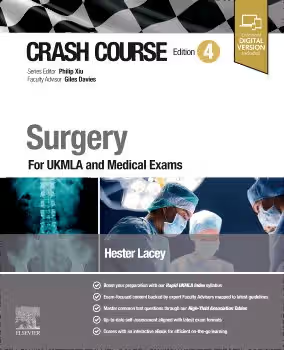
The fourth edition, subtitled "For UKMLA and Medical Exams", is written by Hester Lacey, a foundation doctor, with Giles Davies as editor, and follows the Crash Course model of books written by recent graduates and quality-assured by faculty advisers. The publisher describes it as a high-yield overview of the core surgical topics for medical examinations, with an emphasis on system-focused history taking and examination guides, figures, imaging and guides to the initial management of disease, so that students can apply what they have learned to exam questions and OSCE stations. Features named by the publisher include checklists of the UK Medical Licensing Assessment (UKMLA) "conditions" and "presentations", "Hints and Tips" boxes and other aide-mémoires. Eleven chapters, ten organized by surgical specialty or region and one on perioperative management, are followed by an assessment section.
Chapters 1–3: The upper gastrointestinal tract; The lower gastrointestinal tract; The anterior abdominal wall
General surgery of the abdomen, divided into the upper and lower gastrointestinal tract and the anterior abdominal wall.
Chapters 4–5: Endocrine surgery; Breast surgery
The surgical management of endocrine and breast disease.
Chapter 6: Vascular surgery
Disease of the blood vessels treated surgically.
Chapter 7: Urology
Surgery of the urinary tract.
Chapter 8: Ear, nose and throat
The surgical specialty of the ear, nose and throat.
Chapter 9: Plastics and skin surgery
Plastic surgery and the surgical treatment of skin conditions.
Chapter 10: Cardiothoracic surgery
Surgery of the heart and chest.
Chapter 11: Perioperative management
The care of the surgical patient around the time of an operation, the one chapter that cuts across all specialties.
Assessment section
The book ends with a UKMLA High Yield Association Table, a set of UKMLA single best answer (SBA) questions with answers, and a section of OSCEs and short clinical cases.
Key Concepts
Chapters 1–10: Surgical Specialties
- System-focused history and examination: the approach to assessing a surgical patient that the publisher highlights across the specialty chapters.
- Initial management: the first steps in managing a surgical condition, presented as guides in this edition.
- Imaging: the use of radiological investigation in surgical diagnosis, which the publisher names as a focus of the book.
Chapter 11 and the Assessment Section
- Perioperative management: preparation for, and care during and after, surgery.
- UKMLA conditions and presentations: the syllabus items checklisted in the book.
- Single best answer questions and OSCEs: the written and practical examination formats the book prepares for.
Critical Analysis
Strengths
- Organized the way surgical rotations are. Ten of the eleven chapters correspond to a specialty or region (upper and lower gastrointestinal, abdominal wall, endocrine, breast, vascular, urology, ENT, plastics and skin, cardiothoracic), so a student can read the chapter that matches each attachment.
- Examination preparation built in. The closing section combines a high-yield association table, SBA questions with answers, and OSCE stations and short clinical cases, matched by the publisher to current examination formats.
- Clinically practical emphasis. The publisher stresses figures, imaging and initial management guides, and presents the book as useful for the transition to clinical practice as well as for examinations.
- Written close to the reader. The author is a recently qualified doctor, in line with the series' approach of writing by those nearest to the examinations, with accuracy checked by faculty advisers.
Limitations
- Specialty coverage is selective. The contents contain no chapters on trauma, orthopaedics, neurosurgery or paediatric surgery, and principles of surgical care are concentrated in the single perioperative chapter. Students should check their own curriculum for these areas.
- Revision depth. As a high-yield overview it summarizes rather than explains in depth; detailed pathophysiology and operative management belong to a full surgical textbook.
- UK orientation. The book is aligned to the UKMLA, and its question formats reflect UK examinations.
Where It Fits in the Course
This is the revision-oriented introduction to surgery in the course. Browse's Introduction to the Symptoms & Signs of Surgical Disease teaches surgical history taking and examination region by region, with many clinical photographs and line diagrams, and is the natural companion for learning to elicit and interpret signs at the bedside. Principles and Practice of Surgery by Garden, Parks and Wigmore is the full undergraduate textbook, covering perioperative care, gastrointestinal surgery and the surgical specialties in the depth that a Crash Course omits; read the matching chapter there when a topic needs more than a summary.
The two remaining books in the course are specialist: Quick Hits in Obstetric Anesthesia is a graduate-level clinical guide, and Surgical and Perioperative Management of Patients with Anatomic Anomalies deals with adapting surgery and anaesthesia to unusual anatomy. Both build on the perioperative principles that Chapter 11 introduces but are intended for later training.
How to Use This Book
The publisher addresses the series to medical students and to other health students who need the essentials quickly; basic anatomy, physiology and pathology from the early years of a medical course are the expected background.
A practical plan:
- On each surgical attachment: read the chapter for that specialty at the start, then use its history and examination guide on the ward and its imaging and initial management content when patients are admitted.
- Read Chapter 11 early, whatever the first attachment, since perioperative care applies to every surgical patient.
- Build depth elsewhere: for any condition you meet, follow the Crash Course summary with the corresponding section of a full textbook or of Browse's for the clinical signs.
- Revision: use the UKMLA checklists to confirm coverage, then work the SBA questions under timed conditions and practise the OSCE stations aloud with a partner.
Keep notes of the "Hints and Tips" boxes that match your own errors in practice questions; they are designed as quick reminders and work best when reviewed often in the weeks before an examination.