01 / Reading Guide
Reading Guide
Citation
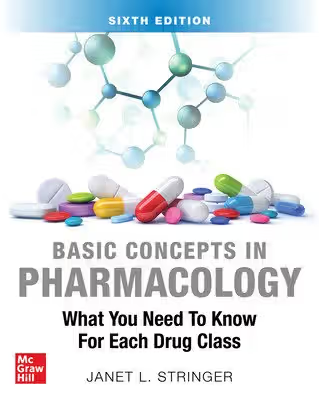
Stringer, J. L. (2022). Basic Concepts in Pharmacology: What You Need to Know for Each Drug Class (6th ed.). McGraw Hill.
Chapter Summary
The sixth edition is a paperback of roughly 280–320 pages (listings differ) with 48 short chapters: an opening chapter, then seven parts from general principles to a miscellaneous group. Almost every drug chapter opens with a section headed "Organization of Class", which signals the book's method: learn how a class is structured before learning its members. The publisher describes a "Trivia Sorter" that runs through the book, a device for sorting what must be known about each class: its mechanism and side effects, whether it treats a disorder or a symptom, what is unique about individual drugs, and its interactions.
Chapter 1: Where to Start
A single introductory chapter, with no subheadings listed in the contents, precedes Part I. The publisher stresses that the book teaches students to organise and condense the drug information they must remember, and this opening chapter is the natural place to read before the drug chapters.
Part I: General Principles (Chapters 2–5)
Chapter 2, Receptor Theory, covers agonists, efficacy and potency, the therapeutic index, antagonists and inverse agonists. Chapter 3, Absorption, Distribution, and Clearance, treats the first-pass effect, how drugs cross membranes, bioavailability and total body clearance. Chapter 4, Pharmacokinetics, works through volume of distribution, first-order and zero-order kinetics, steady-state concentration, the time needed to reach steady state and the loading dose. Chapter 5, Drug Metabolism and Renal Elimination, covers liver metabolism and renal excretion.
Part II: Drugs That Affect the Autonomic Nervous System (Chapters 6–10)
Chapter 6, Review of the Autonomic Nervous System, reviews anatomy, transmitters, receptors, general rules of innervation and presynaptic receptors. Chapters 7–10 cover Cholinergic Agonists (including cholinesterase inhibitors), Cholinergic Antagonists (muscarinic antagonists, ganglionic blockers and neuromuscular blockers), Adrenergic Agonists (direct- and indirect-acting agents, dopamine, and the cardiovascular effects of norepinephrine and epinephrine) and Adrenergic Antagonists (central blockers, α-blockers, β-blockers and mixed blockers).
Part III: Drugs That Affect the Cardiovascular System (Chapters 11–17)
Chapter 11, Diuretics, sorts the diuretics by the renal transporter or channel they inhibit. Chapter 12, RAS (ACE Inhibitors and ARBs) and CCB (Calcium Channel Blockers), introduces groups that Chapter 13, Antihypertensive Drugs, then combines with diuretics, vasodilators and sympathetic depressants. Chapter 14, Drugs Used in Ischemic Heart Disease and Congestive Heart Failure, covers nitrates and the approaches to heart failure, from neurohumoral modulation and preload and afterload reduction to SGLT2 inhibition. Chapters 15–17 cover Antiarrhythmic Drugs (by Classes I–IV, plus drugs that increase heart rate), Drugs That Affect Blood (antiplatelet agents, anticoagulants, thrombolytics, and drugs for anaemia and sickle cell disease) and Lipid-Lowering Drugs.
Part IV: Drugs That Act on the Central Nervous System (Chapters 18–26)
The CNS part runs through Drugs Used in Dementia; Anxiolytic and Hypnotic Drugs (from barbiturates and benzodiazepines to Z compounds and orexin receptor antagonists); Drugs Used in Mood Disorders; Drugs Used in Thought Disorders (first- and second-generation antipsychotics); Drugs for Movement Disorders (Parkinson disease, plus ALS, MS, Duchenne muscular dystrophy and spinal muscular atrophy); Drugs for Seizure Disorders; Narcotics (Opiates); General Anesthetics, including the uptake and elimination of inhaled agents; and Local Anesthetics.
Part V: Chemotherapeutic Agents (Chapters 27–37)
Chapter 27, Introduction to Chemotherapy, sets out the approach to antimicrobials, general principles of therapy, definitions and classification. Chapters 28–36 then take the antimicrobial classes in turn: Inhibitors of Cell Wall Synthesis, Protein Synthesis Inhibitors, Folate Antagonists, Quinolones and Urinary Tract Antiseptics, Drugs Used in Tuberculosis and Leprosy, Antifungal Drugs, Anthelmintic Drugs, Antiviral Drugs (HIV, influenza, hepatitis B and C) and Antiprotozoal Drugs (including antimalarials). Chapter 37, Anticancer Drugs, covers terminology and principles of therapy, adverse effects, the classes of cytotoxic drugs, hormonal agents and pathway-targeted therapies (growth factors and receptors, intracellular kinases, angiogenesis).
Part VI: Drugs That Affect the Endocrine System (Chapters 38–41)
Adrenocortical Hormones; Sex Steroids (including oral contraceptives, androgens, GnRH agonists and antagonists, and PDE5 inhibitors); Thyroid and Parathyroid Drugs; and Insulin, Glucagon, and Oral Hypoglycemic Drugs, where the oral agents are grouped by what they do: stimulate insulin release, decrease glucose production, increase sensitivity, reduce absorption or increase elimination of glucose.
Part VII: Miscellaneous Drugs (Chapters 42–48)
The final part collects Histamine and Antihistamines, Respiratory Drugs (bronchodilators, inhaled corticosteroids and other anti-inflammatory approaches, biologics, pulmonary hypertension and cystic fibrosis), Drugs That Affect the GI Tract, Nonnarcotic Analgesics and Anti-Inflammatory Drugs (NSAIDs, aspirin, acetaminophen, antigout agents and headache drugs), Immunosuppressives, Drugs Used in Osteoporosis, and Toxicology and Poisoning (principles, general treatment and specific antidotes).
Key Concepts
Part I: General Principles
- Efficacy versus potency: how large an effect a drug can produce, as distinct from how much drug is needed to produce it.
- Therapeutic index: the margin between effective and toxic doses.
- Bioavailability and first-pass effect: the fraction of a dose that reaches the circulation, reduced when the liver removes drug before it gets there.
- First-order versus zero-order kinetics: elimination proportional to concentration versus elimination at a fixed rate.
- Steady state and loading dose: the plateau reached with repeated dosing, and the larger initial dose used to reach it quickly.
Parts II–III: Autonomic and Cardiovascular Drugs
- Presynaptic receptors: receptors on nerve terminals that regulate transmitter release.
- Site-based classification of diuretics: grouping diuretics by the renal transporter or channel they inhibit.
- Antiarrhythmic classes: sodium channel blockers, β-blockers, potassium channel blockers and calcium channel blockers.
Parts IV–VII: CNS, Chemotherapy, Endocrine and Miscellaneous
- Tolerance and dependence: introduced with the anxiolytics and hypnotics.
- Antimicrobial classification by target: cell wall, protein synthesis, folate pathway and nucleic acid targets.
- Pathway-targeted cancer therapy: drugs aimed at growth factor receptors, kinases and angiogenesis, alongside cytotoxic agents.
- Specific antidotes: targeted treatments for particular poisonings, set against general principles of poisoning management.
Critical Analysis
Strengths
- A consistent method. The repeated "Organization of Class" sections and the Trivia Sorter give every chapter the same frame: what the class does, its side effects, what makes individual drugs distinctive, and its interactions. For a first course, where the problem is the number of drug names, this structure is the main reason to choose the book.
- Short chapters, complete coverage. Forty-eight chapters in around 300 pages handle each class briefly, yet span a full medical pharmacology course, from receptor theory to toxicology.
- Current drug groups. The sixth edition includes SGLT2 inhibition in heart failure, orexin receptor antagonists for insomnia, therapies for Duchenne muscular dystrophy and spinal muscular atrophy, sclerostin inhibition in osteoporosis and pathway-targeted cancer drugs.
- Pharmacokinetics treated as its own topic. Chapter 4's headings (volume of distribution, kinetic orders, steady state, loading dose) cover the quantitative ideas that students often find hardest, before any drug class is introduced.
Limitations
- Brevity by design. The book aims at what a student needs to know for each class, not at depth; detailed mechanisms, clinical trial evidence and prescribing guidance are outside its scope.
- A classification-led order. The book is organised by drug class rather than by disease, apart from the cardiovascular and CNS chapters that follow conditions. Students who need to know how to treat a given disease will find the material spread across several chapters.
- Uneven granularity. The chapters vary widely in structure: Lipid-Lowering Drugs and Folate Antagonists list only two headings each, while Anticancer Drugs and Respiratory Drugs list more than a dozen. Students should expect some classes to be handled in a few pages and should not assume equal depth for every topic.
- US framing. The publisher's description presents the book as preparation for one of the most difficult courses in medical school, and drug naming follows US usage (acetaminophen, epinephrine), which students elsewhere will need to translate.
Where It Fits in the Course
This is one of two short entry points to the pharmacology course. Neal's Medical Pharmacology at a Glance is the other: 47 two-page chapters, each built around a summary figure and grouped largely by disease and organ system. The two complement each other: Stringer explains how to organise a drug class in prose, Neal shows where drugs act in a diagram and links them to conditions such as asthma, angina or Parkinson's disease. Reading the Stringer chapter on a class first and then the matching Neal spread is an efficient combination.
Brenner and Stevens' Pharmacology is a mid-length textbook that presents each class through mechanism, pharmacokinetics, clinical uses, adverse effects and interactions, with clinical boxes; it is the natural step up once a class has been mapped in Stringer. Katzung's Basic & Clinical Pharmacology and Rang and Dale's Pharmacology are comprehensive references: Katzung connects prototype drugs to clinical use with case studies and questions, and Rang and Dale explains drug action from biological targets upward.
How to Use This Book
The book is aimed at students taking pharmacology for the first time, especially medical students, and at anyone who needs an organised way to hold a large number of drugs in memory. Basic physiology (autonomic nervous system, cardiovascular and renal function) helps; Chapter 6 reviews the autonomic material itself.
A practical plan:
- Start with Chapter 1 and Part I. Read Where to Start, then Chapters 2–5 slowly. The pharmacokinetic concepts in Chapter 4 recur throughout, so work through them until steady state and loading dose make sense.
- Then follow the course's order. Read each part when the corresponding system is taught. Within a chapter, read the Organization of Class section first and reproduce it from memory before moving on to individual drugs.
- Use the Trivia Sorter actively. For each class, write down mechanism, side effects, disorder or symptom, unique features of individual drugs and interactions. These notes become the core of exam revision.
- Treat Part VII and Chapter 48 as part of the course. Antihistamines, NSAIDs, respiratory and GI drugs, immunosuppressives and toxicology are drugs in everyday clinical use; the "miscellaneous" label is not a reason to skip them.
- Go deeper elsewhere. For clinical detail (dosing, guidelines, trial evidence), move to a longer textbook; Stringer is the framework, not the reference.