01 / Reading Guide
Reading Guide
Citation
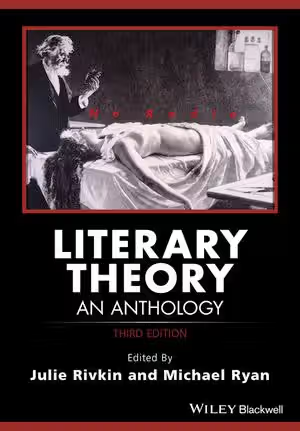
Rivkin, J., & Ryan, M. (Eds.). (2017). Literary Theory: An Anthology (3rd ed.). Wiley-Blackwell.
Chapter Summary
The anthology runs to about 1,650 pages and is organised in ten parts, each opening with an editorial introduction by Julie Rivkin and Michael Ryan. A preface and "A Short History of Theory" come before Part One, and a glossary of terms closes the book. The parts hold about a hundred selections in all, and every part ends with "Theory in Practice" essays that apply the school in question to the same shared texts: King Lear appears in every part, with poems by Elizabeth Bishop and stories by Alice Munro in several.
Part One: Russian Formalism, New Criticism, Poetics
The editors' introduction, "Formalisms", explains how the early twentieth-century formalist movements shifted attention from a work's biography and context to its language, through ideas such as defamiliarization and the distinction between plot and story. The selections include Viktor Shklovsky's "Art as Technique", Cleanth Brooks on the formalist critics and on Keats, and Monroe Beardsley and W. K. Wimsatt's "The Intentional Fallacy", together with newer pieces on poetry and serial television.
Part Two: Structuralism, Linguistics, Narratology
Introduced as "The Implied Order: Structuralism", this part moves from Jonathan Culler on the linguistic foundation to Saussure's Course in General Linguistics, Lévi-Strauss on myth, Barthes's Mythologies, Bakhtin on discourse in the novel and Foucault's "What Is an Author?". It ends with David Herman on narratology and Michael Newman on the poetics of television narrative.
Part Three: Phenomenology, Reception, Ethics
The part introduces "Situations of Knowledge/Relations with Others" and includes Kant's transcendental aesthetic, Georges Poulet on reading, Kathleen McCormick on production and reception, Pierre Bourdieu's Distinction, Emmanuel Levinas on ethics and the face, and Martha Nussbaum on the narrative imagination.
Part Four: Post-Structuralism
Under "The Class of 1968", the part collects Nietzsche, Deleuze, two essays by Derrida ("Différance" and "That Dangerous Supplement"), Barthes's "The Death of the Author" and "From Work to Text", and Barbara Johnson.
Part Five: Psychoanalysis and Psychology
The introduction is "Strangers to Ourselves". Selections are by Freud (on dreams, the uncanny and group psychology), Lacan on the mirror stage and Winnicott on transitional objects, with a trauma-studies essay on the literature of the US South.
Part Six: Marxism, Critical Theory, History
Starting with Marx's 1844 manuscripts and The German Ideology, the part continues through Walter Benjamin, Bourdieu, Althusser, Foucault, Giorgio Agamben and Louis Montrose on new historicisms.
Part Seven: Gender Studies and Queer Theory
The largest part runs from Gayle Rubin, Adrienne Rich and Hélène Cixous through Judith Butler, transnational feminist work by Grewal, Kaplan and Mohanty, Jasbir Puar, Eve Kosofsky Sedgwick, Lauren Berlant and Michael Warner, to José Esteban Muñoz.
Part Eight: Ethnic, Indigenous, Post-Colonial, and Transnational Studies
Introduced as "English Without Shadows: Literature on a World Scale", this part includes Edward Said's Orientalism, Chinua Achebe on Conrad, Spivak, Toni Morrison, Jamaica Kincaid, Arjun Appadurai, Stuart Hall and Lawrence Venuti.
Part Nine: Cognition, Emotion, Evolution, Science
The selections range across cognitive approaches to genre, Suzanne Keen on narrative empathy, Sara Ahmed on affect, evolutionary and neuroscientific criticism, digital humanities (Ted Underwood) and Franco Moretti.
Part Ten: Animals, Humans, Places, Things
The final part presents Nigel Thrift, John Urry and Bruno Latour on non-representational theory, complexity and actor-network theory, followed by work on the animal turn, disability, ecocriticism and food and other life forms in Lewis Carroll's Alice books.
Key Concepts
Parts One to Three
- Defamiliarization: formalist term for literary language that disturbs habitual perception.
- Plot and story: the formalist distinction between events as narrated and events as they ostensibly occurred.
- Structuralism: the view, introduced in Part Two, that culture is constituted by the same kind of rules that govern language.
- Reception and ethics: Part Three pairs studies of reading and reception (Poulet, McCormick) with ethical philosophy (Levinas, Nussbaum).
Parts Four to Six
- Différance and the supplement: Derrida's essays anchor Part Four.
- The author's death, work and text: Barthes's two essays in Part Four.
- The uncanny, the mirror stage, transitional objects: psychoanalytic terms given by Freud, Lacan and Winnicott in Part Five.
- Ideology and ideological state apparatuses: Althusser's essay in Part Six.
Parts Seven to Ten
- Gender and queer theory: Rubin through Muñoz in Part Seven.
- Orientalism and diaspora: Said and Hall in Part Eight.
- Affect, narrative empathy and digital humanities: topics of Part Nine.
- Actor-network theory and the animal turn: topics of Part Ten.
Critical Analysis
Strengths
- Range across schools. Wiley describes the book as covering the major schools and methods of literary theory from Formalism to Postcolonialism. The third edition adds disability studies, ecocriticism and ethics, and work by Stuart Hall, Sara Ahmed and Lauren Berlant.
- Shared test texts. Every part ends with essays applying its approach to the same few texts, so a reader can see one play and a few poems and stories read through ten different frameworks.
- Editorial scaffolding. Each part opens with an introduction by Rivkin and Ryan; the one on formalisms, for example, sets out the school's origins, main claims and key terms in a few pages. A glossary of terms closes the book.
- Primary texts, not summaries. Readers meet Saussure, Barthes, Derrida and Said in their own words.
Limitations
- Length and selection. At about 1,650 pages the book is heavy to carry and to read, and the selections are excerpts, as the page ranges show (for example, Saussure's Course in General Linguistics runs about forty pages).
- Modern focus. The selections begin with Kant, followed by Nietzsche, Marx and Freud, so the contents include no classical poetics and no Romantic or Victorian criticism. Readers seeking those must use another volume.
- Uneven level. Primary essays by Kant, Derrida or Lacan sit alongside shorter recent pieces, such as readings of serial television and food, so difficulty varies sharply from essay to essay.
- Not an introduction. The anthology gives theorists' own arguments with editorial introductions rather than a step-by-step explanation of the field. The editors' own Literary Theory: A Practical Introduction (Wiley-Blackwell, 3rd ed., 2016) is the companion guide for beginners.
Where It Fits in the Course
Within the introduction to literary studies, this anthology is the primary-source volume for theory, the one to turn to after a first overview. An Introduction to Literature, Criticism and Theory (Bennett and Royle) is organised around short thematic chapters, each starting from a question about reading such as character, narrative or the uncanny, and works well beforehand. Critical Terms for Literary Study collects essays that trace the history of one key term each and show it at work in a reading.
The Bedford, Norton and Portable anthologies are organised around poetry, fiction and drama rather than theory; they supply the literary texts, and the basics of reading and writing about them, that theory is later applied to. A sensible sequence is a literature anthology and one of the introductory guides first, this anthology second.
How to Use This Book
The anthology suits advanced undergraduates and graduate students in literary studies. Prior experience of close reading is assumed, and knowing some Freud, Marx or Saussure helps but is not required, because the editorial introductions supply context.
Read Rivkin and Ryan's introduction to each part before the essays, then choose a small number of core selections: for example, Shklovsky and Wimsatt and Beardsley in Part One, Saussure in Part Two, Barthes's "The Death of the Author" read with Foucault's "What Is an Author?", Derrida's "Différance", Freud on the uncanny, Said's Orientalism and Butler. Read the "Theory in Practice" essays on King Lear in order across parts to compare methods. Use the glossary for terms, and treat Parts Nine and Ten as optional, newer additions.