01 / Reading Guide
Reading Guide
Citation
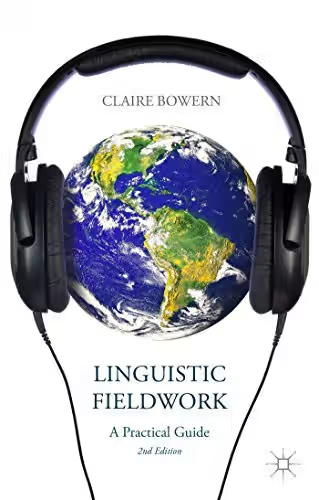
Bowern, C. (2015). Linguistic Fieldwork: A Practical Guide (2nd ed.). Palgrave Macmillan.
Chapter Summary
The second edition is a compact handbook of about 230 pages of text in fourteen chapters, keeping the structure of the first edition (2008). It covers everything that fieldwork on a language involves, not only elicitation: equipment, data management, the linguistic subfields, choosing consultants and field sites, ethics, funding, older sources, and giving results back to communities. The publisher describes the second edition as expanded, with new material on research results, prosody elicitation, field experiment design and complex syntax. Lameen Souag's review of the first edition in Language Documentation & Conservation (2011) is the main published description of the chapters, and is drawn on below; its account fits the second edition's unchanged chapter titles.
Chapter 1: Introduction
The opening chapter discusses what fieldwork is, dispels romantic stereotypes of the lone adventurer, and presents fieldwork as a two-way relationship with a community. It argues that fieldwork and theory are complementary, and stresses the value of learning the language being studied.
Chapter 2: Technology in the Field
How to choose audio and video recorders, microphones and related equipment, and how to use them well, balancing recording quality against keeping speakers at ease. Good recordings make results checkable by others.
Chapter 3: Starting to Work on a Language
A short chapter on the first sessions: elicit word lists and simple sentences, learn them, get a grip on the sound system, test emerging analyses, and work with more than one speaker early to separate variation from individual habits.
Chapter 4: Data Organisation and Archiving
Note-taking, file management, backup and metadata, and preparing materials for archiving. Software specifics were left to the book's companion website in the first edition.
Chapter 5: Fieldwork on Phonetics and Phonology
A relatively short chapter on collecting and analysing sound data; the second edition adds material on eliciting prosody.
Chapters 6–7: Eliciting: Basic Morphology and Syntax; Further Morphology and Syntax
The two longest linguistic chapters. Chapter 6 treats elicitation methods: translation, grammaticality judgements, questionnaires, manipulating data, controlled tasks and stimuli such as video clips, and their pitfalls. Chapter 7 surveys grammatical topics worth investigating, and is the most likely home for the second edition's new material on complex syntax.
Chapters 8–9: Lexical and Semantic Data; Discourse, Pragmatics and Narrative Data
A brief chapter on building a lexicon, with references for anyone compiling a full dictionary, and a chapter on eliciting narratives while also recording non-narrative genres of speech.
Chapters 10–12: Consultants and Field Locations; Ethical Field Research; Grant Application Writing
The practical prerequisites: where and when to go, how to prepare, finding consultants, working within an unfamiliar culture and coping with culture shock (Chapter 10); consent, community control of knowledge and other ethical issues, including the observation that written consent forms can be culturally inappropriate (Chapter 11); and general grant-writing and administration rather than the rules of particular funders (Chapter 12).
Chapter 13: Working with Existing Materials
How to use earlier records of a language, often made by people without linguistic training, which can yield historical data or forms no longer in use.
Chapter 14: Fieldwork Results
Making research useful to the community: orthographies, learners' guides, sketch grammars, websites, dictionaries and revitalization, with a frank account of difficulties. The second edition expands this material on research results. Appendices include sample metadata and consent forms, a Swadesh list and elicitation checklists.
Key Concepts
Chapters 1–4: Foundations
- Fieldwork as relationship: the linguist's role and obligations within the speech community.
- Recording technology: equipment choice and technique as the basis for reproducible data.
- Metadata and archiving: documenting and preserving recordings and notes so they remain usable.
Chapters 5–9: Collecting linguistic data
- Elicitation methods: translation, judgements, questionnaires, controlled tasks and stimuli, each with known biases.
- Prosody and phonology in the field: collecting sound-system data, including intonation.
- Lexicon and discourse: building a word list toward a dictionary, and recording narratives and other genres.
Chapters 10–14: The fieldwork context
- Consultants and field sites: choosing and working with speakers in their own setting.
- Research ethics: consent, community control of restricted knowledge, and reciprocity.
- Grant writing: funding fieldwork through proposals.
- Returning results: orthographies, learner materials, dictionaries and support for revitalization.
Critical Analysis
Strengths
- Covers the whole of fieldwork. Souag identifies this as the book's great strength: technology, culture, ethics and funding are discussed in detail, though they are usually passed on only by word of mouth.
- Readable and compact. Souag found it written in a non-technical, easy-to-follow style and an excellent starting point for beginners, with tips useful even to experienced fieldworkers.
- Practical appendices. Sample forms, a Swadesh list and checklists can be used directly in planning a project.
- Updated second edition. New material on prosody, field experiments, complex syntax and research outcomes addresses areas of fieldwork practice that developed after the first edition.
Limitations
- Not a questionnaire or grammar guide. By the same reasoning, Souag notes that anyone seeking questionnaires or detailed guidance on what grammatical data to collect will have to look elsewhere.
- Uneven depth across subfields. Phonetics and phonology and the lexicon receive short chapters; someone compiling a dictionary will need the suggested further reading.
- Technology dates quickly. Equipment advice ages fast, which is why the author keeps specifics on a website; readers should check current recommendations.
- The community outcomes chapter may overstate the linguist's role. Souag suggests that for many communities the main value of the linguist's work is the sustained interest it shows in the language, rather than the products themselves.
Where It Fits in the Course
In a course combining typology and fieldwork, this is the practical guide to planning and carrying out fieldwork. Meakins, Green and Turpin's Understanding Linguistic Fieldwork is a shorter, gentler introduction to the same activity and suits students before their first field methods class; Bowern then gives the fuller, step-by-step treatment.
For the analysis of the data collected, Paul Kroeger's Analyzing Grammar teaches morphosyntactic analysis from data, and Thomas Payne's Describing Morphosyntax is the detailed guide to what to describe in a grammar, exactly the questionnaire-style guidance that Bowern leaves to others; it pairs naturally with Chapters 6–7. Viveka Velupillai's An Introduction to Linguistic Typology and William Croft's Typology and Universals supply the cross-linguistic background that tells a fieldworker which structures are common or unusual.
How to Use This Book
The book suits advanced undergraduates and graduate students in linguistics taking a field methods course or preparing their first field trip. It is most useful after introductory courses in phonetics, phonology, morphology and syntax, since the linguistic chapters concentrate on how to collect data rather than on the analysis itself.
- For a field methods class: Chapters 1, 3, 4 and 6–9 first, alongside weekly sessions with a speaker; Chapter 5 with the phonetics work.
- Before a field trip: Chapters 2, 10, 11 and 12 well in advance, since equipment, ethics approval and funding take time; Chapter 13 when searching for earlier sources.
- During and after: Chapter 14 and the appendices when planning outputs for the community.
- Alongside it: use Payne's Describing Morphosyntax as the grammatical checklist, check the author's companion website for current software and equipment advice, and draft a metadata and backup plan before the first recording.