01 / Reading Guide
Reading Guide
Citation
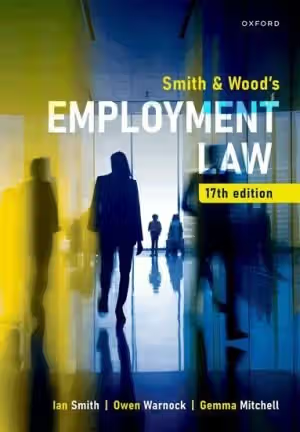
Smith, I., Warnock, O., & Mitchell, G. (2026). Smith & Wood's Employment Law (17th ed.). Oxford University Press.
Chapter Summary
The seventeenth edition is a single-volume account of UK employment law in ten chapters, running to roughly 840 pages. The publisher describes it as a detailed but accessible guide in which case law and legislation are accompanied by commentary and critique, with topics explained in their social and historical context and a view of where the law is heading. The chapters follow the life of an employment relationship, from who counts as an employee through pay, discrimination, dismissal and redundancy, and then turn to the collective side of the subject.
Chapter 1: Introduction
The opening chapter introduces the subject and the framework within which the later chapters work.
Chapter 2: Contracts of employment (1): status, formation, continuity, and change
The first of two chapters on the contract of employment deals with who is covered by employment protection (status), how the contract is formed, and its continuity and change over time. Status and formation underpin almost everything later in the book, because most statutory rights depend on the claimant being an employee.
Chapter 3: Contracts of employment (2): content and wages
The second contract chapter turns to what the contract contains and to wages, completing the account of the individual employment relationship while it is running.
Chapter 4: Discrimination in employment
Discrimination in employment is given a chapter of its own, so it can be read as a self-contained unit.
Chapter 5: The work-life balance legislation
This chapter covers the legislation on work-life balance, the statutory rights that sit alongside the contract and the equality rules.
Chapter 6: Termination of the employment contract at common law
Ending the contract is treated in two stages. This chapter sets out the common law of termination, which is the background against which the statutory regime of the next chapter operates.
Chapter 7: Unfair dismissal
The statutory right not to be unfairly dismissed has a chapter of its own, placed directly after the common law chapter so that the two systems can be compared.
Chapter 8: Redundancy, reorganization, and transfers of undertakings
The chapter brings together redundancy, reorganization and transfers of undertakings, the situations in which jobs end or change hands because of the employer's business decisions rather than the individual's conduct.
Chapters 9–10: Collective labour law; Industrial action
The last two chapters move from the individual to the collective: collective labour law, and then industrial action. Together they close the book with the law governing trade unions, collective relations and strikes.
Key Concepts
Chapters 1–3
- Employment status: whether a worker is an employee, which decides access to most employment protection.
- Formation, continuity and change of the contract: how an employment contract comes into being and how it develops.
- Content and wages: the terms of the contract, including pay.
Chapters 4–5
- Discrimination in employment: the statutory protection against discrimination at work.
- Work-life balance legislation: statutory rights that help workers combine employment with other parts of life.
Chapters 6–8
- Termination at common law: ending the contract under contract principles.
- Unfair dismissal: the statutory remedy for dismissal without good reason or fair procedure.
- Redundancy, reorganization and transfers of undertakings: the rules for job loss and business change.
Chapters 9–10
- Collective labour law: the law of trade unions and collective relations.
- Industrial action: the legal framework for strikes and other action.
Critical Analysis
Strengths
- Doctrine and commentary together. The publisher highlights clear accounts of essential cases and legislation combined with commentary and critique, which suits both exam preparation and essay work.
- Complete coverage in a fixed order. Ten chapters take the reader from status and the contract, through discrimination and dismissal, to collective law. Each stage of the employment relationship has a chapter, so the book can be used as a full course text.
- Context for the rules. The authors explain topics in their social and historical context, so the reader sees why a rule exists and how it has changed.
- Support materials. The seventeenth edition has an e-book and online resources with self-test questions and feedback for each chapter, further reading lists and useful websites.
- A recently revised edition. The book is revised repeatedly, and the seventeenth edition appeared in July 2026 with a new author team of Ian Smith, Owen Warnock and Gemma Mitchell, which matters in a subject where legislation changes quickly.
Limitations
- Scale. At about 840 pages the book is a reference work as much as a course text, and individual chapters such as discrimination and unfair dismissal are substantial.
- Doctrinal focus. The list of chapters shows a doctrinal approach organised around statutes and cases. Readers who want a theory-led or comparative treatment of labour law will need another book.
- Fast-moving subject. The publisher's description stresses the fast-paced development of employment legislation, so the book should be read with a current statute and case update for any assessed work.
Where It Fits in the Course
This is the fullest textbook in the labour-law list. Taylor and Emir's Employment Law: An Introduction is an accessible introduction that links the rules to workplace practice, and is the gentler first read. The Cambridge Labour Law by Hugh Collins and others, the Hart Labour Law by Simon Deakin and others, and Anne Davies's Perspectives on Labour Law are labour-law textbooks that cover sources, the contract, termination and collective rights, with a critical and contextual treatment. Smith and Wood supplies detailed statutory and case-law coverage of the same ground. Freedland and Kountouris's The Legal Construction of Personal Work Relations is a research monograph on employment status and the contract, and is best read after a course text such as this one.
How to Use This Book
The book suits second- and third-year law students taking an employment law course, and also postgraduates and practitioners who want a detailed reference. A grounding in contract law is the most useful preparation.
A practical reading plan:
- Core for most courses: Chapters 2 and 3 (the contract), Chapter 7 (unfair dismissal) and Chapter 4 (discrimination), in that order, then Chapters 6 and 8 for the other ways employment ends.
- For collective labour law modules: Chapters 9 and 10 together.
- Introductory reading: Chapter 1 first, as the introduction to the subject.
- Alongside: use the online self-test questions after each chapter, read the key cases and statutory provisions cited, and check recent case law and legislation before relying on any rule in coursework.