01 / Reading Guide
Reading Guide
Citation
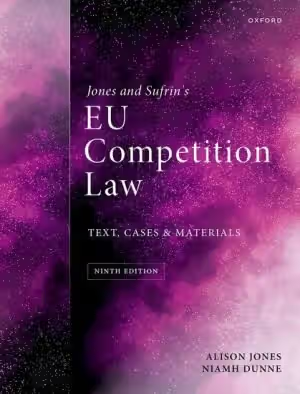
Jones, A., & Dunne, N. (2026). Jones & Sufrin's EU Competition Law: Text, Cases, and Materials (9th ed.). Oxford University Press.
Chapter Summary
The ninth edition has seventeen chapters. The publisher describes the book as a complete guide to EU competition law in one volume: in-depth commentary from the authors, supplemented by selected extracts from key cases and statutory materials. The chapters fall into four clusters: foundations, the two main prohibitions, particular types of agreement and conduct, and enforcement and wider context.
Chapters 1–2: Introduction to Competition Law; Competition Law and Institutions of the European Union
The opening chapters set out what competition law is for and where EU competition law sits within the institutions of the Union. They are the place to find the framework in which every later chapter operates.
Chapter 3: Market Power, Market Definition, Barriers to Entry
A chapter on three linked notions from the chapter title: market power, market definition and barriers to entry. It comes before the two prohibitions in the order of the book.
Chapters 4–5: Article 101 TFEU: The Elements; Article 101 TFEU: Substantive Appraisal
The first prohibition is covered in two steps. Chapter 4 takes the elements of Article 101, and Chapter 5 turns to its substantive appraisal.
Chapters 6–7: Article 102: Introduction and Dominant Position; Article 102 TFEU: Conduct which can be Abusive
The second prohibition follows the same pattern: the concept of a dominant position first, then the kinds of conduct that can amount to abuse.
Chapter 8: Competition and the State
A chapter on the relationship between competition rules and the state.
Chapters 9–12: Horizontal agreements: Cartels and Collusion; Horizontal Cooperation Agreements; Vertical Agreements; Licensing Agreements and other Agreements Involving Intellectual Property Rights
Four applied chapters take the Article 101 framework to categories of agreement: cartels and collusion between competitors, cooperation agreements between competitors, agreements between firms at different levels of a supply chain, and licensing and other agreements involving intellectual property rights.
Chapters 13–14: Public Enforcement of Article 101 and Article 102 by the Commission and National Competition Authorities; Private Enforcement of Articles 101 and 102
Enforcement is divided into public enforcement, by the Commission and national competition authorities, and private enforcement of the same two articles.
Chapter 15: Mergers
A separate chapter on merger control.
Chapter 16: EU Competition Law and Policy in the Digital Economy
A chapter devoted to competition law and policy in the digital economy.
Chapter 17: International Aspects
The closing chapter deals with the international aspects of EU competition law.
Key Concepts
Foundations (Chapters 1–3)
- Market definition: named in the title of Chapter 3.
- Market power and barriers to entry: also named in the title of Chapter 3, ahead of the chapters on Articles 101 and 102.
The prohibitions (Chapters 4–8)
- Article 101 TFEU: the prohibition on anticompetitive agreements, treated through its elements and its substantive appraisal.
- Article 102 TFEU: the prohibition on abuse of a dominant position, treated through dominance and then abusive conduct.
- Competition and the State: the relationship between competition rules and the state, the subject of Chapter 8.
Applications and enforcement (Chapters 9–17)
- Cartels, horizontal cooperation and vertical agreements: the main categories of agreement considered under Article 101.
- Public and private enforcement: enforcement by authorities and by private parties.
- Merger control, the digital economy and international aspects: the subjects of the last three chapters.
Critical Analysis
Strengths
- Commentary and primary materials in one volume. The publisher stresses the combination of expert commentary with selected extracts from key cases and statutory materials. A reader can follow the argument and then go to the source.
- Critical engagement. The publisher says the book offers critical insights into developments in the field and addresses ongoing policy debates and disputed legal questions, which suits students who must argue a position.
- Attention to the literature. The publisher highlights thorough footnoting and referencing as a way to navigate the available literature, which helps with dissertations and specialised study.
- A clear division of the subject. The seventeen chapters separate the two prohibitions, the categories of agreement, the two modes of enforcement, mergers, the digital economy and international aspects, so a reader can use the book topic by topic.
- Current coverage. The publisher states that the ninth edition is updated with the most recent regulations and guidance, EU court case law and Commission decisional practice, and the table of contents includes a chapter on the digital economy.
Limitations
- A large, specialised book. The subject is treated in great detail, which suits a dedicated competition law course but is more than a survey course needs.
- EU law only. The title and chapters are about EU competition law. Readers who need the competition law of the United Kingdom or the United States will need other sources.
- Not a first introduction. The publisher addresses scholars engaged in specialised study, undergraduate and postgraduate students and legal professionals; a reader meeting EU law for the first time will want a general EU law text alongside.
Where It Fits in the Course
In this competition and regulation list, the book is the specialised text for the EU side. Whish and Bailey's Competition Law is a comprehensive textbook covering both EU and UK competition law with economics where it helps, and it is the broader choice for a reader who also needs UK law; Jones and Dunne give more space to extracts from the sources and to critical debate on the EU rules. The Antitrust Enterprise is an introduction to United States antitrust law and offers a contrast with the US approach.
Understanding Regulation and The Oxford Handbook of Regulation concern regulation more broadly, including its theories and strategies; they provide the wider setting in which competition law is one instrument among others. Read those for context, and this book for doctrine.
How to Use This Book
The book suits students on advanced undergraduate or postgraduate competition law courses, researchers and practitioners. A previous course in EU law or competition law, plus some comfort with basic economic ideas such as markets and market power, makes the first chapters easier.
A practical plan:
- Core: Chapters 1–7, then Chapter 9 on cartels. These give the framework, the economic tools and the two prohibitions.
- Applications: Chapters 10–12 and 15, taken according to the course syllabus: horizontal cooperation, vertical and licensing agreements, and mergers.
- Enforcement: Chapters 13–14 once the substantive rules are clear.
- Selective: Chapter 8 (competition and the state), Chapter 16 (digital economy) and Chapter 17 (international aspects) for the topics on a particular course or dissertation.
Read the extracts of judgments and decisions alongside the commentary rather than skipping them, and use the footnotes to find the secondary literature for essays.